Sri Lanka: One Island Two Nations

Search This Blog

Thursday, 1 October 2020


Kingdom of Silence: 2 Years After Khashoggi Murder, New Film Explores Deadly U.S.-Saudi Alliance

Image Credit: Showtime


OCTOBER 01, 2020

Two years ago, in a story that shocked the world, Saudi journalist Jamal Khashoggi entered the Saudi Consulate in Istanbul for marriage documents and was never seen again. It was later revealed that Khashoggi — a Saudi insider turned critic and Washington Post columnist — was murdered and dismembered by a team of Saudi agents at the direct order of Crown Prince Mohammed bin Salman. We speak with a friend of Khashoggi and with the director of a new documentary, “Kingdom of Silence,” that tracks not only Khashoggi’s brutal murder and the rise of MBS, but also the decades-long alliance between the United States and Saudi Arabia. “What drew me into this story is Jamal was one of our own,” says director Rick Rowley. “When one of our colleagues is killed, it falls on all of us as journalists to try to do what we can to rescue their story from the forces that would impose silence on it.”

This is a rush transcript. Copy may not be in its final form.

AMY GOODMAN: This is Democracy Now! The Quarantine Report. I’m Amy Goodman, with Nermeen Shaikh.

Friday marks the two-year anniversary of the brutal assassination of the exiled Saudi journalist Jamal Khashoggi inside the Saudi Consulate in Istanbul, Turkey. In a story that shocked the world, Khashoggi entered the consulate October 2nd, 2018, for marriage documents, his fiancée waiting outside. He was never seen again. It was later revealed that Khashoggi, a Saudi insider turned critic and Washington Post columnist, was murdered and dismembered by a team of Saudi agents at the direct order of Crown Prince Mohammed bin Salman.

Two years later, the prince has not been held accountable, remains a close ally of the U.S. government. Last month, a Saudi court issued prison sentences of between seven and 20 years for the eight defendants in Khashoggi’s murder, but the trial and verdict did not address who ordered the killing. Agnès Callamard, the U.N. special rapporteur on extrajudicial executions, called it “a parody of justice.”

We turn now to a new Showtime documentary about the assassination. It tracks not only the brutal murder of Khashoggi and the rise of Crown Prince Mohammed bin Salman, but also the decades-long alliance between the U.S. and Saudi Arabia. It’s called the Kingdom of Silence. This is the film’s trailer.

MOHAMED SOLTAN: This man was a noble man, courageous man, very serious about the evolution that he was making.

MAGGIE MITCHELL SALEM: He was threatened and intimidated all the time.

UNIDENTIFIED: The Saudi monarchy operates like a mafia. And you don’t cross the godfather.

JOHN BRENNAN: There is no way that that horrific act was carried out without the blessing from the very top of the Saudi government. Just no way.

PRESIDENT DONALD TRUMP: We’ve become very good friends over a fairly short period of time.

BEN RHODES: Mohammed bin Salman was feted in Washington. Every aspect of American power rolled out the red carpet for this guy. Jamal Khashoggi was one of the only dissenting voices.

MOHAMED SOLTAN: To speak freely, he knew what the stakes were.

UNIDENTIFIED: Jamal was publishing articles that were critical of the Saudi regime.

MARWAN BISHARA: That could not be tolerated.

LAWRENCE WRIGHT: To what extent was the Saudi government entangled with al-Qaeda? Is there a person in the world that knows more than Jamal Khashoggi? He had made a huge sacrifice. His children are being held hostage.

MAGGIE MITCHELL SALEM: “You are in a war, and you can’t give up. You can’t disappear.” Those are the last words I said to him.

NAWAF OBAID: The moral of the story is that there is no moral. I mean, what is the morality of this?

AMY GOODMAN: That’s the trailer for Kingdom of Silence. The new documentary airs on Showtime tomorrow — that’s Friday — the two-year anniversary of the death of Jamal Khashoggi.

For more, we’re joined in New York by the film’s director, Rick Rowley, Oscar-nominated, Emmy-winning filmmaker and independent journalist with Midnight Productions. And in Austin, Texas, Lawrence Wright is with us, a Pulitzer Prize-winning author, screenwriter, playwright, staff writer for The New Yorker magazine, featured in the film. He’s also the executive producer, and friend of Jamal Khashoggi.

We welcome you both to Democracy Now! Rick Rowley, let’s begin with you. I remember the last time you were in studio, you were just starting this documentary. The significance of what happened on this week, two years ago, when The Washington Post correspondent walked into that Saudi Consulate in Istanbul? Talk about what you learned and what the world now knows happened next.

RICK ROWLEY: Thank you, Amy. It’s great to be back here.

I mean, I think really what drew me into this story is the fact that Jamal was one of our own. Jamal was a journalist who was murdered by the regime that he criticized. And, you know, when one of our colleagues is killed, it falls on all of us as journalists to try to do what we can to rescue their story from the forces that would impose silence on it.

So, you know, in a very short period of time, we learned a lot about the murder. I mean, we began this project kind of as a murder mystery, right? And so, we did the things that you do when you begin that sort of investigation. We met with multiple national intelligence agencies. We reviewed classified intel. We tracked down insiders who had never spoken before, and found new details about the killing.

But very quickly, it became clear that there were far more important and interesting questions here at stake, not just did the crown prince and the Saudi royal family order his execution — we know that he did. There’s a consensus among global intelligence agencies that that’s what happened, and there’s an overwhelming evidence, you know, everything from the planes that were used to the electronic communications to recorded — transcripts of recorded conversations inside the consulate, that make it clear that that’s what happened. So, not just did that happen, but why; not just how this gruesome killing was carried out — we know that now in granular detail — but who was this man, Jamal, who the kingdom would risk so much to silence.

And so, those deeper questions propelled us then on a much longer journey, that spans multiple continents and 20 months of production, to really find out that question. And Jamal’s life really turned into an epic story. I mean, he was — Jamal was more than just a journalistic witness. He was a participant in some of the events that — most important events of our time, events that continue to structure the way that we live the world today. And he played all these kind of amazing roles. And his story is kind of this story of transformation and redemption, but also a roadmap to this toxic relationship between the U.S. and Saudi Arabia that has sown violence and chaos around the region for decades.

NERMEEN SHAIKH: Lawrence Wright, as Rick said, Jamal Khashoggi was a participant in some of the key events that continue to shape the way the world is today, starting with the Soviet invasion of Afghanistan, his coverage of that war and of the resistance, including, of course, the role played by Osama bin Laden, whom he met and whose cause at the time he believed in, as did the U.S. They shared an interest then: the defeat of the Soviets. One of the people interviewed in the film, Marwan Bishara of Al Jazeera, also says that throughout the history of U.S.-Saudi relations, Jamal was there at the crossroads either reporting, explaining or spinning. Could you give an account of his role in documenting the relationship between the U.S. and Saudi Arabia, and how he eventually came to dissent from the Saudi royal family, how that happened and when?

LAWRENCE WRIGHT: Well, as a young man, Jamal actually studied in America, so he was used to — you know, he spoke English. He knew his way around the West. But then he was also in the Muslim Brothers, as was bin Laden, which was a forbidden organization in Saudi Arabia.

Then he became a reporter, when the jihad against the Soviets took place. And when I say he became a reporter, you have to understand, Amy, how unusual that is in Saudi Arabia. Actually going out and carrying out the task of journalism is rarely done. And there are lots of things you’re not allowed to speak about. But he became an actual war correspondent, going to Afghanistan and interviewing people and sending in dispatches.

And it was there that he and bin Laden became close, not just as friends, but there was a relationship, a professional one, in — you know, Jamal was chronicling the jihad. And in the process of writing about bin Laden, he was enlarging this young man’s image. So, in some respects, you know, Jamal fashioned the myth that surrounded Osama bin Laden. And that would link them together for the rest of their lives.

AMY GOODMAN: Lawrence Wright, let’s go to the Kingdom of Silence, featuring Jamal Khashoggi in his own words about Afghanistan.

JAMAL KHASHOGGI: Afghanistan was the major Islamic cause in Saudi Arabia in the ’80s. Americans did not want to appear as if they are in direct war with the Soviet Union. So, we and Saudi Arabia and Pakistan were doing a cover-up on the operation, which was an open secret. Everybody knew about it, this Saudi-American-Pakistani campaign to drive the Soviet Union out of Afghanistan. I do not deny that I had sympathy toward the Afghan cause, because I myself come out from Islamic circles. And I still believe it was a just cause. And Saudi Arabia should be appreciated for that. And it was a big story, which kind of made my name in the field of journalism.

AMY GOODMAN: The words of Jamal Khashoggi himself, murdered two years ago on Friday. Lawrence Wright, take us from his relationship with Osama bin Laden, what happened in Afghanistan — and this is where he rose as a war correspondent — and why the current regime saw him as so threatening when he turned against them, given his knowledge of what that Saudi relationship was with Osama right through to bin Salman’s rise, which is synonymous with the genocide in Yemen.

LAWRENCE WRIGHT: Yeah, Amy, when bin Laden and Jamal returned to Saudi Arabia, they were different men. Bin Laden was famous. I think of him as being like Saudi Arabia’s first celebrity, because that’s a category that didn’t exist until bin Laden came home in Saudi Arabia. There was the royal family, and there’s everybody else. And, you know, the royal family owns all the newspapers. They own almost all of the satellite channels in the Arab world. They control the narrative.

And then, you know, Jamal comes, and he’s gotten a voice. He’s become a well-established journalist, which itself is exceptional in that country. And he set out to expand the zone of what you could say in Saudi Arabia. Now, I worked in the Saudi press for a while, and I learned that there are three things you can’t talk about: You can’t talk about the government, you can’t talk about the royal family, and you can’t talk about religion. So it takes a lot off your plate. But Jamal was willing to speak, and he was not — he was not afraid. That was the thing that really stood out to me about Jamal, because people were so worried about what they might say. They were worried about the consequences even then. Jamal understood what the parameters were, but he was willing to work inside them and try to enlarge that space.

And that’s, really, eventually what killed him. He had gotten too big for his britches, as far as the royal family was concerned. They began to cut back on his ability to publish. And even when they shut down his Twitter, he realized that it was over for him in Saudi Arabia and there was no room for his voice. And so he came to America, and he started writing for The Washington Post. Now, you cannot imagine what a big deal that was in Saudi Arabia. He is working for one of the most important newspapers in the world, inside the capital, where all the lawmakers get up every morning and read that newspaper. What a powerful platform that was! It was unheard of in Saudi Arabia. It was a countervailing force that they simply couldn’t tolerate.

NERMEEN SHAIKH: Well, Lawrence Wright, if we could just talk a little bit about when Khashoggi separated, when his interests separated, he stopped supporting the royal family? It’s not just that he initially backed the jihadis fighting the Soviets in Afghanistan, but he also supported the U.S. invasion of Iraq, which could not have been fought without Saudi support.

LAWRENCE WRIGHT: Right.

NERMEEN SHAIKH: But then, when the Arab Spring began, he was surprised by the uprisings across the Arab world. And it had something to do with those uprisings, his distancing from the royal family.

LAWRENCE WRIGHT: You’re totally right. I mean, in 2003, I visited Jamal in Asir, in southern part of the country. And he had been made editor of a newspaper there. And he was the only Saudi I met who was in favor of the war. And I said, “Why? Why do you support it?” And he said, “Because we need a push. You know, we are so paralyzed in this country.” And the only force that was great enough, in his opinion, that could change the Arab world was the United States. So he thought that this would be a push towards democracy. And, of course, it turned out so catastrophically.

And then, he came to — you know, at that point, he was really under death threat. And it was Prince Turki who rescued him and took him to be his spokesperson in London, and then in Washington, where he served as ambassador. That was a period of dutiful service on the part of Jamal for the royal family.

But then, along came the Arab Spring. And this was transformative for Jamal. He suddenly saw that there was a popular movement in the Arab world and that people felt as he did, that there should be a larger space for ordinary people to express themselves and to have fulfilled lives. And he was very enthusiastic about it. And, you know, even at the end of his life, Amy, he was going around — there’s a diaspora of the people that were involved in the Arab Spring, many of them in the U.S., and Jamal was going around rallying them, trying to put them back together again as a movement. And so, I think that that was really the moment that his life totally changed.

AMY GOODMAN: We’re going to go to break, then come back to this discussion. We’re talking to the Pulitzer Prize-winning journalist Lawrence Wright, who was a friend of Jamal Khashoggi, and the Emmy-winning filmmaker Rick Rowley, who just did Kingdom of Silence. He just won, along with Jacquie Soohen, the Emmy last week for investigative journalism for their documentary on the killing of Laquan McDonald, a young African American teen, by Chicago police. Stay with us.

[break]

AMY GOODMAN: “Blue Monk” by Thelonious Monk. This is Democracy Now! The Quarantine Report. I’m Amy Goodman, with Nermeen Shaikh. Friday marks the second anniversary of the murder of the exiled Saudi journalist Jamal Khashoggi inside the Saudi Consulate in Istanbul, Turkey. We’re talking to Rick Rowley, director of a new documentary, out tomorrow, about Khashoggi called Kingdom of Silence, and with Lawrence Wright, Khashoggi’s friend. He’s author and Pulitzer Prize winner. I want to go to another clip from Kingdom of Silence. This looks at the day The Washington Post published Khashoggi’s first op-ed, headlined “Saudi Arabia wasn’t always this repressive. Now it’s unbearable.” It was September 2017.

MOHAMED SOLTAN: Fall of 2017, Jamal was in self-imposed exile. We met, and he gave me the biggest bear hug. It was really, really warm. And then he started crying. He said, “I left my country, I left my family behind for freedom. Just to be free. And no one knows what that feels like more than you.” I learned later that his first Washington Post article was published that hour.

JAMAL KHASHOGGI: [read by Nasser Faris] “Saudi Arabia wasn’t always this oppressive,” by Jamal Khashoggi. “We spend endless hours on the phone trying to understand this wave of arrests … are we going to be the core of a Saudi diaspora? … Al-Hayat, canceled my column. The government banned me from Twitter … I spent six months silent, reflecting on the … stark choices before me. [Y]ears ago when several friends were arrested[,] I said nothing. … I have made a different choice now. I have left my home, my family and my job, and I am raising my voice.

AMY GOODMAN: Those are the words of Jamal Khashoggi, that are read by someone else. That was the piece he had in The Washington Post. Rick Rowley, talk about what would then happen and about bin Salman coming to the United States, not just hailed by the president, but hailed by business leaders, proudly getting the red carpet all over this country, and what this meant, how dangerous this was for the man who was now turned against the leadership.

RICK ROWLEY: Yeah. So, Jamal is a man who, throughout his life, saw his heroes, heroes who he had championed in the press, who he had helped create the stories and the myths around — he saw them turn into villains before his eyes and commit crimes that he felt himself to be implicated in, you know, from September 11th and Osama bin Laden to the murder of the Arab Spring. And he was wounded by those crimes that he saw, and transformed by them. And his story is a story of continual transformation. So, after the Arab Spring is — he watches the princes he spent his life serving murder the hope of the Arab Spring in the streets of Cairo and elsewhere. Then the rupture begins between him and the Saudi regime, and he becomes a critic and then is forced into exile. And he ends up a martyr.

But when Jamal comes to the States and he begins publishing in The Washington Post, he’s one of the only dissenting voices in the U.S. that is critical at all of the new regime. Saudi Arabia, in many ways, depends on the United States. The United States has been Saudi’s security guarantor for — you know, since the beginning, and has time and again defended it. So they recognize the importance and the value of American public opinion, and they invest incredibly heavily in it. Saudi Arabia dumps billions of dollars into Hollywood. They’re linchpin investors in Silicon Valley, aside from all the money they spend inside the Beltway, bankrolling almost all of the think tanks that cover the Middle East, endowing chairs at most of America’s elite universities that have Middle Eastern studies departments. So, today, if you turn on cable news and you see an expert talking about Saudi Arabia, the odds are very high that they have — part of their salary is paid for by the kingdom itself.

So, when MBS came to power, he came on this sort of victory lap through the United States, where he met everyone, you know, from Bill Gates to The Rock to Oprah, you know, I mean, every cultural and political figure in Washington, New York, L.A. or Silicon Valley or Seattle. And there was this unanimous [inaudible], in spite of the fact that at the same time he was doing this, he had dragged the U.S. into this — what the U.N. calls the greatest humanitarian catastrophe of our time, this massive war crime that is the Saudi and American attack on Yemen.

So, Jamal is the lone voice in Washington, D.C., speaking out against this or criticizing, even in gentle ways, this new regime. And that made him incredibly dangerous to Saudi Arabia. That is compounded by the fact that Jamal knew so much. He was an insider, the ultimate insider, not just someone who has the ear of powerful people inside the royal court, but someone who was working closely with Saudi intelligence and was at this nexus of, like, the CIA in Saudi Arabia and Islamists not just in Afghanistan, but, in the decades afterwards, throughout the region. So, he knew things that would be incredibly damaging to the royal family and to the U.S.-Saudi relationship.

NERMEEN SHAIKH: And, Lawrence Wright, we have 30 seconds. MBS, Mohammed bin Salman, was hailed as a reformer in the U.S. when he came and met all of these important people across every industry. You, yourself, believed he was a reformer. What made you change your mind?

LAWRENCE WRIGHT: My last conversation with Jamal, I was asking him about that. And the thing that Jamal told me is that, you know, there’s no room for anyone else’s voice. And, you know, like the women who wanted to drive, he’s granted them driving, but he’s locked up the women that proposed it, and tortured them. So, the message that’s gone out from those actions is, “I’ll do the deciding here. Nobody else has a voice in this kingdom except for me.”

AMY GOODMAN: And at the end, after Jamal Khashoggi was murdered and President Trump was asked about this, when the CIA director said it was clearly from orders from the top, President Trump’s response was “America first.” He was not going to change his support of the Saudi regime. I want to thank Rick Rowley, director of Kingdom of Silence, and Lawrence Wright. We will do a post-show with Lawrence Wright on his book.

Protesters storm Beirut bank, demand return of savings

Demonstrators and security forces clash outside banks in Beirut in a protest against the economic conditions, on 28 April 2020 [Houssam Shbaro/Anadolu Agency]

Demonstrators and security forces clash outside banks in Beirut in a protest against the economic conditions on 28 April 2020 [Houssam Shbaro/Anadolu Agency]


October 1, 2020 

Protesters stormed a bank in the Downtown district of Beirut yesterday and staged a sit-in, demanding the institution return their savings which have been trapped since late last year, Lebanon’s National News Agency (NNA) reported.

Hundreds of thousands of bank account holders have been unable to access their entire savings since November, when the country’s financial institutions imposed informal restrictions, limiting withdrawals to meagre weekly sums.

Banks unofficially introduced the restrictions to prevent capital flight and protect foreign currency reserves after anti-government protests broke out in October, amid a worsening economic and financial crisis.

In the months since, banks have frequently been targeted by protesters as a symbol of the crisis-ridden country’s problems.

In April, several bank branches across the country were torched or attacked with Molotov cocktails as anger at the financial institutions bubbled over.

Yesterday’s demonstration targeted the general headquarters of Bank Audi, according to a report by Al Arabiya, with protesters reportedly telling local television channel MTV, they were customers of the bank.

READ: Lebanon central bank employees to receive bonuses

The unidentified protester told MTV the group had “come here to deliver a message to managerial boards of all banks”, but that demonstrators had not forced their way into the bank’s offices.

“Bank Audi is not the target [itself]”, the protester added. “Rather, we are addressing the whole corrupt banking system [in Lebanon] that hasn’t responded to enquiries of clients and depositors or explained to them the fate of their deposits and savings since February 2020”.

He later said protesters could no longer wait for the banks to respond to their queries but had to take action.

Protests in Lebanon - Cartoon [Sabaaneh/MiddleEastMonitor]

Protests in Lebanon – Cartoon [Sabaaneh/MiddleEastMonitor]

Lebanon’s economic situation has worsened rapidly in recent weeks, in the aftermath of the Beirut port explosion, which left 200 dead, 6,500 injured and hundreds of thousands more with damaged or destroyed homes.

The crisis-ridden state is also grappling with a snowballing outbreak of the novel coronavirus, rapidly rising poverty and a wave of attempted sea migrations by Lebanese and Syrians desperate to seek a better life in Europe.

Moreover, Lebanon is currently without a government. Prime Minister-designate Mustapha Adib stepped down on Saturday after weeks of talks failed to produce a workable cabinet. While, former-Prime Minister Hassan Diab’s cabinet resigned in August, in the wake of the Beirut blast.

French President Emmanuel Macron has attempted to incentivise government talks by offering significant, and much needed, aid to a reformist cabinet, though the scheme has so far been unsuccessful.

Kremlin says Navalny works with CIA after he accuses Putin of poisoning


FILE PHOTO: Russian opposition leader Alexei Navalny delivers a speech during a rally to demand the release of jailed protesters, who were detained during opposition demonstrations for fair elections, in Moscow, Russia September 29, 2019/File Photo


By 

BERLIN/MOSCOW (Reuters) - The Kremlin on Thursday accused opposition politician Alexei Navalny of working with the CIA after Navalny said he believed President Vladimir Putin was behind the suspected poisoning that put him in a coma in Germany.

The accusation from Kremlin spokesman Dmitry Peskov appears to be the first time the Russian authorities have directly accused Putin’s highest-profile critic of working with a foreign intelligence agency.

It raises the stakes should Navalny fulfil a pledge to return to Russia, and may add to pressure on Western leaders, especially German Chancellor Angela Merkel, to take action over his case.

Navalny responded by saying he would sue Peskov over the accusation, challenging him to present evidence to back it up. His aide Lyubov Sobol called the allegation “complete gibberish”.

Navalny, 44, emerged in recent weeks from a coma after suddenly falling ill in during a flight in Siberia and being air-lifted to Berlin for treatment. German doctors say he was poisoned with novichok, a rare Russian nerve agent.

“I believe that Putin is behind the crime and I don’t have any other versions of what happened,” Navalny told Germany’s Der Spiegel magazine in an interview published on Thursday.

Peskov said Navalny’s allegations against Putin were unacceptable, groundless and insulting.

“It’s not the patient working with Western intelligence, it’s Western intelligence working with him. That would be more accurate. There is such information. I can even say definitely - specialists of the U.S. Central Intelligence Agency are working with him currently,” the Kremlin spokesman said.

In response, Navalny wrote on his website: “Firstly, I am suing Peskov.”

“And secondly, I demand the publication of proof and facts, demonstrating my ‘work with CIA specialists’. Show it on television at prime time. You have my permission.”

YOU KNOW YOU ARE DYING

Germany and other Western countries have demanded an explanation from the Kremlin for Navalny’s illness. Russia says it has seen no firm evidence he was poisoned and denies involvement in any attack on him.

In a separate development, Russian news agency RIA said Moscow had invited experts from the Organisation for the Prohibition of Chemical Weapons (OPCW) to come to Russia to cooperate on the Navalny case.

Germany requested the OPCW’s assistance last month. Russia has criticised both Berlin and the agency for what it says is their refusal to share information.

Navalny has posted on social media about his recovery, but the interview with Der Spiegel was the first he has given to a major news organisation since regaining consciousness.

He told Der Spiegel he would return to Russia.

“My task is now to remain fearless. And I have no fear! If my hands are shaking, it’s because of the poison, not out of fear. I will not give Putin the gift of not returning,” he said.

Describing the moment that the poison began to take effect, Navalny said: “You don’t feel any pain but you know you’re dying.” He said he was making a steady recovery and was now relearning how to balance on one leg.

Navalny has tormented the Kremlin for years with online videos in which he details the lavish lifestyles and undeclared wealth of senior officials he castigates as “swindlers and thieves”.

In a country where opposition figures have little access to traditional politics, his anti-corruption campaign has become one of the few successful outlets for popular discontent.

He and his wife are now living in a rented flat in Berlin, but he said he would only resume posting videos once he was back in Russia. “I do not want to be the opposition leader in exile.”

The politician, who was visited at his hospital bedside by Merkel, said he felt a personal bond to Germany and was impressed by Merkel’s knowledge of Russia.

“My impression is that Merkel needs no advice from me,” he said. “But any Russia strategy must account for the depth of madness that Putin has now reached.”

Reporting by Thomas Escritt, Michelle Adair in Berlin and Maria Tsvetkova, Tom Balmforth, Anton Zverev and Alexander Marrow in Moscow; Editing by Maria Sheahan and Angus MacSwan

Meet the Calais migrants, willing to risk their lives to reach the UK


By -1 Oct 2020

It is the very visible arrival of desperate people in small boats across the Channel that has made the question of asylum more politically urgent.

Most of them set off from Calais, determined to seek refuge in Britain – seen by many as a less racist and fairer place than the countries they’ve passed through on their dangerous journey to the west.

Yousra Elbagir has been speaking to one group of young Sudanese men in Calais who are planning to cross the Channel – and are willing to risk their lives time and again to get to the UK.

A year after the October uprising, Iraqis have more reasons to protest

Iraq’s October uprising was a wake-up call for desperate generations caught in an endless cycle of poverty, marginalization and injustice. How does the struggle continue today?

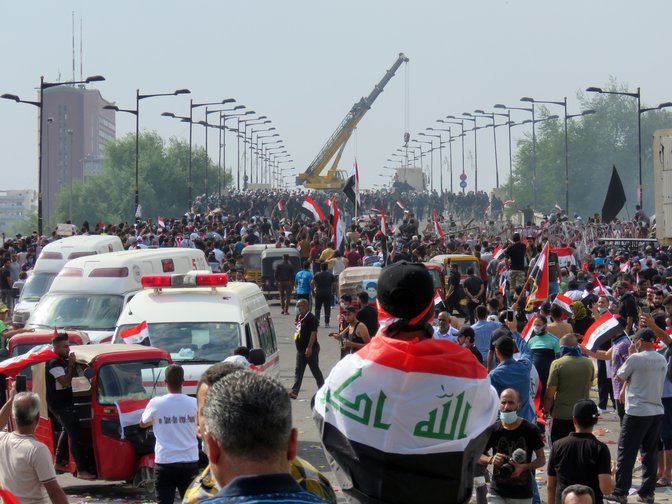
mhuriya bridge attempt to push them back to Tahrir square during a protest in Baghdad, Iraq 25 October 2019| Picture by Nabil Salih. All rights reserved


Nabil Salih-1 October 2020

“Iwish to give my life for Iraq and become a martyr,” he told me, smiling, sitting alone on the curb. Next to him was a tent set-up by volunteer medics, tending wounded protesters frantically shipped-in by knackered tuk-tuks throughout the evening. Instead of obsessing on his medical or engineering school application, the soot-covered thin boy who scored an average grade of 94 in high-school fled home to join flocks of livid youth at Baghdad’s Tahrir square, hell-bent on toppling the government.

This was a year ago, at the end of October 2019. It was a bloody night. No breeze blew from the Tigris. Tear gas, blended with sweat and smoke, swept away. The square buzzed with chants, music and shrieks of grief. On the neck of al-Jumhuriya bridge, state executioners deployed stun and gas grenades at the craniums of destitute youth with nothing in hand but the blood-stained tricolor of Iraq.

IMG_9298.JPG
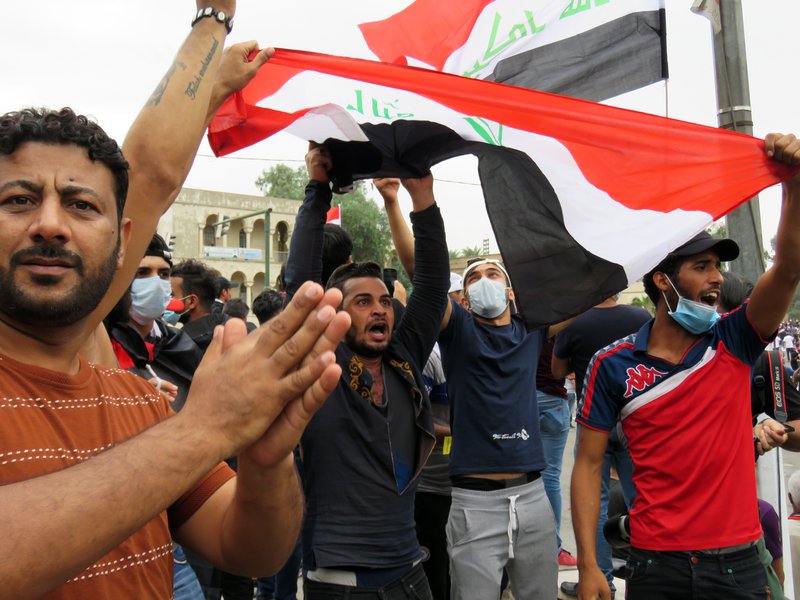
Protesters chant and raise the Iraqi flag during a protest at Tahrir square in Baghdad, Iraq 25 October 2019 | Picture by Nabil Salih. All rights reserved

What happened to that boy?

In 2019, 725 Iraqis attempted suicide, according to the Iraqi High Commission for Human Rights. In taking their own lives, they escaped the misery of a life marred by myriad challenges – eventually pushing their anguished peers to protests. Little informed journalists who placed the unarmed protesters at the frontlines of “clashes” with security forces – joining state rhetoric in by portraying protesters as saboteurs – extolled a superficial stability under the rule of Adel Abdul Mahdi, the toppled prime minister who oversaw the bloody crackdown.

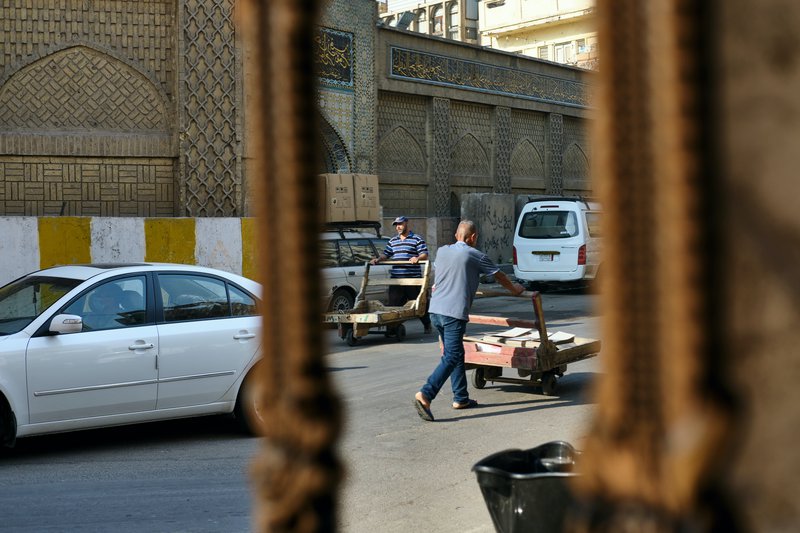
While they celebrated a partial access for civilian cars to the airport and blast walls coming down as achievements, not obligations, in downtown Baghdad, countless youth and child workers made living pushing handcarts through ramshackle alleys. Unemployed youth, widows and exploited children swarmed at Baghdad’s intersections like ants. They begged for alms, sold tissue packs or bottled drinking water. Meanwhile, in far-flung areas, remnant militants of Islamic State (IS) group continued to wage frequent attacks harming both civilians and security forces.

IMG_9567.jpg
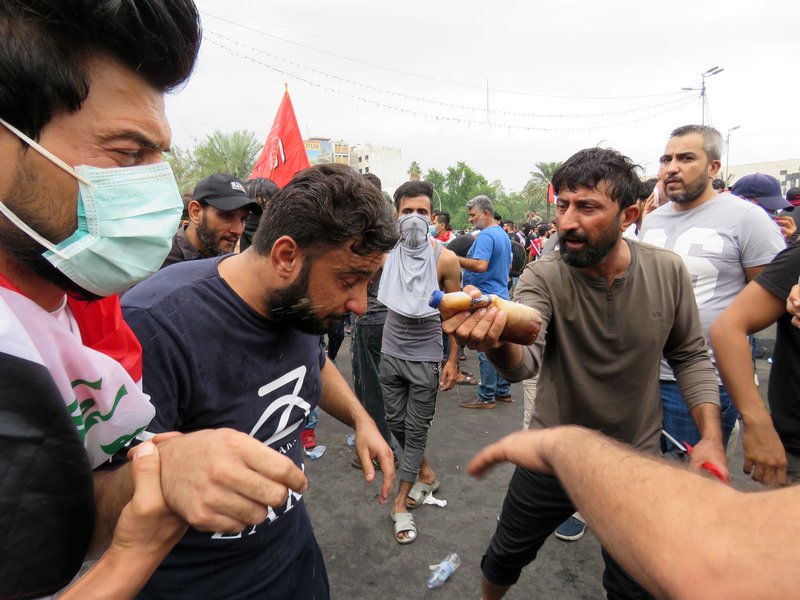
A protester sprays Pepsi on another's eyes to wash out tear gas during a protest at Tahrir square in Baghdad, Iraq 25 October 2019 | Picture by Nabil Salih. All rights reserved

On the first day of October 2019, the downtrodden gathered on the streets of Baghdad to voice their rejection to the boots treading heavily on the faces of marginalized generations since 2003 – the year many of Iraq’s shipped-in democracy knights rode US tanks rolling into Baghdad to ‘liberate’ it.

The lack of basic services was merely one reason for igniting the anger harbored by millions. They rose to break the fetters of humiliation and injustice, to voice their refusal to the flogger whipping their backs for years.

Some were assassinated for covering the protests, others – myself included – were harmed and harassed while death threats reached many others

“We want a homeland!” they chanted. Live bullets, skull-smashing tear gas canisters and an incessant campaign of intimidation, kidnapping and assassination ensued. Journalists where not spared either. Some were assassinated for covering the protests, others – myself included – were harmed and harassed while death threats reached many others.

I spoke to victims of state repression receiving care at Médecins Sans Frontières’s hospital in Baghdad. Some with amputated limbs or shredded bones, breadwinners of their families no longer able to work. Despite their crippling injuries, none of them regretted participating in the protests.

The protests pushed Abdul Mahdi’s government to resign and stripped clerics of their red-line shields. But these were only two of many significant gains.

Despite the grave human cost, with hundreds of deaths and tens of thousands of injuries, the October Uprising was the beginning of change. It was a wake-up call for desperate generations caught in an endless cycle of poverty, marginalization and injustice to reclaim Iraq. It evidentiated the unity of Iraqis and refuted the divisions made-up and pushed by post-invasion politicians and their sectarian quota system - ‘Muhasasa’.

The movement was so pure and powerful that it left many politicians drooling, pitifully trying to appease the protesters in their statements. Even the US Secretary of State Mike Pompeo exploited the protests. He posted a video showing protesters in Baghdad celebrating the death of Iranian General Qasem Soleimani and deputy chief of Iraq’s Popular Mobilization Forces Abu Mahdi al-Muhandis in a US airstrike near the airport.

The protests pushed Abdul Mahdi’s government to resign and stripped clerics of their red-line shields. But these were only two of many significant gains

Yet, Pompeo – whose opportunism placed more danger on the protesters who were accused of receiving support from foreign embassies – seemed unaware that one of the most popular chants reverberating at protest squares slammed both Iran and the US intervention in Iraq: “Stooge, toady, to hell with Iran and the US!”

One year after

In the following months, Iraqis never really stopped protesting, albeit in subpar numbers. Today, there are calls to take to the streets in honor of those who sacrificed their lives for the Iraq they wished to see.

No wonder why. In recent weeks, at least ten Iraqis reportedly committed suicide. Among them a sixteen-year-old boy who hanged himself in al-Karradah neighborhood of Baghdad.

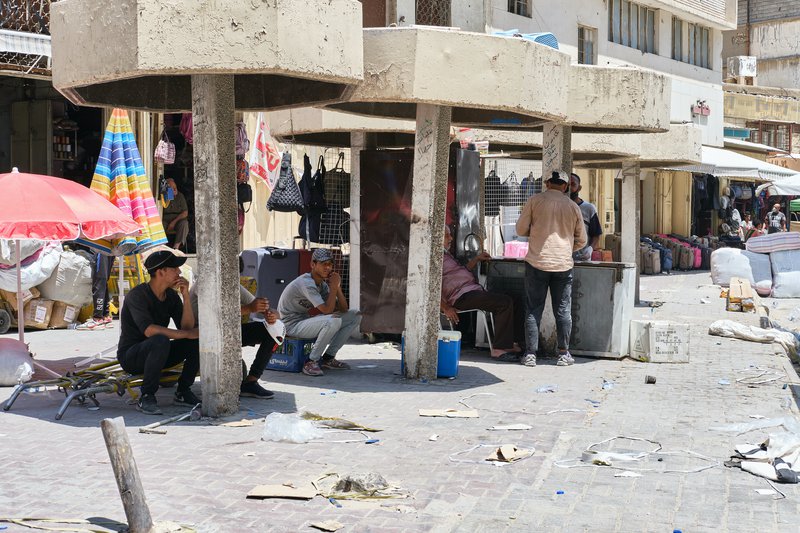
At daybreak, queues of young, unmasked day laborers line the sidewalks of Baghdad hoping someone would hire them. Those who afford to, have breakfast among stray dogs on traffic islands littered with garbage.

DSCF1821.jpg

Daily workers sit on a sidewalk at al-Rusafi square in Baghdad, Iraq 22 June 2020 | Picture by Nabil Salih. All rights reserved

In recent weeks, at least ten Iraqis reportedly committed suicide. Among them a sixteen-year-old boy who hanged himself

In the evening, starved children roam main streets in flip-flops. They sell chewing gum, or wipe windshields of gleaming modern cars, gluing their faces to the windows in hope that the drivers would bother to forgo a few banknotes.

Meanwhile, unmasked customers file in flashy restaurants, where hardly any countermeasures to contain COVID-19 are in place. If any of them showed symptoms, private laboratories on al-Kindi street provide blood tests in secret for no more than $30 – away from the notoriously infected corridors of state hospitals.

Promises of justice and early elections

Iraq’s current premier, Mustafa al-Kadhimi – who ascended to power by agreements among the ruling elite and complete exclusion of Iraqis’ say in typical “democratic” fashion – promised to investigate the killing of protesters and hold early elections in June 2021.

DSCF3060.jpg

Porters push wooden trollies through al-Rashid street in Baghdad, Iraq 7 September 2020 | Picture by Nabil Salih. All rights reserved

But Iraq’s ruling political blocs are stalling, irked that their access to state coffers and sway over decision making would lessen if elections take place according to an electoral law with multiple constituencies, where people cast their votes for individuals, rather than coalitions on provincial level. It remains unclear what form the law will take.

What’s certain is that parliamentarians are aiming to pass the notorious “cybercrimes law” which could be an instrument to silence critics of state failure by severe punishments ascending to execution.

In recent months, activists in Baghdad, Basra and Dhi-Qar were killed and kidnapped and the perpetrator remains “unknown”

In today’s Iraq, security breaches remain commonplace. It is a manifestation of lethal state failure.

In recent months, activists in Baghdad, Basra and Dhi-Qar were killed and kidnapped and the perpetrator remains “unknown”. To date, “unknown” armed groups continue to terrorize locals with frequent attacks on the US embassy, coalition camps, and logistic convoys. On 28 September 2020, two rockets landed in a residential area in western Baghdad, killing three children and two women.

DSCF3008.jpg

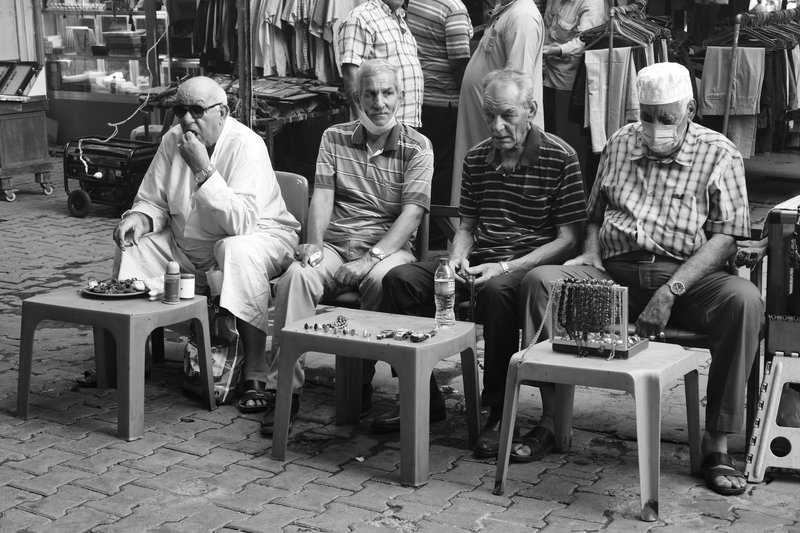
Old men ply their trade and eat at an outdoor café on a narrow alley in old Baghdad, Iraq 7 September 2020 | Picture by Nabil Salih. All rights reserved

A few days earlier, al-Kadhimi endorsed a call by cleric Muqtada al-Sadr to form a committee charged with investigating breaches “targeting Iraq’s security, prestige, reputation and international commitments”. A move that seems logical, considering Sadr’s large follower base and Kadhimi’s alleged attempts to curb powerful outlaw groups.

The irony is that Sadr’s supporters have reportedly opened fire in February on protesters in southern Iraq. So how are Iraqis supposed to have faith in the current administration and the results of its probe into the killing of protesters?

COVID-19 and the Failures of Capitalism

Photograph by Nathaniel St. Clair


BY 

The desperate policies of panic-driven governments involve throwing huge amounts of money at the economies collapsed in response to the coronavirus threat. Monetary authorities create money and lend it at extremely low interest rates to the major corporations and especially big banks “to get them through the crisis.” Government treasuries borrow vast sums to get the collapsed economy back into what they imagine is “the normal, pre-virus economy.” Capitalism’s leaders are rushing into policy failures because of their ideological blinders.

​The problem of policies aimed to return the economy to what it was before the virus hit is this: Global capitalism, by 2019, was itself a major cause of the collapse in 2020. Capitalism’s scars from the crashes of 2000 and 2008-2009 had not healed. Years of low interest rates had enabled corporations and governments to “solve” all their problems by borrowing limitlessly at almost zero interest rate cost. All the new money pumped into economies by central banks had indeed caused the feared inflation, but chiefly in stock markets whose prices consequently spiraled dangerously far away from underlying economic values and realities. Inequalities of income and wealth reached historic highs.

​In short, capitalism had built up vulnerabilities to another crash that any number of possible triggers could unleash. The trigger this time was not the dot.com meltdown of 2000 or the sub-prime meltdown of 2008/9; it was a virus. And of course, mainstream ideology requires focusing on the trigger, not the vulnerability. Thus mainstream policies aim to reestablish pre-virus capitalism. Even if they succeed, that will return us to a capitalist system whose accumulated vulnerabilities will soon again collapse from yet another trigger.

​In the light of the coronavirus pandemic, I focus criticism on capitalism and the vulnerabilities it has accumulated for several reasons. Viruses are part of nature. They have attacked human beings—sometimes dangerously—in both distant and recent history. In 1918, the Spanish Flu killed nearly 700,000 in the United States and millions elsewhere. Recent viruses include SARS, MERS andEbola. What matters to public health is each society’s preparedness: stockpiled tests, masks, ventilators, hospital beds, trained personnel, etc., to manage dangerous viruses. In the U.S., such objects are produced by private capitalist enterprises whose goal is profit. It was not profitable to produce and stockpile such products, that was not and still is not being done.

Nor did the U.S. government produce or stockpile those medical products. Top U.S. government personnel privilege private capitalism; it is their primary objective to protect and strengthen. The result is that neither private capitalism nor the U.S. government performed the most basic duty of any economic system: to protect and maintain public health and safety. U.S. capitalism’s response to the coronavirus pandemic continues to be what it has been since December 2019: too little, too late. It failed. It is the problem.

The second reason I focus on capitalism is that the responses to today’s economic collapse by Trump, the GOP and most Democrats carefully avoid any criticism of capitalism. They all debate the virus, China, foreigners, other politicians, but never the system they all serve. When Trump and others press people to return to churches and jobs—despite risking their and others’ lives—they place reviving a collapsed capitalism ahead of public health.

The third reason capitalism gets blame here is that alternative systems—those not driven by a profit-first logic—could manage viruses better. While not profitable to produce and stockpile everything needed for a viral pandemic, it is efficient. The wealth already lost in this pandemic far exceeds the cost to have produced and stockpiled the tests and ventilators, the lack of which is contributing so much to today’s disaster. Capitalism often pursues profit at the expense of more urgent social needs and values. In this, capitalism is grossly inefficient. This pandemic is now bringing that truth home to people.

A worker-coop based economy—where workers democratically run enterprises, deciding what, how and where to produce, and what to do with any profits—could, and likely would, put social needs and goals (like proper preparation for pandemics) ahead of profits. Workers are the majority in all capitalist societies; their interests are those of the majority. Employers are always a small minority; theirs are the “special interests” of that minority. Capitalism gives that minority the position, profits and power to determine how the society as a whole lives or dies. That’s why all employees now wonder and worry about how long our jobs, incomes, homes and bank accounts will last—if we still have them. A minority (employers) decides all those questions and excludes the majority (employees) from making those decisions, even though that majority must live with their results.

Of course, the top priority now is to put public health and safety first. To that end, employees across the country are now thinking about refusing to obey orders to work in unsafe job conditions. U.S. capitalism has thus placed a general strike on today’s social agenda. A close second priority is to learn from capitalism’s failure in the face of the pandemic. We must not suffer such a dangerous and unnecessary social breakdown again. Thus system change is now also moving onto today’s social agenda.

This article was produced by Economy for All, a project of the Independent Media Institute.

Richard Wolff is the author of Capitalism Hits the Fan and Capitalism’s Crisis Deepens. He is founder of Democracy at Work.

No lost generation: can poor countries avoid the Covid trap?

We must act now to stop the pandemic inflicting long-term damage, says the head of the IMF


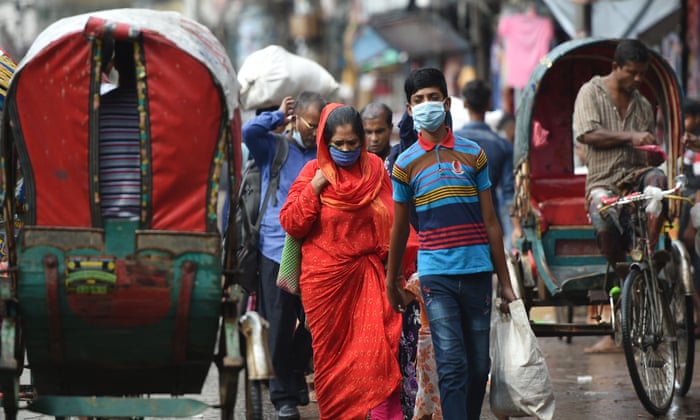
 People wearing face masks on a street in Dhaka, Bangladesh. The country has been hit hard by the loss of remittances during the Covid crisis. Photograph: Xinhua/Rex/Shutterstock


Tue 29 Sep 2020 

Never before in living memory have so many lives and livelihoods across the world been disrupted at the same time. The International Monetary Fund estimates the pandemic’s loss to the global economy at around $12tn (£9.4tn) over 2020-21. The poorest countries – with limited resources and constrained capacity – are hit hardest: growth in low-income nations will be at a standstill this year, compared with 5% last year.

Without necessary action, this group of about 70 countries, representing more than 1 billion people, faces unprecedented human and economic devastation. The decades-long declining trend in global poverty is being pushed into reverse, with as many as 90 million additional people falling into extreme poverty, mostly in sub-Saharan Africa and south Asia.

Just this month, the UN warned of famine. There is also the fear that the pandemic will set back health progress for decades as well as reverse progress on other crucial fronts such as gender equality.

Just as people with weak immune systems are more vulnerable to the virus, so low-income countries with weak fundamentals are more prone to its economic effects. More than half of these countries were already at high risk of – or actually in – debt distress before the crisis began.

The pandemic has exacerbated this with a poisonous cocktail of external shocks: sharply falling exports and commodity prices, collapsing trade, evaporating tourism and less capital inflows. Remittances, which are the main source of income for many poor families, have been hit hard – by almost 20% in countries such as Bangladesh.

It is urgent that we act now to prevent “scarring” – long-term loss of human and economic capacity – in the poorest countries. Most importantly, we must secure access to opportunities – education, jobs, financing to start businesses – for the generation of young people upon whom the future of these countries depends. What needs to be done?

First, governments must prioritise health for a durable exit from the pandemic. Saving lives and saving livelihoods are two sides of the same coin. Given that lockdowns are difficult to sustain, this means combining investments in treatment capacity with targeted measures such as social distancing and contact tracing, and with an emphasis on the most vulnerable, including elderly people. Vietnam and Cambodia are examples of where this is happening.

Second, economic measures – especially fiscal ones – should be even more focused. The quality and effectiveness of domestic resource mobilisation and spending are at a premium. For example, protecting education is critical to avoid permanent damage to young people’s prospects. And there must be zero-tolerance of corruption. The crisis has exposed structural weaknesses in social protection systems and offers an opportunity to build stronger systems that can reach vulnerable populations.

Third, even while fighting the pandemic today, countries must look to transform their economies for a very different tomorrow – including by incentivising the transition to a climate resilient and low-carbon economy, and by building digital skills and infrastructure. For example, expanding internet access in sub-Saharan Africa by 10% could increase real per capita GDP growth by up to an estimated four percentage points.

Fourth, the international community must do even more. Helping low-income countries gain equitable access to vaccines is an imperative. So is securing universal access to the internet.

This demands an increase – not a decline – of aid resources in the form of grants, concessional loans and debt relief. Responding to the IMF and World Bank’s call, the G20 has suspended official bilateral debt payments from the poorest countries – freeing up about $5bn this year for 42 low-income countries. The initiative could be extended along with increased participation by commercial creditors.

The IMF is playing its part. We have tripled our capacity to provide zero-interest loans to low-income countries. We have disbursed over $30bn in emergency financing to 76 countries, including over $10bn to 47 low-income countries – without traditional conditions but with fiduciary safeguards. And we have given immediate debt relief, in grant form, to 29 of our poorest member countries.

This is a crisis like no other and we are responding like never before – particularly to support the most vulnerable countries and the most vulnerable people.

Make no mistake: without urgent action, we risk deepening the divide – globally –between the rich and poor. The impact will be profound – and not only in low-income countries. It risks reverberating throughout the world with increased inequality leading to economic and social upheaval: a lost generation in the 2020s whose after-effects will be felt for decades to come.

I do not see this outcome as inevitable. On the contrary, I believe that, working together, we can build forward to a better world for all.

To get there, we must act now.

  • Kristalina Georgieva is managing director of the International Monetary Fund

Tech prescription for eldercare

The Japanese government has been striving to improve its medical and nursing care and lead relevant high-tech applications globally, something essential in a developed country with the world's most severe aging problem.

CAI MENG/CHINA DAILY

China can borrow from Japan's experience in using robots to provide medical and nursing care for the aged


BY YUAN YOUWEI | 

The Japanese government has been striving to improve its medical and nursing care and lead relevant high-tech applications globally, something essential in a developed country with the world's most severe aging problem.

One of the greatest challenges for the country is the rising demand for healthcare practitioners. According to the Japanese government, aging people will need nearly one-fifth of the workforce engaged in healthcare by 2040, when the number of people aged over 100 in Japan is likely to reach 300,000.

The various needs of the elderly call for the diversification of medical care services. By 2030, the number of elderly people in cities will increase dramatically, while that in the countryside will decline by nearly 15 percent, thus widening the age gap in urban and rural areas.

Going high-tech is the key to caring for the growing elderly population. The Japanese government has set out three goals-building intelligent infrastructure, meeting personalized needs and forging a sense of community among the aged. That will create an environment where telemedicine and other services can be optimized using artificial intelligence and other programs. With the help of professional guidance, senior citizens can better understand their health condition and choose health services suited to their needs. Also, senior citizens can support and help each other by becoming part of a network. They will be assisted by cloud services and robots adjusted according to the environment changes and personal demands.

Since 2013, the Japanese Ministry of Economy, Trade and Industry, and the Ministry of Health, Labour and Welfare have emphasized developing nursing robots, leading to policies being refined.

The government is also committed to promoting information and communication technology in medical care. By setting standards and norms for information cooperation between companies and nursing institutions, it is helping improve efficiency and coordination.

Japan's nursing industry for elderly citizens has been developed on the basis of a concrete outline. In April 2019, the Ministry of Health, Labour and Welfare released a report on promoting the development of information and communication technology and operational efficiency in nursing. The report proposed concrete implementation plans for health, medicine and nursing. Moreover, the healthcare industry has also established a group to review and revise the Cabinet's documents, examine the need for technology research and development, and promote new technologies' social application.

To regulate the application of information and communication technology in nationwide nursing institutions, the Japanese government created a standard for information management and medical care institutions in 2018. It formulated safety standards in nursing institutions in the fiscal year 2019.

China can learn from Japan's experience.

The Chinese government and relevant companies can borrow from Japan's experience in supporting the R&D of robots and information and communication technology for eldercare, which focuses on improving financial support for the high-tech industry.

Japan's experience shows that government policy and financial support are the foundations for high-tech application and information exchanges, offering references for the Chinese government.

In recent years, the Chinese government has made comprehensive plans to improve the technological level of senior citizen-related healthcare. And it has made greater efforts to accelerate this process by vigorously promoting the Internet Plus model in medical care and nursing services for the elderly.

But governments at all levels should coordinate and provide financial support. Both the Japanese central and local governments have increased spending to accelerate relevant technologies and equipment for nursing robots. The central government contributed two-thirds of the investment while local governments paid one-third. The latter have also set up regional medical funds to support the introduction of nursing robots in regular facilities. Since 2018, the maximum aid for each device has increased from 100,000 yen ($949) to 300,000 yen, with a subsidy rate of 50 percent.

The Japanese government has supported the development of information and communication technology in nursing institutions using medical insurance. The subsidies for the cost of software and tablet terminals are provided by the local government. Each nursing agency's subsidy is limited within 50 percent of its total cost and cannot exceed 300,000 yen.

Since 2018, China's central government has invested 3 billion yuan ($439.8 million) annually in medical care facilities. Besides, 960 million yuan has been drawn from lottery revenue each year for the related projects.

The Chinese government should also work on other problems such as insufficient government guidance and lack of investment in the initial stages of R&D to arouse the enthusiasm of enterprises in R&D. Also, it is necessary to standardize relevant regulations to improve the adaptability and quality of products.

In addition, companies and nursing institutions should be encouraged to participate in the research process. In Japan, the government and private research institutes have worked together. Enterprises highlighting R&D have cooperated with the nursing agencies and established councils to meet their needs better.

And guided by experts from the beginning, the two sides can put forward suggestions for developing nursing robots based on local demand.

When products are introduced in the market for trials, experts can demonstrate the application. Finally, they can be promoted through various channels, such as robot displays, visitor experience, renting, and seminars.

Learning from Japan's practice, China can also help build a cooperative connection between nursing agencies and enterprises and create a sound ecosystem for R&D to promote the development and application of high-level technologies and products in the field of nursing.

The author is the deputy director of the Department of External Affairs at the China Center for International Economic Exchanges. The author contributed this article to China Watch, a think tank powered by China Daily. The views do not necessarily reflect those of China Daily.

A fungus known as white mold can kill a plant in days. Unless, that is, a virus is around to tame it.

Pea pods showing the white mold, Sclerotinia sclerotiorum.

Credit...Nigel Cattlin/Science Source


By Sept. 29, 2020

When crops have nightmares, they dream of Sclerotinia sclerotiorum.

The fungus, known by stomach-turning names such as “white mold” and “watery soft rot,” manifests as a cottony, cream-colored fuzz that attaches to stems, where it gouges wound-like lesions. Tiny appendages called appressoria punch into cells with astounding force, while a torrent of toxins liquefies the plant’s innards, upon which the fungus begins to feast. Within days, the plant is dead.

“It really is a deadly fungus,” said Daohong Jiang, an agricultural microbiologist at Huazhong Agricultural University in Hubei, China.

Some 400 species of plants are thought to be susceptible to the pathogen, including soybeans, which fell in droves to the fungus in 2009, costing farmers $560 million. The fungus also goes dormant in soil for years, seeding new infections that can raze entire fields of crops.

Dr. Jiang has spent 10 years hot on Sclerotinia’s trail in the hopes of bringing the blight to heel. He and his colleagues now think they’ve found an answer: a treatment that doesn’t just stop the fungus from killing, but transforms it into a probiotic that can boost plant growth and enhance resilience to future disease. They reported their findings Tuesday in the journal Molecular Plant.

Their horticultural hero is a virus called SsHADV-1. Typically, it rides around on a fungus-munching insect called a mushroom fly. And it’s able to fully domesticate Sclerotinia over the course of a single encounter, turning a wolf into a watchdog.

“There have been some reports about how viruses are able to manipulate hosts, but this one is so unique,” said Aurelie Rakotondrafara, a plant pathologist at the University of Wisconsin, Madison, who was not involved in the study. “You can’t help but ask: How is this possible?”

Dr. Jiang’s team first noticed the virus’s unusual sway over Sclerotinia over a decade ago, when they discovered that rapeseed plants were able to peacefully coexist with virus-infected strains of the fungus, despite being felled in droves by their virus-free counterparts. What exactly drove the difference was, at the time, unclear.

Their latest work showed that the virus hijacked its host’s cells on a global scale, controlling which genes the fungus shut on and off as it infiltrated rapeseed plants. Virus-infected fungi, for instance, no longer flooded plants with tissue-macerating juices. And while they still forced their way into a host’s cells, the virus-infected fungi were far more gracious tenants, and left the rapeseed mostly intact.

The virus had, in effect, compelled the fungus into sheathing its plant-impairing weapons, Dr. Rakotondrafara said: “A mean pathogen turned into a gentle microbe.”

The puppeteering didn’t stop there. Bridled by the virus, Sclerotinia prompted the plants to sprout heftier leaves and more robust roots. The buoyed rapeseed plants also became resistant to virus-free Sclerotinia strains and other damaging fungi — a hint that the virus-infected fungus had acted as something of a crude “vaccine” against future disease, Dr. Jiang said.

What’s behind this bonus protective effect isn’t yet completely clear, said María Rebolleda Gómez, a microbial ecologist at Yale University who was not involved in the study. “Maybe it’s inside the cell and can outcompete other fungi that are trying to get in, or it is just priming the plant’s defenses,” she said.

Once tamed by the virus, the fungus also didn’t grow quite as enthusiastically on rapeseed, potentially because the newly bolstered plant was able to keep its guest in check, Dr. Jiang said. A fungus this docile, he added, could end up being a fantastic preventive treatment for vulnerable plants.

That’s something his team has already tried. Young plants sprayed with bits of virus-infected Sclerotinia matured alongside the domesticated fungus in the field, the researchers found, and wound up healthier than untreated plants.

Under natural circumstances, fungus-eating flies can chauffeur the virus from place to place. Dr. Jiang’s vision for crop protection would, in theory, be more direct: spiking fungus, pre-loaded with pacifying virus, onto plants. It would give farmers a speedy way to bolster their fields against future disease, he said, rather than being forced to scramble to contain an outbreak.

“Fungicides are working less and less all the time,” said Adriana Romero Olivares, a fungus expert at New Mexico State University who was not involved in the study. “This type of approach could be more sustainable,” she said, as long as the fungus doesn’t spontaneously jettison the virus and regain its plant-demolishing ways.

If the relationship between virus and fungus is as durable as it seems, it prompts fascinating questions about how the two microbes might coevolve, Dr. Romero Olivares said. Plenty of fungi are capable of playing nice with plants; some manage it after a past of crop-killing crime. What triggers that transition remains mysterious — but in at least some cases, viruses might be to blame, or, depending on your perspective, thank.

“We often think about microbes as, they’re pathogenic or not, bad or good,” Dr. Rebolleda Gómez said. “But the truth is, it depends quite a bit on the ecology and the interactions around it. This is a really cool example of that.”