Sri Lanka: One Island Two Nations

Search This Blog

Monday, 1 March 2021

Dr Fauci fears the US has stalled at 70,000 new coronavirus cases a day and warns America could be headed for another surge after a five-fold increase in new 'super-Covid' infections

  • Dr Anthony Fauci said it is good that the baseline of coronavirus infections has decreased from 300,000 per day to around 70,000, but that the number is still too high
  • He said it is too soon to relax restrictions, otherwise the country will see a rebound withs cases spiking again 
  • The U.S. recorded 51,204 infections, a decline of 5.4% over last week and the lowest number seen since October 13
  • There were 1,097 daily deaths recorded in the last 24 hours, as new fatalities continue to decline, decreasing 16% over the last week 
  • Currently, 47,352 Americans are hospitalized with COVID-19, which marks 47 straight days of falling numbers for hospitalizations 
  • Cases of coronavirus variants in the U.S. increased five-fold over the month of February from 471 to 2,463 across 47 states
  • On Sunday, a record-high number of 306 new variant infections were reported, and nearly all were in Florida, Michigan or Texas
  • Fauci also encouraged that Americans get whichever coronavirus vaccine is available to them after J&J's vaccine received emergency use authorization from the FDA last month


Dr Anthony Fauci, the nation's top infectious disease expert, said he's worried that cases of coronavirus will plateau around 70,000 rather than decline.

On Sunday, the U.S. recorded 51,204 infections, a decline of 5.4 percent over last week. This is also the lowest figure seen since October 7, when 50,341 cases were recorded, according to a DailyMail.con analysis.  

Over the past week, the nation recorded multiple days of daily news cases around 70,000. Despite plunging from a high of nearly 300,000, Fauci said it's not enough.

'We've been in this situation before, when you start to see a decline in number of cases, if you prematurely lift the restrictions, we have a few examples of the rebound back,' Fauci, the director for the National Institute for Allergy and Infectious Disease said on NBC's Meet the Press on Sunday.

'Our baseline of daily infections now, even though it's way down from where it was, 300,000-plus per day, is down to around 70,000. That baseline's too high.

'Let's keep our feet on the accelerator right now, because we are going in the right direction.' 

There were 1,097 daily deaths recorded in the last 24 hours, as new fatalities continue to decline. 

In addition, the number of people currently hospitalized with COVID-19 fell to 47,352 marking 47 straight days of falling numbers and 64 percent lower than the peak of 132,474 hospitalizations recorded on January 6. 

It comes as the country saw a record 306 new coronavirus variant infections on Sunday. Health officials say cases have increase five-fold over the month of February - and nearly all of the new cases were in Florida, Michigan or Texas.

A homegrown variant that first appeared in New York is stirring increasing concern among officials, including Fauci, who highlighted at a press briefing the fact that it appears to evade either antibodies from prior infection or those triggered by vaccines.

However, laboratories that run tests to determine if coronavirus samples are variants are not allowed to tell patients if they are infected with a mutant strain due to federal rules that control what information labs can share.

The baseline of coronavirus infections has decreased from 300,000 per day to around 70,000, but that the number is still high, which Dr Anthony Fauci said on Sunday is good but still too high

The baseline of coronavirus infections has decreased from 300,000 per day to around 70,000, but that the number is still high, which Dr Anthony Fauci said on Sunday is good but still too high

The U.S. recorded 51,204 infections, a decline of 5.4% over last week and the lowest number seen since October 13, but Fauci said it is too soon to relax restrictions

The U.S. recorded 51,204 infections, a decline of 5.4% over last week and the lowest number seen since October 13, but Fauci said it is too soon to relax restrictions

There were 1,097 daily coronavirus deaths recorded in the last 24 hours, as new fatalities continue to decline, decreasing 16% over the last week

There were 1,097 daily coronavirus deaths recorded in the last 24 hours, as new fatalities continue to decline, decreasing 16% over the last week

Currently, 47,352 Americans are hospitalized with COVID-19, which marks 47 straight days of falling numbers for hospitalizations

Currently, 47,352 Americans are hospitalized with COVID-19, which marks 47 straight days of falling numbers for hospitalizations

On Monday, CDC director Dr Rochelle Walensky also expressed her concerns about the plateau.

'I am really worried that states are rolling back the same restrictions that helped us. We cannot be resigned to 70,000 cases a day, 2,000 daily deaths.,' she told reporters during a press briefing. 

'At this level of cases, we stand to lose the hard-earned ground we have gained...This is the not the time to relax critical safeguards...We have the potential to stop the surge of cases. Stay strong in convictions.' 

Fauci also said he would take any of the vaccines that are approved in the U.S. - Pfizer-BioNTech, Moderna or Johnson & Johnson - because all showed protection against severe disease and death. 

'All three of them are really quite good, and people should take the one that's most available to them,' he told NBC.

'If you go to a place and you have J&J and that's the one that's available now, I would take it. I personally would do the same thing. I think people need to get vaccinated as quickly and as expeditiously as possible.'

Fauci (pictured) encouraged that Americans get whichever vaccine is available to them after J&J's shot received emergency use authorization from the FDA last month

Fauci (pictured) encouraged that Americans get whichever vaccine is available to them after J&J's shot received emergency use authorization from the FDA last month

On Saturday, the U.S. Food and Drug Administration (FDA) authorized the J&J one-shot vaccine for emergency use one day after an independent panel of advisors recommended that it be approved. 

The inoculation was found to be 86 percent effective at preventing serious disease overall with 72 percent efficacy in the U.S. and 64 percent in South Africa.

By comparison, Pfizer's vaccine as well as Moderna's are about 95 percent effective at preventing severe disease. 

'It's not the weaker vaccine. They are all three really good vaccines,' Fauci told NBC.

The first doses of J&J's long-awaited one-dose COVID-19 vaccine began shipping overnight, and the first shots could be given as early as tomorrow, the firm's CEO said Monday. 

'We think literally between the next 24 to 48 hours, Americans should start receiving shots and arms,' said Alex Gorsky on NBC's Today. 

J&J started shipping four million doses of America's third coronavirus vaccine overnight on Sunday, after it received emergency authorization from the FDA. 

J&J's vaccine was approve for emergency use authorization, which should help boost the number of daily vaccinations even higher than the current average of 1.7 million per day

J&J's vaccine was approve for emergency use authorization, which should help boost the number of daily vaccinations even higher than the current average of 1.7 million per day

Vaccine rollout is picking up speed across the U.S., with about 15% of the population having received one or more doses

Vaccine rollout is picking up speed across the U.S., with about 15% of the population having received one or more doses

It comes after the firm hit production delays, forcing it to walk back its original pledge to deliver 10 million doses in its first shipments, but CEO Alex Gorsky said J&J can 'absolutely' meet its new delivery goal.

J&J still thinks it can deliver 100 million doses of the vaccine by July. Combined with the promised doses from Moderna and Pfizer, that would give the US enough vaccine to inoculate every adult in the nation.  

The firm's highly-anticipated vaccine couldn't come soon enough. After six weeks of promising declines in COVID-19 case numbers, there are signs the trend may be stalling.   

Vaccine rollout is picking up speed across the U.S., where 15 percent of the population has now had one or more doses, according to Bloomberg data. 

But the race to inoculate Americans is heating up, too, as the nation tries to out outpace the spread of highly infectious variants from the UK, South Africa and Brazil, as well as its own homegrown mutant forms of coronavirus. 

Cases of the coronavirus variants in the U.S. increased five-fold over the month of February from 471 to 2,463 across 47 states, with a high number of cases reported on Sunday at 306

 Cases of the coronavirus variants in the U.S. increased five-fold over the month of February from 471 to 2,463 across 47 states, with a high number of cases reported on Sunday at 306 

It comes as the U.S. reported a record-high number of coronavirus variant cases on Sunday at 306.

The majority of the increase was seen in three states: Florida, Michigan and Texas. Florida saw an increase of 104 cases to a total of 605, Michigan was up 85 cases to 421, and Texas saw a rise of 41 cases to 102. 

At least 2,400 cases are linked to B.1.1.7, which was first seen in the UK and that the CDC says will become the dominant strain in March.

Over the month of February, the nation has seen variant infections increase five-fold from 471 to 2,463 across 47 states.

However, laboratory officials say they cannot tell patients or their physicians if they have been infected with a mutant strain.

The tests needed for detecting variants, known as genome sequencing tests, have not been authorized by the FDA as a diagnostic tool, according to Kaiser Health News. 

What's more, there are federal rules which dictate what information university labs can report and to whom, meaning health officials counties don't even know which counties in states have cases.

The testing is only performed by certain labs that are not required to tell patients or doctors their results. 

Recently, a new study found that every coronavirus variant of concern has been circulating in Houston at a low level for at least six to eight weeks, The New York Times reported.

This makes Houston the first city in the country to not only find all the variants that have come from abroad but also homegrown variants first seen in New York and California. 

The findings highlight how the true prevalence of the variants are all unknown and how there are no surveillance measures in place to track their fast spread. 

U.S. OFFICIALS CANNOT TELL CORONAVIRUS PATIENTS IF THEY ARE INFECTED WITH A VARIANT 

Laboratory officials say they cannot tell patients or their physicians if they have been infected with a variant of the novel coronavirus.

The tests needed for detecting variants, known as genome sequencing tests, have not been authorized by the U.S. Food and Drug Administration (FDA) as a diagnostic tool, according to Kaiser Health News. 

What's more, there are federal rules which dictate what information university labs can report and to whom, meaning health officials counties don't even know which counties in states have cases.

The testing is only performed by certain labs that are not required to tell patients or doctors their results. 

This is in stark comparison with the UK's Office for National Statistics, which has very detailed accounts of which regions of England have cases of the variant and what percentage of test are linked to mutant strains.   

Officials told Kaiser Health News that that there are federal guidelines regarding who can be told about variant cases.

This means public health officials telling residents about the detection of new cases may only know the county a case in, or just the fact that it is in a state.

Dr Nick Gilpin, the director of infection prevention at Beaumont Health in Michigan, told Kaiser Health News, that his hospital is informed if samples submitted for sequencing have been confirmed to be linked to variants.

However, laboratories will not shared who these patients are.  

'It's relevant from a systems-based perspective,' Gilpin told the news website. 

'If we have a bunch of B.1.1.7 in my backyard, that's going to make me think a little differently about how we do business.' 

While notifying patients that they have a variant won't affect how patients are cared for, it could help contact tracers identify close contacts so they can quarantine and prevent potential spread. 

The Council of State and Territorial Epidemiologists, a non-profit organization, have asked the federal government to wave these rules.  


Three cases of the Brazilian variant have been confirmed in Scotland and three in England – and officials have no idea where one of the English individuals is, as they failed to complete their test registration card.

But there has been some good news too – more than 20 million people in the UK have now had their first Covid vaccine – hailed by Boris Johnson as “a huge national achievement”.

COVID-19 Vaccine Doses: Who’s Got At Least One?


Note: Use the “Add Country” (top left) function to add countries to the list. This visualization updates regularly.

COVID-19 Vaccine Doses: Who’s Got At Least One?


By

With COVID-19 vaccine rollouts well underway in some countries, a return to ‘normal life’ could come sooner than later.

That said, many jurisdictions have experienced serious delays and supply shortages that have made it difficult to distribute COVID-19 vaccine doses to their populations. As of mid-February, 130 countries had not been able to begin vaccinating at all.

This interactive chart from Our World in Data tracks the share of people in each country that have received COVID-19 vaccine doses so far.

The Global Vaccine Rollout

As of publication date, roughly 100 countries have begun vaccine distribution, with about seven different vaccines available for public use at this stage.

The sheer logistical challenge of doling out vaccines is immense. Experts estimate that 70-80% of the world’s population will need to be vaccinated to reach herd immunity. Additionally, some of the vaccines require two doses which adds extra time and complexity to the process.

Here’s how the various vaccines compare in terms of required doses and levels of effectiveness.

Source: Bloomberg Vaccine Tracker

One key barrier to successfully administering vaccines is the prevalence of vaccine hesitancy around the globe.

For example, many people in Germany have been refusing the AstraZeneca vaccine due to a belief in its ineffectiveness and a preference for the ‘in-house’ German Pfizer/BioNTech vaccine. Although 1.45 million AstraZeneca COVID-19 vaccine doses have arrived in the country so far, just 270,000 have been administered.

Who’s Got at Least One Dose?

According to Bloomberg’s Vaccine Tracker, the current rate of doses being administered globally is more than 6 million per day. In particular, the U.S. has been remarkably efficient at administering doses, with a vaccine administration rate of over 1.7 million per day.

Here’s a breakdown of the countries who have begun vaccinating their populations and their current daily rate of doses administered.

Country Daily Rate of Doses Administered
🇦🇷 Argentina 43,534
🇦🇹 Austria 21,073
🇧🇭 Bahrain 3,364
🇧🇩 Bangladesh 113,082
🇧🇧 Barbados 3,503
🇧🇪 Belgium 18,998
🇧🇲 Bermuda 560
🇧🇷 Brazil 215,713
🇧🇬 Bulgaria 14,486
🇰🇭 Cambodia 1,564
Global Total 6,730,633
Showing 1 to 10 of 76 entries
PreviousNext

Source: Bloomberg Vaccine Tracker. Data as of Feb 28, 2021.

Certain countries appear to be on track to distribute all of their COVID-19 vaccine doses at an immensely quick rate. For example, the UK plans to vaccinate enough people to be able to lift all lockdown restrictions completely by the end of June 2021.

Additionally, the first COVAX rollouts have officially begun; COVAX is an initiative working to ensure equitable access to COVID-19 vaccines. Ghana was the first country to receive doses through the initiative.

Back to Normal?

Most countries are prioritizing vaccinating their high-risk groups first, from older adults to healthcare workers. That said, the planning required to vaccinate an entire population needs to be carefully thought out and often comes with immense logistical challenges.

While many countries have begun to immunize their populations, others have not been able to purchase doses yet. At the current pace, it could take a few years before things are completely back to normal and we reach herd immunity globally.

Vaccine passports

There are a multitude of ethical issues for consideration. The lessons of the mortality rate of the pandemic haunts everyone.


by Victor Cherubim   -
February 27, 2021

As countries around the globe ramp up vaccine roll out and some are having to pursue a vigorous “vaccination persuasion” effort in line to balance early social mixing, the hope is that travel could start again soon with vaccinations.

Most people would like to think COVID-19 as a one-off event in history that will be paid off over a couple of generations, or sooner. Yet others are rather sceptical. 

Some people, in fact some governments think that Immunity Passports – a universal document - to show proof of vaccination(s) - would be an ideal way to reopen not only travel, but countries and back to work.

Governments know that people have money and until they spend it, the economy will be in a slump. People on the other hand want to spend their cash but not to splash it about for fear of not being trapped again.

The attraction to Vaccination Passports  

Vaccination Passports introduction is being considered by several countries including UK, Denmark, Estonia, Italy, Chile, and Canada, but they are not rushing headlong to issue this authorisation either in the form of a document or otherwise, for many understandable safe reasons. Israel, however, has gone ahead and issued their own “Green Document” the Immunity Passport, ahead of others. 

We know that Health Certification Vaccination for public health purposes is already in use worldwide, especially for the management of Yellow Fever, but there is hesitancy in issue for Coronavirus. 

Vaccination Passports, we are told could take different forms, such as Smart Phone application (APPs), Wrist hand band identification, or even a Certificate to be used to confirm international travel, stating a particular individual is at low risk of acquiring COVID-19 or transmitting it, without testing each individual traveller on arrival or quarantine. This Immunity Passport could also be used during lockdowns permitting workers to return to work, or even care for those at risk to supplement Test and Trace.

Whether this strategy should be pursued depends on both scientific evidence and ethical reasoning. Regarding scientific evidence, it is the degree of immunity and the duration of this immunity, that is the main concern. The doubt is whether it is a short-lived immune response or whether it is an “antibody response “which may persist for many years, is still unclear.

Beyond scientific evidence -the ethical view

In the absence of an immunological correlation of protection there is concern. All we know from Science is that Vaccine induced immunity can produce some protection. But it is too early for researchers to assume a more predictable pattern and duration of immunity over the years with just two doses of vaccine. 

As far as the ethical issue of immunity, this becomes one of timely access to vaccination for everyone or much of the population.

Some have argued that Vaccine Passports are unethical and impractical due to the uncertainties relating to COVID-19 immunity, testing, tracing, and the doubtful economic benefits and particularly the risk of discrimination.

There are also practical problems, the vulnerable and the poor or poorer nations may be left out or behind, or that people in richer nations could face losing their jobs or be barred from essential shopping, if they cannot produce proof of vaccination. 

There are a multitude of ethical issues for consideration. The lessons of the mortality rate of the pandemic haunts everyone.

Further, removing civil liberties of a people is considered unjustified. We know many black and ethnic minority population of UK have yet to make up their minds on vaccination. The Queen too has spoken on the take up of vaccination by the undecided. 

This trepidation has been due to many reasons not least as vaccination up to now is by free choice. Black and Ethnic minorities may have their own reasons, some due to their residential status as migrants, some being illegal in residence, some for ethical or health concerns.

Behavioural scientists are worried granting a portion of the population more freedoms ahead of others during lockdown before everyone gets a chance to be vaccinated, is wrong. They state this would seriously undermine civil liberties, which unlike many Asian nations matters, much more in the so-called West. Whether we in the East accept it, is yet another matter. 

Then there are those who cannot be vaccinated due to underlying health conditions. They may be exempt, with a notification on their Certificate   that they cannot be vaccinated.

It is also the belief that these privacy concerns are not insoluble, through modern day technological advancement. 

Challenges relating to the implementation of Vaccine Passports ought to be met with targeted solutions to maximise their overall benefit as their forced introduction would exacerbate existing inequalities with marginalised groups subject to more scrutiny and perhaps, racism. 

Next logical step, among the options available? 

Of course, many feel that Vaccination Passports is seen as the next logical step after negative COVID-19 tests, to get the travel sector up and running. 

Some others maintain Vaccination Passports will be inevitable and/or even mandatory. 

One idea in UK Government is to adopt the NHS App to hold proof of “Vaccine Status” and test results, with encryption to keep data secure and facial recognition to stop it be borrowed.

There are many benefits for Vaccine Passports but at the same time there are also challenges. The pandemic has provided many ways of new thinking. Everything today is a measure of proven efficacy rather than only a passport to freedom.

COVID-19 has made the super-rich richer. It’s time for a billionaire wealth tax

The US’s billionaires have amassed democracy-distorting concentrations of wealth and power as millions have been thrown into poverty

Elon Musk’s wealth has grown by nearly $157bn since the start of the pandemic | Britta Pedersen/DPA/PA Images


Chuck Collins-01 Mar 2021 - 9:45am

What should good societies do when a wealthy few reap enormous financial windfalls during a global pandemic?

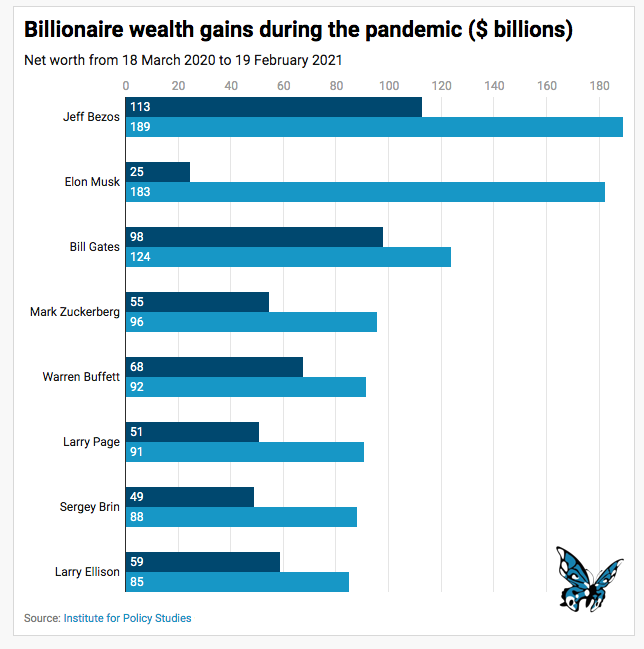
While millions lost their lives, livelihoods, health and wealth, the world’s billionaires and super-rich prospered. According to research from Americans for TaxFairness and the Institute for Policy Studies, between 18 March 2020 and 19 February 2021, the combined wealth of US billionaires increased by $1.3trn, a 44.6% increase in the space of just 48 weeks.

The concentration of wealth is staggering. There are now 661 billionaires in the US, with a total wealth of $4.26trn as of 19 February 2021, up from $2.9trn on 18 March 2020, nearly a year earlier. For perspective, the combined wealth of the bottom half of all US households, 165 million people, is $2.4trn, according to the Federal Reserve.

Elon Musk’s wealth grew by an astounding $157bn, from $24.6bn on 18 March 2020 to $182bn on 19 February 2021, a nearly seven-fold increase, boosted by the rapid increase in the value of Tesla stock.

Jeff Bezos’s wealth grew from $113bn to $189bn over the same period, an increase of almost 60%.

Mark Zuckerberg’s wealth grew from $54.7bn to $95.7bn, fueled by his ownership of Facebook.

Dan Gilbert, chairman of Quicken Loans, saw his wealth skyrocket by 559%, from $6.5bn in March 2020 to $42.8bn on 19 February 2021.

Billionaire chart.png
The combined wealth of US billionaires increased by 44.6% between March 2020 and February 2021 | Data from the Institute of Policy Studies

These are democracy-distorting levels of concentrated wealth and power. And many of these billionaires control powerful companies with the ability, especially during the pandemic, to consolidate their market share and monopoly power over large sections of the US and global economy. Amazon, Walmart and Target have all benefited from having their main-street competition effectively shuttered under the artificial economic conditions of the pandemic.

The wealthy do not always benefit during economic adversity. In the aftermath of the 2008 recession, US billionaires saw their fortunes decline along with everyone else’s. It wasn’t until almost four years later, in September 2012, that the total wealth of the Forbes 400 exceeded its pre-2008 recession levels.

While some increases in billionaire assets mirror the overall rise in stock markets, the largest gains reflect their ownership stakes in powerful companies that have taken advantage of temporary monopoly and home isolation conditions created by the pandemic.

Online retail, restaurant and food delivery apps, telemedicine, big pharma, and video-conferencing have all reaped windfalls from the unusual pandemic economy. Of the roughly 56 new billionaires that emerged over 2020, many are associated with initial public offerings at companies like Doordash, AirBnB and Snowflake.

The US's 661 billionaires have a total wealth of $4.26trn. The total wealth of the bottom 50% of all households, 165 million people, is $2.4trn

These unseemly inequalities are the context for a debate over who should pay for trillion-dollar COVID-recovery packages. While politicians of all persuasions have largely avoided talking about how to pay for the trillions in deficit spending over 2020, the moment has now arrived.

Around the world, countries are considering wealth taxes on surging billionaire assets as one source. Argentina and Bolivia are both considering wealth taxes to help pay for economic recovery.

Times of war and crisis in the US have historically led to the institution of more progressive tax systems, including the "conscription of wealth" to pay the bills. In 1862, the US established an inheritance tax to help pay for the Civil War. Levies on inheritances and estates appeared during the Spanish American War and First World War, finally being codified in 1916 with permanent federal income and estate taxes.

In July 2020, several US Senators introduced the Make Billionaires Pay Act to levy a one-time 60% pandemic wealth tax on billionaire gains over 2020. By one estimate, this would have raised $420bn for a health care provision. Several states, including California and Washington state, have legislation pending to institute a wealth tax and make their state estate taxes more progressive, with higher rates on billionaires.

Elizabeth Warren.jpg
This week Senator Elizabeth Warren will introduce wealth tax legislation | Nash Greg/Pool/ABACA/ABACA/PA Images

This week, Senator Elizabeth Warren will introduce an updated version of her wealth tax proposal. Warren’s initial proposal was an annual wealth tax on households with wealth starting at $50m, roughly the 100,000 wealthiest households in the U.S. The 2% annual levy would increase to 6% on every dollar of net worth above $1bn. The proposal would raise almost $4trn over the next ten years.

A tax that exempts 99.9% of taxpayers yet raises substantial revenue from billionaires is good politics and policy. While members of Congress might be divided over a wealth tax, polls over the past two years indicate wide public support for taxing the wealthy.

An annual tax on wealth will require a new set of implementation rules. In the meantime, Congress can move quickly to restore progressivity to the US tax code, a system that has seen tax rates paid by billionaires erode over the last half-century.

One proposal is to institute a millionaire surtax, a 10% income tax surcharge on incomes over $3m, whether from capital or wages. This would raise $660bn over the next decade entirely from households in the top 0.1% – and move us closer to a fairer system that eliminates the preferential tax treatment of income from capital over income from wages and work.

None of these proposals will succeed unless the US shuts down the tax loopholes, offshore tax havens, and dynasty trusts that enable the very wealthy to hide their wealth at a dizzying pace.

Taxing wealth to pay for COVID relief and economic recovery initiatives is only fair during a pandemic where lower-income and people of color have been hit hardest. But a tax on wealth would also help protect democracy from the “tyranny of a plutocracy” that worried President Theodore Roosevelt at the beginning of the last century.

Today’s massive concentrations of wealth and power are disruptive to democratic institutions, social cohesion, and economic stability for all. It’s time for a billionaire wealth tax.

France: Investigation opened into attempted murder after attack on journalist

Credit: Facebook


01-03-2021

A photographer for the regional daily L’Union, Christian Lantenois, was seriously injured on Saturday 27 February while covering tensions in the Croix-Rouge district of Reims. Lantenois is currently in the intensive care unit in Reims’ hospital in a serious condition. The European and International Federation of Journalists (EFJ/FIJ) strongly condemn this despicable act. An investigation has been opened for attempted murder.

Christian Lantenois, 65 years old, went to Croix-Rouge on Saturday 27 February at around 3 pm in a car identifiable as belonging to the newspaper L’Union to cover the tensions in the district. The photographer was found shortly afterwards, in great distress on the ground near his car. The circumstances of the attack are not yet known.

Authorities in France have opened an investigation for attempted murder. The newspaper reported that the journalist’s condition is worrying but stable.

“Nothing and no one will hinder our will to inform, nor our freedom to act and report the news”, hammered the editors of L’Union in an editorial and recalled the importance of continuing to cover the difficult districts in Reims. “Giving up this reporting is like closing our eyes, abandoning a piece of territory and those who live there. Giving up is like betraying reality, and making the daily life of thousands of citizens fall into oblivion for good”.

The French journalists’ unions, the SNJ, SNJ-CGT and CFDT-Journalistes expressed their support in a joint declaration:

“”With the tragic events of Saturday afternoon, our colleague has become, in spite of himself, the symbol of the scorned journalist on whom malicious people have given themselves the right to unleash themselves. This is a serious attack on the freedom to inform”.”.

Anthony Bellanger, IFJ General Secretary said: “We express our full support to Christian Lantenois and the editorial staff of L’Union. To target a journalist who is just doing his job is to deny the importance of a free and independent press, to deny the public the right to know and to send a chilling message to the media. We will never accept the targeting of our colleagues in France as elsewhere. We demand that justice be done as soon as possible.”

“We are outraged to learn of this new aggression against a photographer in France. Our thoughts are with Christian Lantenois and his family. We monitor more and more violence against journalists in Europe. We are sounding the alarm once again, this must stop,” said Ricardo Gutiérrez, EFJ General Secretary.

This statement has been coordinated by the Media Freedom Rapid Response (MFRR), which tracks, monitors and responds to violations of press and media freedom in EU Member States and Candidate Countries. This project provides legal and practical support, public advocacy and information to protect journalists and media workers. The MFRR is organised by a consortium led by the European Centre for Press and Media Freedom (ECPMF) including ARTICLE 19, the European Federation of Journalists (EFJ), Free Press Unlimited (FPU), the Institute for Applied Informatics at the University of Leipzig (InfAI), International Press Institute (IPI) and CCI/Osservatorio Balcani e Caucaso Transeuropa (OBCT). The project is co-funded by the European Commission. www.mfrr.eu

A worker cuts flowers at Ayura farm, Tocancipa, Colombia, Feb. 11, 2021.
A worker cuts flowers at Ayura farm, Tocancipa, Colombia, Feb. 11, 2021. | Photo: EFE

 1 March 2021

The unemployed population climbed to 4.1 million people, with women being the most affected. 

Colombia's National Administrative Department of Statistics (DANE) informed that the unemployment rate stood at 17.3 percent in January, representing an increase of 4.3 percentage points compared to the same month last year. 

RELATED: 

Colombian Senator Demands President Duque Admit to State Crimes

Between January 2020 and January 2021, the employed population dropped from 21.5 million to 19.9 million, which represented a reduction of -7.3 percent. 

The active population grew by 1.5 million to 15.9 million while the unemployed population went from 3.2 million to 4.1 million.

Manufacturing, accommodation, food service activities, arts, and entertainment were the hardest hit sectors by job loss.

The gender labor gap deepened, particularly in the 25-54 age range. The unemployment rate for men stood at 13.4 percent and 22.7 percent in the case of women.

The country's 13 major cities concentrated 80 percent of the employment contraction. Bogota experienced a 55.8 percent of job decline with almost one million unemployed people. 

DANE director Juan Oviedo explained that labor force reduction in the period was almost entirely due to company closures and the measures to contain the COVID-19 pandemic.

The Biden Presidency Is A Point Of Inflection 


Prof. Kumar David

“This country belongs to the people who inhabit it. Whenever they grow weary of the existing government they can exercise their constitutional right of amending it, or their revolutionary right to dismember or overthrow it.” ~ Abraham Lincoln, First Inaugural Address, 1861.

The term ‘economy’ is constrained and narrow, the phrase ‘material and social conditions of life and the interface between State and citizen’ is clumsy but better conveys my import. I have no choice but to keep switching terminology as this column progresses. True, America is still the “greatest power on errthth” (said with rasping tongue on dry palate) but it is also a very troubled nation in a turbulent world. I have a gut sense that the Biden Presidency signals a transition between what is and what may be. Let my mind roam through this maze; without imagination we are dullards. It’s not that Old Joe is great or god’s gift to America, it is that matters have come to such a pass that it is not possible to run away any longer. America lives on borrowed time and fake money thanks to the world’s greed for the almighty dollar. The US runs up ever more debt and prints ever more dollars and the world chases them in perpetual defiance of financial gravity. This has to give! It will in three ways – (a) domestic instability – drawn out or sudden, (ii) wakeup and change, (iii) withdrawal from global dollar veneration. Or more likely an interweaving of all three in now indeterminate proportions.

My conjecture, for the purposes of today’s essay is that Old Joe, perhaps kicking and screaming, will be a step in the direction of option (ii). Commentators these days are stodgy and dull; instead, let us be bold. In these strange times imagination is more real than prosaic reason. I begin with the proposition that the Biden Administration intends to and will be the antithesis of Trump since its domestic and global credibility are predicated thereon. Next it will have to address social problems that were the grounds for the rise of the Trump Base. It will have to address them from premises where it can, in the end, say: “Trump was an aberration, his methods were wrong. We overcame crises from diametrically opposed premises on race, economy, climate, global engagement and moral values at large”. Third, not only this presidency but what becomes of future presidencies will depend on whether the Biden experience stands or falls. In other words I am making the case that we are at an inflexion point in American history. At an inflexion or a saddle point a momentous transition can materialise but it is an uncertain switch which may flip in unexpected directions.

Luck has been on Biden’s side so far and he is cashing in. There has been a 70% reduction in the rate of spread of covid since mid-January. Ninety million vaccine doses have been distributed and three-quarters have found their way into people’s arms. Biden is backed by a scientific team headed by Anthony Fuchi, America’s and perhaps the world’s leading expert on infectious diseases and the team includes Professor (Ms) Rochelle Walenky of Harvard Medical School and current head of the Centre for Disease Control, and health-care businessman Andy Slavitt who signed on as Presidential Covid Advisor. US scientists in tears say “Oh my god what a change”. On other matters too the US has given notice: Return to the Paris Accord, WHO and Iran Nuclear deal. US allies are ecstatic and ungrudgingly make room for the big guy calling it a reassertion of American leadership or a return of the prodigal, depending on whether the speaker is of Anglo-Saxon/Germanic or a Latin-derived tongue. The switch from a Neanderthal to a Homo-sapiens variant of genus Americanus is widely welcome. The icing on the cake was Percy’s arrival on Mars. 

Yet things are bad for America though Biden glows in redeemers luck. Some scientists on US TV say the country will lick the pandemic by Christmas even if the fast spreading British and South African mutants prove stubborn, but others reckon that unless tough measures as in S Korea, China, Taiwan and New Zealand are adopted this will not be possible. Americans, unlike people elsewhere, are uncooperative though science has got the virus by the balls, and if it sets its sights it can subdue it. However, more critically, this is not the case with socioeconomic ‘epidemics’ which span all dimensions – class, state, poverty, wealth & income, race and politicos hungering for eternal power. In respect of the last cancer, be it America or Lanka, vermin behaviour is similar.

While Biden has scored some successes his greatest challenge, the one that will decide his fate, is how his Administration addresses the economic conundrum that underlies partisanship, sparks social instability and nurtured the extremism which burst out in terrorist proportions on Capitol Hill on 6 January. So much has been written about inequality in the world’s richest country that I can get by with one graph. The top 10% in the US take 50% of national income as in 1929 in the period leading up to the Great Depression. The forty years from the end of WW2 to the mid-1980s spans the four decade dream of American exceptionalism; the shinning city on the hill, the immigrants’ beacon, the apogee of welfare capitalism when income distribution was fairer. But that was then. Wealth inequality now is even worse than income inequality. The top 5% owns nearly 70% of all wealth and the median wealth of the poorest 20% is either zero or negative (indebted). The median wealth of White families exceeds $150,000, Latinos $6500 and Blacks $3500 – 2016 statistics. Wealth-Income inequality is but a single indicator; I do not have the space to enumerate other inequities such as healthcare, education and housing. Inequality and inequity almost completely explain why so many are angry and why nearly 75 million Americans voted for an insolent, uneducated scoundrel.

What can a new administration, even if well-intientioned and willing to go the extra mile do? Inflection is not revolution, nor are Americans ready to countenance structural overturn of property relations. Capitalism has accomplished “wonders surpassing Egyptian pyramids, Roman aqueducts and Gothic cathedrals”; it has conducted expeditions that have reached the planets of the sun. Still it caries within it the seeds of its own decay. That came to pass in the Great Depression and again in the Great Recession of 2009. The point is how governmnets and the entrenched global economic order dealt with the downfall this time. No, not by classic cleansing of the Augean Stables as Adam Smith anticipated nor by Schumpeter’s creative destruction. Finance capital was too entrenched to be thus overthrown. This time the tools were different; creation of gigantic debt. Not only Sri Lanka, though we are among the most foolish at the game, in America, Europe, Japan and everywhere, central banks are issuing electronic paper-mony like spillage gushing from a raptured sewer. 

I cannot inundate you in a statistical flood; one barchart must suffice. The chart makes a point needed for this essay, Bidden’s impasse. The raputre spurted out stimulus packages (grants to bankrupt businesses and to banks deemed “to big to fail” that their bankruptcy would entail a threat to the system itself). Quantitaive Easing (QE) poured astronimcal quantities of central bank (CB) money into financial houses, banks and insurance companies. CB funds purchased their bonds at low or negative real interest rates and thus found its way into stock-markets and prime property creating an asset boom and the largest flare-up of income and wealth inequality in capitalism’s history. In America alone this injection reached nearly three trillion dollars in 2020 before the December $960 billion ‘Covid Package’. The Fed’s net balance-sheet (net because short-term support is recovered at intervals) swelled to $5.3 trillion in March 2020. At one point Bank of America’s Mark Cabana feared that  “Unlimited QE and emergency liquidity programmes will see the Fed balance sheet double in size (to $10 trillion) over 2020” (CNBC, 27 March, 2020). Biden is now comitted to another $1.9 trilllion to fight the pandemic, provide essential public assistance and rebuild infrastructure. This is unavoidable and has my support. (Wipe that smirk off your face; no I don’t have a vote in the US Senate!)

Read More

 Evil Now Rules Over Good

Americans should be greatly concerned that while they engaged in their famous insouciance, good has been defined as evil, and evil has been defined as good.


by Paul Craig Roberts-
March 01, 2021

Big Tech consists of Gestapo organizations that suppress the First Amendment; yet “democratic Americans” continue to support these fascist organizations.  If Americans cared about democracy, they would boycott Big Tech and drive the Gestapo organizations into bankruptcy.

Instead, Americans have permitted Gestapo institutions to be institutionalized in American social, political, and economic life.  Today in “free America” people are fired from their jobs not because of inadequate performance but for having social media accounts with companies that do not censor.  For example, Colleen Oefelein, a literary agent for the Jennifer De Chiara Literary Agency in New York City was fired by her boss, Jennifer De Chiara, for merely having a Gab social media account.  De Chiara did not even have an excuse that Oefelein uttered a non-woke-approved word.  Oefelein experienced ongoing technical problems logging in to her Twitter account.  She posted “I can no longer log in to Twitter on my computer. I’ll be on Facebook and maybe gab? And Instagram.”  An American Nazi anonymously complained to De Chiara that her employee “frequents alt-right social media.”  DeChiara thanked the anonymous Nazi and said: “I have taken swift action, and as of this morning, Colleen Oefelein is no longer an agent.” 

De Chiara went on to apologize for her former employee’s unpardonable sin of using social media that conservatives use:

“The Jennifer De Chiara Literary Agency was distressed to discover this morning, January 25th, that one of our agents has been using the social media platforms Gab and Parler. We do not condone this activity, and we apologize to anyone who has been affected or offended by this.”

“The Jennifer De Chiara Literary Agency has in the past and will continue to ensure a voice of unity, equality, and one that is on the side of social justice.”

What are we to make of this?  De Chiara claims to stand for “unity, equality, and social justice,” and fires an employee for having a social media account.  Some unity!  Some equality!  Some social justice!  An employee doing her job suddenly and unexpectedly finds herself without an income stream to pay her rent or mortgage and to purchase food.  For De Chiara, the punishment of people suspected of being conservative and Christian is social justice. Oefelein said she was fired for suspicion of being a “Christian and a conservative.”  

Perhaps De Chiara’s agency serves the woke left, and she feared having a suspected conservative as an employee would threaten her business and acted to perserve her agency’s clientele. If so, this means the situation in America is even more desperate.  Not only are employees at risk of Nazi persecution, but also businesses themselves.  Indeed, we already see it with the organized boycott of MyPillow whose CEO protests the stolen election.  But don’t dare boycott Israel for violating law, stealing Palestine and demonizing and murdering Palestinians.

Americans should be greatly concerned that while they engaged in their famous insouciance, good has been defined as evil, and evil has been defined as good.

Intelligence report on Khashoggi killing removes names of three suspects

A Turkish forensic police officer carries evidence packs while he leaves the Saudi Arabiain Consulate on 18 October 2018 in Istanbul. [OZAN KOSE/AFP via Getty Images]


March 1, 2021

The long-awaited US intelligence report released last Friday about the Saudi government's role in the killing of Jamal Khashoggi has been taken down off the website of the Office of the Director of National Intelligence (ODNI) without explanation. It was replaced with another version that has removed the names of three people who were initially thought to have been complicit in the gruesome assassination over two years ago in Istanbul.

The long-awaited declassified report concluded that the Kingdom's de facto ruler, Crown Prince Mohammed Bin Salman, "approved" and almost certainly ordered the murder.

A link to the first report sent out by the ODNI went dead soon after the original version was posted online. It was replaced by a second version which had three fewer names on a list that included the names of 18 people. These are individuals of whom the ODNI says it has "high confidence" that they had "participated in, ordered, or were otherwise complicit in or responsible for the death of Jamal Khashoggi on behalf of Mohammed Bin Salman."

Read: Gulf allies back Riyadh on Khashoggi murder report

The ODNI declined to clarify why the names were originally on the list and what roles, if any, they may have had in Khashoggi's killing. "We put a revised document on the website because the original one erroneously contained three names which should not have been included," an ODNI spokesperson told CNN.

Abdulla Mohammed Alhoeriny is one of the three names removed from the list. He was not previously connected with Khashoggi's killing. CNN cited a person familiar with the inner workings of Saudi intelligence, who said that Alhoeriny is the brother of General Abdulaziz Bin Mohammed Al-Howraini, a minister who is in charge of the powerful Presidency of State Security which oversees multiple intelligence and counterterrorism agencies.

The two other names that appeared in the unclassified intelligence report and then disappeared are Yasir Khalid Alsalem and Ibrahim Al-Salim. It was not immediately clear who they are.

Culpability and Recalibration: MBS and the Killing of Jamal Khashoggi


Photograph Source: Navy Mass Communication Specialist 1st Class Kathryn E. Holm 


BY 

It was a brutal way to go, and it had the paw prints of the highest authorities.  On October 2, 2018, Jamal Khashoggi, the Saudi Arabian insider turned outsider, was murdered by a squad of 15 men from the Kingdom of Saudi Arabia.  He was dismembered and quite literally cancelled in the Saudi consulate in Istanbul.

This state sanctioned killing was a vile, clumsy effort against a journalist and critic of a person who has come to be affectionately known in brown nosing circles as MBS, the ambitious, bratty Crown Prince Mohammed bin Salman.  Since then, every effort has been made on his part, and his followers, to repel suggestions of guilt or involvement.

It is worth remembering how the narratives were initially developed.  First, the killing was denied as a libel against the kingdom.  “Mr Khashoggi,” claimed an official statement from the Saudi authorities, “visited the consulate to request paperwork related to his marital status and exited shortly thereafter.”  Then, his death was accepted, but deemed the result of a dreadful accident in which the men in question had overstepped.  The death subsequently became the work of a blood thirsty gang of sadists who had acted on their own volition or, as US President Donald Trump called them, “rogue killers”.

Saudi Foreign Minister Adel Al Jubeir was a model of dissembling grace, telling news networks that it had all been a “tremendous mistake” which the Crown Prince was “not aware” of.  “We don’t know, in terms of details, how.  We don’t know where the body is.”

Statements of this nature run the risk of being totally implausible while also being revealing.  It certainly showed a level of audacity.  But in the exposure of the operation, the Saudi intelligence services also risked looking amateurish and startlingly incompetent.  As a reward for their activities, 11 of the crew were tried by the Saudi government, eight of whom were convicted of murder.  Their names have never been released.

Investigations into the murder are generally of the same view: the operation was authorised by the Crown Prince or certainly someone in the highest reaches of the Saudi government.  The UN Special Rapporteur on extrajudicial, summary or arbitrary executions, Agnès Callamard, thought as much.  In June 2019, the rapporteur published a report finding that the execution “was the result of elaborate planning involving extensive coordination and significant human and financial resources.  It was overseen, planned and endorsed by high-level officials. It was premeditated.”

The latest publication to stack the shelves of the Kingdom’s culpability comes in the form of a declassified US intelligence report submitted to Congress by the Director of National Intelligence Avril Haines.  The authors of the short document are clear about the lines of responsibility.  “We assess,” goes the Executive Summary, “that Saudi Arabia’s Crown Prince Muhammed bin Salman approved an operation in Istanbul, Turkey to capture or kill Saudi journalist Jamal Khashoggi.”  This conclusion was arrived at given the role of the Crown Prince in “the decision making in the Kingdom”, the participation “of a key adviser” along with members of bin Salman’s protective detail, and his “support for using violent measures to silence dissidents abroad, including Khashoggi.”

Sombrely, the compilers of the report can only state the obvious.  “Since 2017, the Crown Prince has had absolute control of the Kingdom’s security and intelligence organizations, making it highly unlikely that Saudi officials would have carried out an operation of this nature without the Crown Prince’s authorization.”

The details of the report corroborate other findings.  The team sent to Istanbul had seven members of Muhammad bin Salman’s protective guard, the Rapid Intervention Force.  It would have been hard to envisage the participation of these men in an operation without approval of the Crown Prince.  Members of the squad also included those from the Saudi Centre for Studies and Media Affairs (CSMARC) based at the Royal Court.

The only note of slight uncertainty to come in the report is the state of mind Saudi officials were in terms of harming Khashoggi.  It was clear that the Crown Prince saw the journalist “as a threat to the Kingdom and more broadly supported using violent measures if necessary to silence him.”  What was less clear that “how far in advance Saudi officials decided to harm him.”

The neglected, and no less obscene aspect of the Khashoggi affair apart from his extrajudicial killing, is the business as usual approach taken by various powers towards Saudi Arabia.  President Trump was merely the frankest of them all, not wishing to cloud lucrative weapons deals and the ongoing security relationship.  “The United States,” he promised in a statement, “intends to remain a steadfast partner of Saudi Arabia to ensure the interests of our country, Israel and all other partners in the region.”

The Biden administration prefers dissimulation and forced sincerity.  US Secretary of State Antony Blinken saw the need to “recalibrate” rather than “rupture” the relations between the two countries.  “The [US] relationship with Saudi Arabia is bigger than any one individual.”  It was sufficient for the US to illuminate the issue of Khashoggi’s killing.  “I think this report speaks for itself.”

Just to show he has been busy recalibrating away, Blinken announced a visa restriction policy named after the slain Saudi – the Khashoggi Ban.  Some 76 Saudi nationals have received bans for having “been engaged in threatening dissidents overseas, including but not limited to the Khashoggi killing.”

Ahead of the report’s release, President Joe Biden called his Saudi counterpart, King Salman, making much of human rights and the rule of law.  But doing so did not mean holding the Crown Prince to account for his misdeeds.  What mattered was “the longstanding partnership between the United States and Saudi Arabia”.  The Royals, to that end, can rest easy.  There will be no substantial change in the arrangements between Washington and Riyadh, merely a heavy layering of cosmetics. That’s recalibration for you.

Binoy Kampmark was a Commonwealth Scholar at Selwyn College, Cambridge. He lectures at RMIT University, Melbourne. Email: bkampmark@gmail.com