Sri Lanka: One Island Two Nations

Search This Blog

Thursday, 1 April 2021

The future of money: Digital currencies as decisive connectors

As we surge into the third decade of the 21st century, money is undergoing a radical change once more. China has developed a Central Bank Digital Currency (CBDC), introducing the digital version of the Yuan, the Digital Currency Electronic Payment (DC/EP) 


Wednesday, 31 March 2021

A century ago, amid the roaring twenties, money underwent a fundamental change with the credit card making its debut in the United States of America. The use of notes and coins of different currencies had been predominant for centuries, and the onset of a new mode of transaction was revolutionary. 

While the first internationally accepted credit card was introduced in the 1950s, it was at end of the 20th century that heavy reliance was experienced, as cards had a preponderant influence on the world of finance. 

As we surge into the third decade of the 21st century, money is undergoing a radical change once more. China has developed a Central Bank Digital Currency (CBDC) introducing the digital version of the Yuan, the Digital Currency Electronic Payment (DC/EP). 

With pilot projects in Shenzhen, Shanghai, Suzhou, Chengdu and Xiongan, the new form of currency will see an up-scaling of the financial system, a reinvigoration of day-to-day exchanges and a resounding impact on China’s monetary dealings with the world. Further, Chinese investors, business travellers and tourists will drive the circulation of the DC/EP to a greater extent.

Over the last several weeks, the cities of Beijing and Suzhou have seen a lottery in which 200, 000 ‘red packets’ of digital currency were distributed through a lottery. Each ‘red packet’ is estimated to be worth Rmb 200 and is part of the trial phase of the large roll out that is taking place throughout the year. Whilst Central Banks globally have started exploring digital versions of their own currencies, it has been seen as a response to cryptocurrency projects which are decentralised. 


The CBDC enables regulation via monetary authorities and affords legality to the digitised currency. Although no country has launched a CBDC officially, the piloting in China is expected to intensify in 2021 with a possible launch later in the year ahead of the 2022 Winter Olympics in Beijing. This is seen as a crucial step in the internationalisation of the Yuan.

As China expands its influence in the global financial arena, trade and investment partners will see their transactions invoiced and settled in the Yuan. This trend is not confined to China, with an estimated 60 countries also experimenting with digital currencies. Although Sweden unveiled plans to become a cashless society by March 2023 with approximately 9% of its population using physical cash in 2020, and the Bahamas have also conducted trials and are finding means to use the digital currency, no country has made the same degree of progress as China.

Earlier this year, Agustin Carstens, General Manager of Bank for International Settlements, whilst speaking at the Hoover Institution Policy Seminar said that “even as they fight the fires related to the COVID-19 pandemic, Central Banks around the world have stepped up their CBDC design efforts. This should not be seen primarily as a reaction to the emergence of cryptocurrencies or the announcement of corporate stablecoin projects. Rather, they are proactively researching a new form of money and how it could improve retail payments in the digital area, in line with Central Bank mandates.”

The newly-appointed US Secretary of the Treasury, Janet Yellon has also weighed in to support digital currencies noting that “too many Americans don’t have access to easy payments systems and banking accounts, and I think this is something that a digital dollar, a central bank digital currency, could help with. It could result in faster, safer and cheaper payments, which I think are important goals.” 

Whilst the US Federal Reserve has been engaging in research in this sphere, the statement of the Treasury Secretary is seen as the closest to an endorsement from the American administration.

In the United Kingdom, The Bank of England has taken steps to introduce ‘RSCoin’, which has been developed at the University College of London. The Bank has pointed out that “the key innovation of digital currencies is the ‘distributed ledger’ which allows a payment system to operate in an entirely decentralised way, without intermediaries such as banks.”

Although such steps are being welcomed, concern grows for private banking institutions, which are keen to remain within the futuristic financial equation.  Japan, in adopting a varied approach to digital currencies has made private banks responsible for issuing digital yen, with some of the largest already identified to start issuing the currency in the course of this year. 

India has also started the process of creating a digital currency with Shaktikanta Das, Governor of the Reserve Bank of India stressing that “a central bank digital currency is work in progress. An RBI team is working on the technology side and procedural side, and how it will be launched and rolled out.”

With India preparing for the new currency, it is evident that the addition of Indian weight to that of China, the United States, Japan, and much of Europe, the enhanced use of this new form of money will receive an invigorated drive as the decade unfolds. 

The emphasis placed by China will primarily see the digital currency used within the country but changes are expected as the country develops its Cross-Border Interbank Payment System (CIPS) through which the transactions in the Yuan sidestep the SWIFT system introduced for international payments. 

In 2019 alone, 980 financial organisations in 96 countries processed CNY 135.7billion a day, making the Chinese currency the 8th largest international trading currency at 1.22 % of the total market share. Although assumed to be relatively low in comparison with the American currency that tops the largest traded international currency table with 45.58% of market share, the wide spread international interactions of China which continue to grow is likely to have a greater impact. 

Back in December 2015, the International Monetary Fund awarded the Chinese currency reserve currency status, and thereafter added the Yuan to the Special Drawing Rights basket in October 2016 giving the currency parity with the British Pound, Euro, Japanese Yen and US Dollar. As the currency gains ground internationally, mainly through its trade and investment, the country will have a profound impact. Given that numerous countries partner with China, the impact would grow exponentially enabling the Chinese currency to gain momentum and thereby in turn influence the interactions of China. 

While the gaining of ground of its currency remains the main priority of China at present, the next and most significant step would be the digital currency roll out going beyond the limits its main cities. Countries with strong trade and investment links with China, especially through engagement in the Belt and Road Initiative, will need an overhaul of their national financial systems with immediate measures to strategise for such an eventuality. 

While the pandemic forced innovation on institutions and individuals, the reliance on physical payments for purchases are being discouraged and the move to the virtual domain is fast becoming the new norm. The rapid changes internationally, particularly in China within this sphere, make it imperative for countries to strategise. While the transition requires time, technology, and thorough understanding, it is clearly imminent. 

Although the steps taken in China and other countries are seen as initial steps towards a digital future, the road ahead is long but vital, if countries are to remain relevant, as digital currencies become the decisive connectors of the 21st century.

 Sri Lanka to tie up with China further

The two presidents discussed, among a host of other matters, the Port City as part of the advancement of cooperation under the Belt and Road Initiative (BRI)

The 2015 change of the Government had an impact on the project, and the new Government proceeded with some amendments to the original agreement

India’s Serum Institute, the manufacture of AstraZeneca vaccine, suspended exports over the rising local demand. This led Sri Lanka to turn to other manufacturers


1 April 2021

President Gotabaya Rajapaksa had a telephone conversation with Chinese President Xi Jinping on Monday. It should not be viewed as just another regular telephone conversation between the two leaders because of the background that preceded it.  The telephone dialogue has been timed in a context where China supported the Sri Lankan Government’s position on the UNHRC resolution on Sri Lanka.  The phone conversation followed the introduction of the bill to regulate the economic affairs of the Colombo Port City which is a US $ 1.4 billion investment by China and COVID-19 vaccine diplomacy.

According to reports, the two presidents discussed, among a host of other matters, the Port City as part of the advancement of cooperation under the Belt and Road Initiative (BRI). Ground breaking for the project was done in 2014 at an event attended by President Xi. The 2015 change of the Government had an impact on the project, and the new Government proceeded with some amendments to the original agreement. 

The Colombo Port City Economic Commission Bill, which provides for regulation and operation of activities in the special economic zone to be established in the landmass reclaimed from the sea under the Port City project, has now been gazetted. It is expected to be passed into law by Parliament  soon.   The enactment is assured because the present Government enjoys a clear-cut majority in the House. 

The Bill, if enacted into Act, will provide for the establishment of a Commission called the Colombo Port City Economic Commission to be entrusted with authority to administer, regulate and operate the activities of the economic zone.  The bill was a product of a long drawn process, initiated first during the time of the previous government. The legislative process could not be completed at that time. Now the legal infrastructure is slated to be set up laying the groundwork for the kick-off of investment activities.    It is a commercial project, but with a strategic component attached to it. The western nations and India are not obviously happy with Sri Lanka nurturing its ties further with China because of their competing interests in the region in terms of geopolitical aspects.

However, any country’s relations with another depends on mutual interests. Recent developments on the world stage, as far as Sri Lanka is concerned,    have left scope for it to tie up China. The Sri Lankan Government tried unsuccessfully to thwart the adoption on a resolution by the UNHRC. The resolution has now been adopted spelling out further challenges for the Government in the international arena.   Likewise, China is also facing critical challenges at the international fora.  Practically, the two countries will seek to cooperate with each other, and it is more than obvious by what transpired during the latest highest level telephone conversation between the presidents of the two countries. 


A statement issued by the Chinese Foreign Ministry after the phone call said, “China will never forget Sri Lanka’s valuable support for the restoration of its lawful seat in the United Nations, and is willing to make continuous joint efforts with Sri Lanka to firmly support each other on issues concerning respective core interests, defend our legitimate rights, promote international equity and justice, and safeguard the common interests of developing countries,”

COVID-19 vaccine diplomacy is also at work in the background to the telephone conversation.  The demand is much higher than supply for global rollout of vaccines against the pandemic. Circumstances have prevailed upon the countries across the globe depend on    the goodwill towards each other to secure jabs from manufacturers. Sri Lanka received a consignment of vaccines as a gift from India first.  Likewise, China also gifted a dispatch 600,000 doses its Sinopharm vaccine. The vaccine manufacturers are struggling to meet the increasing demand.  India’s Serum Institute, the manufacture of AstraZeneca vaccine, suspended exports over the rising local demand. This led Sri Lanka to turn to other    manufacturers. Already, an order has been placed with Russia to purchase 700,000 vaccines.  Likewise, Sri Lanka will seek more cooperation from the Chinese authorities to secure sufficient vaccines.  

Mention is made in this regard in the statement issued by the Chinese Foreign Ministry  
“Xi Jinping pointed out that since the onset of the COVID-19 pandemic, China and Sri Lanka have pulled together and helped each other, writing a new chapter of China-Sri Lanka friendship. China attaches great importance to the development of bilateral ties, and stands ready to work with Sri Lanka to determine the strategic direction and achieve steady growth of the relationship. China will continue to provide as much assistance as its capacity allows for Sri Lanka’s fight against COVID-19, and seek to gradually carry out cooperation in fields like aviation and education while keeping pandemic control measures in place, and continuously explore new channels and areas of collaboration. China stands ready to steadily push forward major projects like the Colombo Port City and the Hambantota Port, and promote high-quality Belt and Road cooperation, providing robust impetus for Sri Lanka’s post-pandemic economic recovery and sustainable development,” the statement said.

President Xi said that China and Sri Lanka are strategic cooperative partners that enjoy sincere mutual assistance and ever-lasting friendship. 

According to the statement, President Rajapaksa warmly congratulated the Communist Party of China (CPC) on its 100th anniversary and highly appreciated the historic achievements made by the CPC. President Xi also greeted his counterpart for Sinhala New Year. 

Currently, Sri Lanka is economically on a weak footing.  It is saddled with a high component of debt. The government has limited option for further burrowing except it is for the repayment of loan instalments. 

According to reports, the presidents of Sri Lanka and China discussed, among a host of other matters, the Port City as part of the advancement of cooperation under the Belt and Road Initiative (BRI)

Secretary to the President Dr. P. B. Jayasundara said Sri Lanka got used to bilateral, unsolicited, expensive loans, and some looked very attractive because of low interest rates. However, he said such loans are extended in the currencies of the respective countries, and the currency conversion cost will result in higher costs in servicing them. He, in a recent function, said the government scrapped such projects based on such loan arrangements be they from China, India or Western or Eastern  European countries . Instead, he said Sri Lanka would look for non-conventional instruments to boost economic growth. 

The policy line of the present government and the practical global realities will result in Sri Lanka engaging further with China for economic revival in the post-pandemic era.

SRI LANKA: A Lunatic Police Attack


By Basil Fernando-
March 31, 2021

A brutal attack by Police Officers caught on a video tape has gone viral on social media. It has caused expressions of public dismay about the levels of violence that Sri Lankan Police practice.

The video shows how a Police Officer jumps on the body of a fallen young driver and attacks him. Though, as an act caught on a video camera, this act of brutality may seem shocking. But, years of observing the practice of torture by the Sri Lankan Police clearly establishes this point. The practice of the cruelest form of physical attacks is routine practice in Sri Lanka.

While the protest against such Police torture is being talked about now, more than ever, the practice of torture has also increased, irrespective of such public criticisms. Consequently, looking into the kind of behavior that is demonstrated in this video requires much more than mere criticism of an individual officer’s behavior.

In fact, it is not even enough to see the responsibility for this kind of behavior merely as a result of a bad Policing System. It is worse.

The actual reason is that the entire machinery of the Law Enforcement System has suffered an exceptional collapse. Violence is now beyond the control of any of the State Agencies. Instead of fulfilling the usual expectation of the State Agencies in restraining violence of every form, now the behavior of the State Officers themselves is beyond the capacity of anyone to control.

This is a lunatic situation. If the Law Enforcement Agencies have become themselves like a lunatic asylum, where no system of hierarchical control could work, then the whole of society become victims of these mad people.

The leaders of the Government have the job to ensure well-functioning Law Enforcement Agencies. But, they have in fact, by their negligence, allowed such an enormous collapse of institutions. These organizations are essential for the establishment of a stable society.
Judicial System Reform, including the reform of the Policing System, is a dire need. It is concerned with the protection of the survival of people and orderly management of Society.

However, the problem is that there is no one to shoulder this responsibility. Leading politicians take advantage of the lawless situation. Their interests are to misappropriate national resources for their personal, private benefit. The link between organized crime and the political establishment is a matter that is commented on by many in the public a kind of a policing system, and a kind of justice system that has become dysfunctional.

The video that has gone viral should not merely be used for some cheap comments. A serious response should be expected from the State on the entirety of the collapsed justice system in Sri Lanka, including the Policing System.

Another feature of this incident is the mob violence used against the driver who caused the initial accident. Ever-increasing numbers of accidents, many resulting in deaths ( an average of 9 a day), have generated a mob mentality to punish the offenders. This is also is a result of people’s loss of faith in the capacity of police even to control the roads. Embittered and angered they take the law into their own hands.

Kindly see below an article that explains the brutal behavior of the Sri Lankan Police.

The Paper on Torture in Sri... by Thavam Ratna

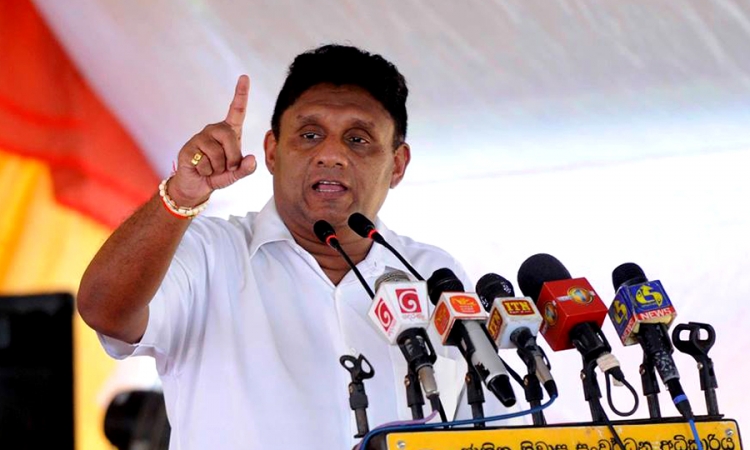
SJB Charts a Clear Alternative National Security Policy

ජනතා à·ƒේවයට මේà¶šà¶´් à¶¶à·„ිරව à¶»ූà¶´ à¶‘à¶´ා - සජිà¶­් (à·€ීà¶©ියෝ)
Photo courtesy of RUnews


HARIM PEIRIS-04/01/2021

Subsequent to the recent release of the report of the Presidential Commission of Inquiry on the Easter Attacks and after the UN Human Rights Council (HRC) in Geneva had passed a resolution highly critical of Sri Lanka’s current human rights situation, Opposition and SJB Leader Sajith Premadasa, speaking in Parliament has, on behalf of his Samagi Jana Balawegaya (SJB), articulated a clear national security and external affairs policy that offers a stinging critique of the ideologically driven and unsuccessful practices of the current administration and lays out a well thought out and centrist alternative on this important area of national life. The policy is noteworthy in that it is essentially a political counter offensive, taking on the Rajapakses in an area which they consider as their strong suit – that of national security and its counterpart, external affairs.

The foreign policy failures of the Rajapakse SLPP

Opposition Leader Premadasa clinically lays out the failures of the current administration. Firstly, he correctly points out that the UN High Commissioner’s report that created the basis for the HRC’s resolution focuses mostly on the current developments in Sri Lanka’s human rights situation after the November 2019 presidential election and much less on developments during war era. The report is not as much about the past as it is about the present. The focus and concern of the international community and the articulation of its responsibility towards conflict prevention is based on and focuses on the failure of Sri Lanka to create a just peace, rather than a critique of a justified war.

Looking at the voting patten in Geneva, where the SLPP Government’s position received just 11 votes, it was an all-time low for country specific resolutions on Sri Lanka. The lack of support was in large part due to the abstentions of Sri Lanka’s traditional friends in the international community, including India and the Muslim nations.

The centralization of state power through the 20th Amendment and the resultant weakening of state institutions that are required to be independent, together with the steady militarization of governance and the erosion of democratic space and freedoms, are all policy and political failures of the current Government. Sajith Premadasa forcefully and convincingly argued in parliament that these developments are not in the interests of either the majority community or for that matter even the minority communities in our diverse country.

The failures of the Presidential Commission of Inquiry on the Easter Attacks

The Leader of the Opposition was stinging in his critique of the Presidential Commission of Inquiry on the Easter Attacks and its report. Drawing comparisons with the US Commission of Inquiry on the 9/11 attacks, he pointed out that despite a period of nearly two years, the Sri Lankan Commission had failed to identify who were the masterminds or the key conspirators behind the attack. The informal nature of the crucial National Security Council (NSC), which is not a statutory body, was also criticized by Mr. Premadasa who proposed that the NSC be formalized through an enabling Act of Parliament and that a single coordinating center for the diverse security and intelligence agencies be created. He promised bipartisan support for any genuine national endeavors while criticizing the politicizing of security issues through ideologically driven unilateral actions followed by blaming regime opponents, as opposed to implementing genuine remedial measures.

Internal strife as a weakening of national security

Sajith Premadasa articulated a truism, widely recognized globally but completely ignored by this Government, that national security is multifaceted and not just based on military or defense policy alone. He argued on the need for economic security. But most importantly, the SJB leader argued forcefully that internal divisions, ethnic polarizations and communal strife cause a significant weakening of national security by alienating huge swathes of society from affinity to, identification with and loyalty towards, the Sri Lankan State. A state that is non inclusive and exclusionary weakens itself. Surely one of the biggest and most objectionable aspects of the LTTE, which we fought for decades to defeat, was its vision and desire for a mono ethnic Tamil state; one in which even Muslims were excluded. Surely having defeated the effort to create a mono ethnic Tamil state, we should hardly be moving in the direction of creating a mono ethnic Sinhala state in which Muslims and other ethnic and religious minorities are excluded.

Making a commitment to both devolution and accountability

The opposition and SJB Leader was bold in breaking away from the new dogma of the current Government, which is that even the currently constitutionally existing devolution of power to the provinces under the 13th Amendment is unwise and unnecessary and that there is no need for any accountability with regards to human rights. The SJB leader committed unequivocally to the implementation of the 13th Amendment to the constitution. A commitment to constitutional governance which would not be newsworthy or surprising except that the Government has repeatedly disavowed the same. Further, in recognition of the international and domestic requirement for accountability with regards to human rights violations, the Opposition Leader committed to an internationally credible domestic process of accountability with foreign observers and the required foreign technical assistance as well as the implementation in good faith of the recommendations of both Sri Lanka’s own LLRC and the Paranagama Commission reports. The significance of this policy, a relatively very centrist position, is a platform to create broad domestic and international consensus on the issues. On the contrary, as internationally observed and carefully documented by the UN High Commissioner for Human Rights, the current Rajapakse Administration has shown zero interest in either post war reconciliation, accountability, the protection of human rights or the promotion of fundamental rights and freedoms.

(The writer served as Advisor, Ministry of Foreign Affairs from 2016 to 2017)

 A Study On The Laws Related To Ragging In Universities In Sri Lanka


APRIL 1, 2021

Introduction

Ragging has not been a traditional event in Sri Lanka. It is an act that came into being during the colonial era. The concept was started when soldiers who fought in the Second World War returned to universities and continued the practice of ragging that they encountered at military camps. In military camps this is used to help soldiers succeed as a team but to fail individually. Following this tradition, civil students at universities still conduct the act of ragging. At the same instances ragging can be used as a mode of humor and a way to have fun; but, in the current context ragging has been used for students to let go of their frustration and cause harm and pain to others.

What is “Ragging”?

Ragging can be defined as the verbal, physical or psychological abuse that newly enrolled students undergo when entering universities in Sri Lanka. It is considered as a mechanism used to welcome new students or freshmen to universities by the immediate or very senior students of the university.

Consequences of Ragging

There are several outcomes when it comes to ragging. As it can be mental, physical or verbal the outcomes differ. As the capacity of tolerance of every person differs from one to another, the outcome of ragging too differs. At most, the toughest people often ignore the effects of ragging and are left tougher than ever before. It’s often those without a very strong level of tolerance and who are mentally vulnerable that succumb to the horrors of ragging. As these students are mentally vulnerable they indirectly allow others to take advantage of them and they do not often know that they are being victimized. Those who are mentally, physically and verbally abused would become afraid of their own shadow or decide to take out their frustration from their juniors or in worst case, the society and become misfits. They have a lack of self-esteem and self-respect. The physical abuse would often entail students to take part in rigorous physical punishments which are conducted in the most inhumane manner. These forms of ragging may result in students having various forms of anxiety, living in denial, shutting down mentally that could even lead up to death of some students.

Other than these consequences, ragging also often results in students leaving state universities without completing their education or even refraining from entering a state university. This would ultimately count as a huge loss to the government as well as the country as the government has spent a large amount of money to provide free education to these students who have worked hard and sacrificed a lot to gain university entrance and would have to ultimately leave university without completing their degree. When such a person enters the job market they often find themselves unemployed as most jobs require their employees to have a minimum qualification of a basic degree. Also students who have often qualified to read for a, for example a medical degree, if subjected to ragging and finds it unbearable and leaves university, would sometimes enter a private university and there this student would have to read for a degree of lesser importance than what he or she had qualified for.

In some universities there are faculties with movements known as “Anti-Ragging”. Often these students are shunned by other students of the university and they are assigned separate places an-d cornered by others.

Example: in the university of Peradeniya, students who are part of the Anti-Ragging movement are assigned a separate canteen and are called “Ala” in sinhala (à¶…à¶½ – à¶…à¶­à·„à¶»ිà¶± ලදී) meaning left alone. 

Purpose of Ragging

The ultimate purpose of ragging in universities in Sri Lanka according to the “raggers”, is to form a bond between the newly enrolled students and their seniors. In local university language this is called forming a “batch fit”. This act is also conducted to lessen the gap between the “rich” and the “poor” students who enter university. By ragging every freshmen or newcomer they hope to give the message that in this university “everyone is equal” and that there are no exceptions.

A survey was conducted among students of universities past and present, in order to get their views and ideas on this topic. A participant stated that most of this ragging is done by these raggers because, “they know they are nothing outside the campus.” This shows that ragging is conducted as a form of self satisfaction as well.

Students who rag others are victims of abuse. They have been in situations where they were once vulnerable. Either being victims of ragging themselves or having an abusive childhood. Due to such situations they develop an inferiority complex once they enter university and they manifest this through violence.

Alternatives to Ragging

As per the results of the survey several alternatives mentioned by the participants are found below.

* Having Socials ( Get-togethers)

* Parties, excursions, clubs and societies

* Talent shows

* Team building sessions

* Conducting special programs for new students which require voluntary participation

* Organizing sports events

* Organizing camps, workshops and leadership development projects.

* Having an English course for the first few months of university.

* Introducing subjects like communication skills which is interactive.

However, some students stated that there was no need for alternatives but the only solution was to eliminate ragging from universities.

Why do we Need Alternatives?

Read More

Value chain financing for MSE sector in SL: Effective impact and models to consider

Rose Priyani Fernando started her business last year. Facing numerous challenges due to the lockdown, the advance credit through the VCF intervention helped pay for necessary raw materials and transport of goods


Tuesday, 30 March 2021


The path to economic recovery ahead remains difficult and prone to global setbacks, and here in Sri Lanka the resurgence of the pandemic has shown just how difficult and steep the ascent to recovery can be. Not just large-scale businesses have been affected by the significant disruptions in their supply chains and financial losses. Small scale producers, those who operate at the very grassroots level and have fewer than 50 employees, have felt the impact adversely. 

Aiming to facilitate a pragmatic and effective approach to the operational and financial challenges that Micro, and Small Enterprises (MSEs) are facing, the International Labour Organization (ILO) introduced a value chain financing (VCF) model in Sri Lanka to help propel economic survival and revival. The VCF model thrives on a strong and mutually beneficial buyer-supplier relationship and can be adapted and implemented in any sector of the economy – be it manufacturing, agriculture or services. The ILO initially commenced a pilot VCF with the coconut and coir industry in Sri Lanka. 

Here are some insights into the VCF model, the ILO’s approach and how this aims to help MSMEs build back better. 


The impact on Micro and Small Enterprises (MSE) sector in Sri Lanka 

The onset of the pandemic triggered an economic downturn, which has negatively impacted MSEs across Sri Lanka. A large number of players in the MSE sector rely on a steady stream of cash to operate their businesses effectively. The lockdown(s) brought many a business operation to a halt, resulting in the lack of working capital. A significant proportion of MSEs in Sri Lanka struggled to secure working capital through more formal channels for a number of reasons, including a lack of credit history or a poor credit rating or an inability to offer collateral. 

In searching for effective measures to help MSEs re-start and/or continue their business operations, the ILO introduced a model for value chain financing; an effective and pragmatic approach to providing business owners with access to sufficient working capital. 

Ranjith from Tharana Udawela, Kurunegala, hopes to use funds received from the ILO to increase occupational safety and health standards at his business and construct a cement floor for drying coco peats

Thus far, the ILO has been engaging with 93 raw husk processing suppliers which has resulted in benefits to over 1,000 working people out of which approximately 50% are women

What exactly is Value Chain Financing? 


The basic premise of VCF pivots around the strength of the buyer-seller relationship. In fact, success depends on the ‘trust’ that both parties build working together toward mutual economic benefit. 

VCF ensures that sellers receive necessary working capital from their buyers which comes as a loan to allow them to produce the products. Later, the loan amount is settled in full or adjustments made while selling these products to the buyer. Generally speaking, there are two forms of value chain financing; direct and indirect. In the latter, financial institutions such as banks are the source of providing a loan or credit-line to micro and small-scale businesses on the strength of their buyers’ reputation. For example, if the small business in question is involved in the apparel value chain, a financial institute would offer credit to the business if a reputed buyer from the apparel industry having commercial transaction with the financial institute vouches for the business. 

In general, VCF is a tool used to increase returns for all stakeholders and growth and competitiveness along the supply chain. In Sri Lanka, the VCF model is practiced in a somewhat informal and ad hoc manner, especially in the agricultural sector. But often value chain financing of this form is carried out in an exploitative manner, in which the buyers (commonly known as middlemen) exploit the farmers. 

The pandemic triggered downturn in MSE activities and access to working capital urgently called for a much better, more comprehensive and reliable model of value chain financing. One where their vulnerability does not lead to exploitation and indebtedness. 


Implementing the Value Chain Financing Model in the coconut and coir industry 

The intention of introducing a viable VCF model in the coconut and coir industry has been to create a working model that can be applied to any sector where buyers have a strong dependency on producers for supplies.  

Having had a number of years of exposure to the industry though collaboration with the Coconut Substrate Exporters Association of Sri Lanka, the ILO approached industry members who were willing to advance credit to their MSE raw husk processing suppliers with the intention of receiving inputs they need to continue their exports. Four of Sri Lanka’s largest coir and coconut related product exporters partnered with the ILO to move forward with this initiative. 

The partnership guaranteed that the ILO would cost share an equal amount of any loan that the company would provide to the MSE supplier as a grant, to be used for improving Occupational Safety and Health and working conditions, machinery acquisition or similar capital investment at the suppliers’ level. Accordingly, both MSEs and buyers would benefit from the resulting improved business conditions and quality of the products. Thus far, the ILO has been engaging with 93 raw husk processing suppliers which has resulted in benefits to over 1,000 working people out of which approximately 50% are women. 

At its core, value chain financing provides an alternative but effective financing model for micro and small businesses, which often remain outside the target of the formal financial sector. A very encouraging aspect is that this model can be adopted and replicated in any sector with strong buyer-seller relationships. 

This VCF intervention is part of an ILO-led initiative in Sri Lanka to facilitate the healthy socio-economic recovery of the Micro and Small Enterprise sector from the negative impacts of the COVID-19 pandemic. 

(The writer is Director, International Labour Organization, Country Office for Sri Lanka and the Maldives.)

 Tracing where the rot began of a righteous society

Sri Lanka from being a disciplined nation has moved towards becoming a country which doesn’t fear laws and regulations (AFP)   

 When we analyse what’s happening in social media circles there is confusion as to how to lead a righteous life. The law of the country must supercede all faiths 

 This is what’s happening in Sri Lanka regarding deforestation incidents in lands close to Sinharaja. There are so much lies out there; more than the number of trees that have been felled 

 When one walks along the sands of time historic records reveal that the Ceylonese of yonder were a well-behaved and cultured society 


1 April 2021

The general breakdown of law and order in the country is of great concern. Days ago we witnessed the beating up of a lorry driver by a law enforcement officer; all in broad daylight. The reason for the assault was the lorry driver knocking down another policeman who was on duty, on the road, close by. 

The video footage of the incident went viral on social media and some comments made by Facebook (FB) users clearly distort facts regarding the application of the law. FB users were quick to state that a civilian can defend him/herself in the face of an attack by a policeman. But the police spokesperson was quoted in national newspapers stating that a civilian can defend him/herself only if there is threat to ones life. 


When we analyse what’s happening in social media circles there is confusion as to how to lead a righteous life. The law of the country must supercede all faiths. But so many individuals with political clout have been acquitted of charges against them in court cases. At the same time individuals in the opposite camp have been hunted and the law has been applied in full force. The rules and regulations specified to deal with the COVID -19 pandemic are not followed despite most state institutes, including the one that handles public transport, being militarised by this government. 


There was one such post regarding the Sinharaja issue where a person was harsh on the much talked about nature lover Baghya Abeyratne. But there was a group of individuals who later made a claim that the person who made the harsh comments was maintaining a false FB account. Efforts made by nature lovers to save the forests are negatively impacted when such bogus posts are made


We see how bus operators are overloading passengers and not even maintaining hand sanitizer and a book to jot down names and addresses of commuters. 

The page one of newspapers highlight the wrong doings of laymen and also the questionable conduct of lawmakers. If one thought that the alleged Central Bank Bond issue was the mother of all financial frauds this regime produced the loss of income to the government by reducing import tax on sugar. 

And when the court verdicts drag and contribute to delays social media users are quick to form opinion. James Callaghan has been quoted in the book ‘the cult of the amateur’ saying, “A lie can make its way around the world before the truth has the chance to put its boots on’. 

This is what’s happening in Sri Lanka regarding deforestation incidents in lands close to Sinharaja. There are so much lies out there; more than the number of trees that have been felled. There is also little or no verifying of facts before posts are made on Facebook. There was one such post regarding the Sinharaja issue where a person was harsh on the much talked about nature lover Baghya Abeyratne. But there was a group of individuals who later made a claim that the person who made the harsh comments was maintaining a false FB account. Efforts made by nature lovers to save the forests are negatively impacted when such bogus posts are made. 


The book mentions that the first set of Justices of the Peace was appointed between 1802-1804. But the writer affirms that after the year 1977 people unsuitable for the post of ‘Justice of the Peace’ were appointed. Much of these were appointments made by politicians of the UNP Government in return for favours


Now the truth circulating regarding the coconut oil that’s being used in Sri Lanka is that its not healthy. Claims are being made that the coconut oil sold to consumers may contain an unhealthy carcinogenic agent called aflatoxin. This news is really going to affect upcoming avurudu (New Year) celebrations. The frying of oil cakes (Kevum) has been put aside till the authorities sort out this coconut oil issue. 

From money laundering to exporting heroin and ladies committing suicide because they can’t settle micro finance loans make borrowers be in two minds about whether to obtain a loan, use the ATM machine at banks (due to hacking) and be involved in fishing because the boats that carry the catch might be transporting illegal weapons and narcotics. 

It’s in this context that we must turn back the clock and trace the roots of these notorious Sri Lankans and see why they have turned to this state of living. When one walks along the sands of time historic records reveal that the Ceylonese of yonder were a well-behaved and cultured society. 

Deshakeerthi J Ranaweera in his book on the history of ‘The Justices of the Peace’ in Sri Lanka reveals that the Ceylonese at the time of British rule were a disciplined lot. He writes, “In 1865 in the month of June as many as 25,000 Buddhists had gathered in Anuradhapura to attend to a four-day Vesak celebration. The British Government appointed Government Agent in Sri Lanka had written to the England authorities stating how well-behaved the devotees at the gathering were. He had added that he didn’t have to use police force to control the crowd at any time. These devotees had ensured that the place was clean when they left. There had been a temple close by. The temple’s donation till contained 4000 silver coins and no one showed any interest to steal this money”. Going beyond this letter in Ranaweera’s book its literature also brings us information about the origins of the appointments of Justices of the Peace in Sri Lanka. The book mentions that the first set of Justices of the Peace was appointed between 1802-1804. But the writer affirms that after the year 1977 people unsuitable for the post of ‘Justice of the Peace’ were appointed. Much of these were appointments made by politicians of the UNP Government in return for favours. 

The President of this country appeared on national television recently and said that this is not an era where there are kings in this island and Maharajas existed in India and not in Sri Lanka. But during the ancient past the kings of ancient Ceylon appointed representatives to ensure law and order in the country. That system produced a disciplined society. But the creating of a parliament system and the adopting of the British Law gave all people of the country a level playing field which also opened the doors for unscrupulous individuals to assume political power. 

The parliamentary system, over the years, produced a method of applying the law in one way to those who walk the corridors of power and another way to those individuals who choose the truth over what’s false and wish to have a righteous society. The decline of discipline and the breakdown of a righteous society might have happened once the ‘Greens’ came to power.