Sri Lanka: One Island Two Nations

Search This Blog

Friday, 1 October 2021

Iceland Didn’t Tilt Left as Expected. A Socialist Reflects on the Election Loss.
Iceland flag

There are still lessons to be learned from the Socialist Party of Iceland's growing pains.

When the world was plunged into crisis during the global financial meltdown of 2008, Iceland was dubbed “the canary in the coalmine.” The country was hit hard by the crash, and Icelanders took to the streets almost immediately, demanding that their long-ruling conservative government step aside for snap elections. The movement succeeded in January 2009, leading to the first left-wing coalition government in Iceland’s history. Sweeping constitutional reform was subsequently put on the table. The canary sang of discontent with neoliberalism and the promise of a left-wing alternative years before the rise of socialist figures like Bernie Sanders in the U.S. and Jeremy Corbyn in the U.K.

Unfortunately, that alternative never emerged. The left coalition ruled as liberal technocrats implementing programs approved by the International Monetary Fund (IMF), and it never advanced constitutional reform through parliament despite a lengthy and inclusive drafting process that produced a draft constitution, which was widely approved by voters in a nonbinding 2012 referendum. When the next election came around, in 2013, the right was swept back into power on promises of mortgage debt relief that were branded as populist, but disproportionately benefited the rich. In hindsight, it was like the canary was trying to warn the rest of the world about the appeal of figures like Donald Trump and Boris Johnson in the face of ineffectual liberalism.

Unsurprisingly, that right-wing coalition angered voters by doing favors for special interests, like Iceland’s all-powerful fishing industry, and finally fell apart in 2016 when it was revealed that then-Prime Minister Sigmundur Davíð Gunnlaugsson was evading taxes. Another right-wing coalition government followed, but that rapidly collapsed in 2017, after it emerged that government officials did favors for a well-connected child abuser. Since then, Iceland has been ruled by a prime minster from the Left-Green Movement, Katrín Jakobsdóttir, in a coalition with the Independence Party, the conservative faction that dominated Icelandic politics during the rise of neoliberalism in the 1990s and 2000s. Iceland couldn’t seem to decide how to orient itself, years after it was hailed for questioning capitalist orthodoxy and declared a bellwether for doing so.

This year, it looked like Iceland was finally going to make a solid shift to the left. The Socialist Party, which was founded in 2017, was contesting its first national election on September 25 and polling well above the 5-percent threshold needed to win seats in Iceland’s parliament, the Althing. Members hoped this would be enough to influence coalition-building after the vote. The party had already built power by electing a member to Reykjavik City Council, Sanna Magdalena Mörtudóttir, who rose to prominence speaking eloquently of her struggles being raised by a single mother in poverty. The Socialists had also forged ties with the labor movement, in a country where organized labor and electoral politics are often viewed as wholly independent of one another. Most notably, party leaders include union organizers who revived labor militancy in Iceland after being elected to lead the second-largest union in the country, Efling, a trade association with a disproportionate number of low-income Icelanders and immigrants as members. In the past few years, strike action by Efling has won raises for service and municipal workers, and prevented employers from using the COVID pandemic from clawing back benefits won during these struggles.

“We told them: ‘Over our dead fucking body,’” Efling leader and Socialist Party founding member Sólveig Anna Jónsdóttir told Truthout. “Because we said, ‘We have this fucking worker power and we will use it if you take our precious money away.’”

But the Socialist Party performed worse than expected in the election, winning only 4.1 percent of the vote, and failing to send a single member to the Althing. In fact, only right-wing parties made gains, including the People’s Party, which is center-left on economic matters, but far right on immigration, and now controls roughly 10 percent of the seats in the Althing.

Mercifully, Iceland is only so capable of playing the role of the world’s canary. Left-wing movements recently made gains after elections in Germany and Norway. In Norway, a Marxist party, the Red Party, went from one to four parliamentary seats. But there are still lessons to be learned from the Socialist Party of Iceland’s growing pains. Jónsdóttir spoke with Truthout roughly 12 hours after polls closed to discuss what went wrong and how to go forward. The following are excerpts from our conversation, which have been edited for length and clarity.

Sam Knight: It’s the morning after the election. It didn’t go how Socialists were hoping, based on how they were polling. What do you think happened?

Sólveig Anna Jónsdóttir: I think in the end, what our biggest problem was is that we had no money. We are a grassroots party run by people donating their time and efforts, and we were up against many well-funded party machines. In the end, this is going to have a huge effect and it is, of course, anti-democratic as you well know. In America, money in politics is poison. The same applies here.

One other issue we were dealing with: The Socialist Party had this huge open political platform on Facebook with 11,000 members, many not in the party. It’s extremely active and everything is discussed. The rules are not strict about content. Of course, racism and such are not allowed, but freedom of speech is practiced very extensively there, and it kind of gave off this negative vibe. The other parties are much stricter about ruling content in their name, whereas the Socialist Party is not, which can be both good and bad.

Number three: The party was not able to come across as the democratic element for marginalized groups. There are many reasons for that. One of the reasons is that there is a party here called Flokkur Fólksins, the People’s Party. They’ve been dealing with a lot of difficulties, but they have a very charismatic leader, a woman called Inga Sæland, who has gained the trust of marginalized groups here.

Also, part of the issue is that the people here in Iceland who have suffered the most because of COVID are foreign workers. We have a huge influx of foreign workers. They get the worst deal, and are stuck in the rental market, with prices disgustingly high because the market has literally been given over to the capitalist class, which was one of the hideous results of the 2008 crisis. These people are low-income workers, and very few of them can actually vote. They are here, they are the engines of the GDP, but they remain marginalized.

There’s also the extreme power of right-wing media in Iceland. Two of the biggest print papers are owned by ferocious right-wing capitalists who are totally willing to do whatever it takes. It’s a complex matter.

There is a tragic element to this: The socialists were organizing some of the most marginalized workers in Iceland, immigrants who can’t vote. Then the People’s Party, which is anti-immigrant, ends up doing better than expected.

It’s an interesting party because it has this charismatic leader who I like when she talks about issues facing the poor in Iceland, the marginalized people who are forced to live on disability payments, poor older people and children. But the party has this very real petit bourgeois element there, which is reactionary in many ways, which I do not see doing any good.

But I should add this: You have in Iceland people who are born poor here. They live in this rich society. They are surrounded by great material wealth, but from the moment that they enter this world until they leave it, they are in dire straits. You have childhood poverty here. You have people living in housing not fit for human dwelling, and children who are living in such bad housing that they don’t even have access to showers. So these people, when they hear someone talk about their plight in such a convincing manner, as she does — these people, they are not racist, and they are not necessarily anti-immigrant. Low-income Icelanders are the ones working side-by-side with immigrants. That was my experience. But the party has drawn into its orbit people who are shit people. That’s the way it is.

My understanding of labor unions in Iceland is that for a long time, they have kept out of parliamentary politics, and the Socialist Party broke that mold. How do you think that was received?

It is widely known that in Iceland we still have a strong union movement, and that a huge percentage of people who work for a living belong to unions. But this only tells part of the story and we need to be careful not to be flippant when we talk about this. Yes, we have a very large union movement. But, in that movement are people from all walks of society: people who have the lowest pay, people who are at the bottom, and then you have people who I don’t think would be called workers anywhere else in the world — men who have very high income, mostly men who have a learned trade and are firmly positioned in the middle class, with all of the good stuff that entails. We also have educated people with university degrees. So, it’s a very complex, huge movement and therefore it doesn’t have a single political will. It is unified on certain issues, like needing to protect the workers’ movement because that is our strength, and we can band together to fight on certain things. But when you get down to the nitty gritty, quickly these class struggles within the movement become extremely real. I have experienced that myself. When I started in the movement, I knew that would be the case, but I was still surprised by how real it is. In the end, it is surprising that we can still band together and fight on certain important issues. But it is a complex movement, and the Socialist Party still needs to make more inroads.

Do you think one of the reasons why the labor movement in Iceland has conservative tendencies is that the labor movement has taken itself out of party politics for so long?

One of the big reasons is that the leadership of the movement, and how it worked on political matters was very professionalized. For example, Efling was this big union, and quite powerful within the movement just because of its size. But when I was working in the care sector as a low-income woman, never did I feel there was any possibility of any radical activism, working-class, labor struggle stuff. There was no interest in mobilizing and organizing within the low-income workers, the true working-class people.

Instead, the union movement had totally, or almost totally, gone into this professionalism: “We all need just to work together, there is just a certain amount of GDP generated, there is this one cake, and we all need to get together and figure out who will get what slice, and if workers will get too big of a slice, inflation will follow blah blah blah.” And this was never actually even debated with workers themselves. There was a very elitist group of people who saw, as their primary function, to protect stability. This reasoning has especially been used since the crash.

Because the working and low-income people were so marginalized and so powerless, there was never any opportunity for them to say, “Your stability rests on my instability,” and the movement was just perfectly fine with this. So not only was the movement elitist and professionalized, but also just incredibly undemocratic. That was where we were. That is what we are trying to change. We have made great inroads, but like you can imagine, it’s not a simple task.

Can you briefly talk about the history of the Socialist Party in the context of the 2008 crash? It’s interesting that the party wasn’t founded until nine years after. It almost seems like the party was established because during the recovery, society was fragmenting. The gap between the haves and the have-nots was widening when there were years of austerity.

In that aspect, you can say the Socialist Party is directly the offspring of the crash. In the years following, what happened politically was that we had a group of people who were economically affected in a very serious manner. Workers like myself, for example. I was working in the care sector when austerity hit us. I know what it’s like to work in an already-underfunded workplace and then you also have to implement bullshit austerity rules that make your life more shit. You also have people who are maybe not personally experiencing the hardship of the crash — austerity, and the trouble that followed — but who realized how some elements in Icelandic society had just corrupted and taken over so much.
In that way, the Socialist Party is the coming together of these various elements: people who already had a Marxist socialist analysis of power dynamics and wealth, and working-class people who themselves suffered, and people who have, because of what has happened in the past years, come to the conclusion through their analysis that only a socialist political and economic vision and movement can be the way forward for us to not live in this extremely wealthy society where still we have way too many people suffering because of political decisions.

What do you think that those of us outside of Iceland can learn from this most recent election?

I was so excited about what happened in Norway. There was this change, and not only did traditional left parties perform well, but the Red Party became a political machine to be reckoned with. I was very much hoping this would be the result here, that we would have a small left wave that would sort of force the middle parties to acknowledge that we need a more left-wing outlook on economic matters, tax matters and matters of economic justice, and that the Socialist Party would have a good solid election result that would give the party this power to take up this space with its analysis. This obviously didn’t happen.

What I think the lesson is: When you live in a class-based, capitalist society, the task of building up a socialist party and movement is very hard. It will not be done easily. That is the lesson that all socialists know, and the political environment we all live in. It’s no great astonishing insight. What we do now is we keep on going, we don’t give up. We understand what we did wrong, we learn the lessons, and we keep organizing. This is what we will keep on doing.

In the end, that is the only thing that works. Just build the fucking foundation, lay the bricks, do the work, and don’t give up. Use the power and the willingness to work for a just society to propel you forward.

The next election, four years away, is a long time, but getting into parliament is only one part of the big struggle. It is, of course, extremely important because that’s where you get the platform, that’s where you get access to lots of stuff, but it is only one part, and in the end, it’s not even the most important part.

 

Concerns grow over Poland’s treatment of migrants stuck at Belarus border

Warsaw defies critics to extend state of emergency as it seeks to portray migrants as dangerous

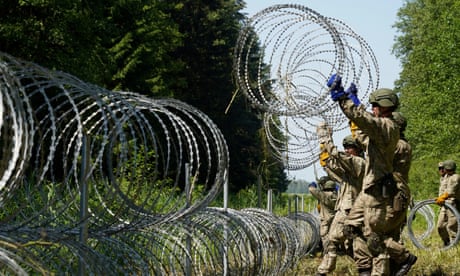
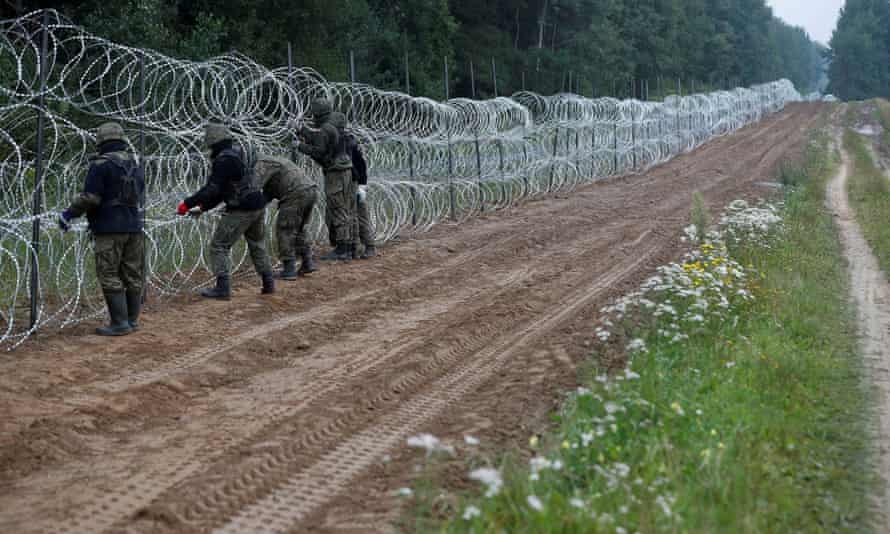
Polish soldiers build a fence on the border with Belarus.

Polish soldiers build a fence on the border with Belarus. Photograph: Kacper Pempel/Reuters

 Europe correspondent-@jonhenley-Fri 1 Oct 2021

Concerns over Poland’s treatment of migrants stranded on its border with Belarus are mounting after Warsaw this week ignored domestic and international criticism to extend a state of emergency and sought to portray them as dangerous deviants.

The European commissioner for Home Affairs, Ylva Johansson, met the Polish interior minister, Mariusz Kamiński, in Warsaw on Thursday night but won no concessions on the bloc’s request for monitors from the EU’s Frontex border force to be allowed into the zone, despite growing fears for the migrants’ safety after the deaths of at least five people.

Poland has sent thousands of troops to the border, built a razor-wire fence along part of its length, and on Thursday extended its state of emergency, which bars journalists and aid workers from accessing the 3km-deep strip, by a further 60 days.

Aid groups have accused the national-conservative government of illegally turning back migrants and failing to provide medical support or adequate food and shelter. Amnesty International says an analysis of satellite imagery and other photos and videos showed evidence of at least one such pushback in August.

The human rights body said on Thursday the 32 people were in Polish territory on 18 August but back on the Belarus side of the border the next day, possibly “constituting evidence of an unlawful pushback, because it appears to have occurred as armed Polish border guards surrounded the refugees’ camp”.

Forcing people “who are trying to claim asylum [back across the border] without an individual assessment of their protection needs is against European and international law”, said Eve Geddie, Amnesty’s EU director.

There was no immediate reaction from the nationalist Polish government, which has repeatedly said the migrants are not refugees but part of a “hybrid warfare” campaign being orchestrated by Belarus in retaliation for EU sanctions, insisting it is defending not only its border but the bloc’s.

 
Lithuanian army soldiers installing razor wire on the border with Belarus in Druskininkai last month
Latvia and Lithuania act to counter migrants crossing Belarus border
Read more

Poland, Lithuania and Latvia have reported sharp increases in migrants, mainly from Afghanistan and Iraq, crossing from Belarus since the sanctions were imposed on the authoritarian regime of President Alexander Lukashenko.

The three EU states accuse Minsk of encouraging migrants to fly to Belarus on tourist visas and then travel onward – often aided by smugglers – to the border. Poland says 11,500 people have tried to cross the border illegally so far this year, including 6,000 in September, compared with about 100 for the whole of last year.

Stanisław Żaryn, a spokesperson for Poland’s special services, said: “Poland is of the opinion that only by thoroughly securing our border with Belarus are we able to stop this migration route, which is a route artificially created by Lukashenko with [Russian president Vladimir] Putin’s support.”

The government has also sought to portray the migrants as potentially dangerous radicals and criminals. Kamiński and Poland’s defence minister, Mariusz Błaszczak, this week showed journalists extreme pornographic images that they said had been recovered from migrants’ mobile phones.

The images were later found to be old and available on the internet, sparking outrage from normally pro-government media and accusations of “lies and manipulation” from opposition politicians. The Rzeczpospolita newspaper said in an editorial the press conference was “a scandalous spectacle”.

The photos, which included images of bestiality and naked children, were “supposed to humiliate the migrants, dehumanise them, and to kill citizens’ belief that they were creatures that should be treated humanely”, the paper said.

“They were supposed to sow fear, hatred, and appeal to racist stereotypes … In a civilised society, even political cynicism should have its limits. The ministers have damaged not only their own credibility, but also that of the Polish state.”

Up to six people had died of hypothermia and exhaustion in the border zone in the past two months, officials said.

The Ocalenie foundation, a Polish migrant aid NGO, asked Johansson before her meeting with Kamiński to use “the voice and authority of the EU” to ensure Poland “respects international law and upholds democratic values”.

Lukashenko was “playing a cynical game”, the foundation said, “but we refuse to accept that Poland – a member state of the European Union for 17 years – is using equally inhumane tactics” in a “humanitarian crisis on the bloc’s eastern border”.

Kamiński tweeted after the meeting that the two sides had agreed that Belarus’s actions must meet with a firm response from the EU member states, adding that Poland had been “actively cooperating with Frontex since the beginning of the crisis”.

The EU commissioner said the talks were open and frank and that the “Lukashenko regime’s aggression deserves a firm and united response from the EU”, but Poland “can show that the capacity to protect the border can be matched with the ability to respect EU fundamental rights and obligations”.

A delegation from her home affairs and migration department would visit Poland next Wednesday for more discussions, Johansson said.

Why India Won’t Ease the Afghan Refugee Crisis

New Delhi once rolled out the welcome mat for those fleeing its neighbors. What happened?

Afghan refugees in Pakistan

Afghan refugees rest in tents at a makeshift shelter camp in Chaman, Pakistan, near the border with Afghanistan, on Aug. 31. -/AFP VIA GETTY IMAGES
 

In 1947, when the British partitioned their Indian empire into two dominions, about 14 million people felt compelled to migrate across the newly formed borders of India and Pakistan. Amid intense interreligious violence, Muslims fled to Pakistan, while Hindus and Sikhs escaped to India. Despite limited resources, the fledgling government of then-Indian Prime Minister Jawaharlal Nehru acted quickly to resettle this vast uprooted population, deeming it essential to provide assistance to those who had lost their homes and livelihoods.

The welcome mat Nehru extended to refugees in the wake of the Partition served as a template for subsequent governments in the second half of the 20th century. But in recent years, this tradition of helping those seeking shelter has been cast aside with the ascendance of the Hindu nationalist Bharatiya Janata Party (BJP). From the Rohingya fleeing genocidal violence in Myanmar to the current plight of Afghans seeking to escape the Taliban regime, Prime Minister Narendra Modi’s government now appears not to care about the plight of refugees in its neighborhood.

For decades, India welcomed waves of refugees with open arms. After the 1959 Tibetan uprising against communist rule, New Delhi not only granted the Dalai Lama asylum but also took in thousands of Tibetans fleeing Chinese repression, leading to a significant diaspora community in India. The Dalai Lama remains in the north Indian town of Dharamshala with his loyal entourage. Apart from limiting Tibetan political activism out of fear of provoking China, successive Indian governments have allowed the community to thrive.

All that said, India did not sign the 1951 Refugee Convention because it said it would threaten its sovereignty, and it did not endorse a 1967 amendment to the convention on similar grounds. Meanwhile, Nehru’s India was less welcoming to immigration when it came to members of the Indian diaspora requesting to return, especially from the Caribbean. As they were not refugees facing persecution, Nehru’s government encouraged them to remain in the West Indies while they sought citizenship instead.

India’s most generous moment came in the wake of the East Pakistan crisis of 1971, when close to 10 million Bengalis fled into India to escape the brutal repression of the Pakistan Army. With limited international humanitarian assistance, India provided for these victims of military brutality for more than six months, regardless of their religion. (Many of those who fled the violence were Bengali Muslims.) India intervened in the Bangladesh Liberation War in December 1971, leading to Pakistan’s surrender. The majority of the refugees who fled to India ultimately returned to the new state of Bangladesh.

Although Pakistan absorbed the bulk of the refugees in the wake of the Soviet invasion of Afghanistan in 1979, India also accommodated a smaller number. Later, as a civil war racked Sri Lanka in the mid-1980s, India took around 30,000 Tamil refugees, and members of the group have continued coming in the years since. There have been allegations of mistreatment of Tamil refugees in camps in southern India. Those issues aside, New Delhi’s stance toward refugees from the region had long reflected a generous capacity for humanitarian action.

So then what explains the shift in New Delhi’s stance toward refugees? One can find the answer in the politics of the ruling BJP and the changing domestic political climate. To varying degrees, past Indian governments committed to a vision of a pluralist and civic state and felt compelled to provide a safe haven to refugees—regardless of their ethnicity or religion—to live up to these principles. The Hindu nationalist BJP, especially under Modi’s leadership, no longer appears to believe in adhering to those norms.

Far from welcoming refugees, Modi’s India has sought to slam the door shut. The BJP government displayed stunning callousness when members of the Rohingya Muslim minority sought refuge in India from the Myanmar military’s campaign of terror in 2017. India refused to grant refugee status to the Rohingyas and even deported seven Rohingya men in October 2018, threatening to kick out thousands more. The government’s justification for this inhospitable policy was that supposed terrorists would enter India under the guise of seeking asylum. The Modi government’s policy toward refugees has frustrated other South Asian states, particularly Bangladesh, which hosts over 1 million Rohingya refugees.

Anti-China rhetoric taking world along dangerous path

modi
 

Currently, there is a build-up of anti-China sentiment among sections of world opinion and this could have grave implications for international peace unless skillfully defused. This opinion trend, which is being amply aired by some Western media organizations, is particularly pronounced among the political Right of the West and some of their counterparts of the global South.

The immediate backdrop to these disquieting developments is the recent coming into being of Western-dominated groupings, such as the Quad and AUKUS, that have a marked security and defense orientation. The decision by the US and the UK, for example, to support Australia in the development of nuclear-powered submarines, which is a cornerstone of the AUKUS pact, contributed in great measure to spike tensions between the dominant powers of the West and China.

This decision is strongly backed by elements of the political Right in the US and the UK who see in it an effective counter-thrust to China’s perceived high military presence in the Asia-Pacific region. The dominant opinion among these sections is that the military threat seen as being posed to Western interests in the region should be strongly countered by effective military counter-measures, such as the arming of Western ally Australia. It may be tacitly understood that the US and the UK would go to Australia’s defense in the event of the latter facing a military threat from China. In the process, the ANZUS treaty, brought into existence some decades back featuring the US, Australia and New Zealand is being overshadowed.

However, what is bound to compound China’s security worries is the Quad grouping, bringing together the US, Australia, India and Japan, which, although having all the appearances of an economic cooperation bloc, is really aimed at blunting the Chinese military and economic presence in the Asia-Pacific. For example, on their meeting in Washington on September 24, in an in-person summit, the Quad leaders said in a joint statement, among other things, that they are for, ‘promoting the free, open, rules-based order, rooted in international law and undaunted by coercion….We stand for the rule of law, freedom of navigation and overflight, peaceful resolution of disputes, democratic values and territorial integrity of states. ‘


It ought to be plain to see that it is China that is targeted through such pronouncements. Besides being an anti-democratic, totalitarian communist state, China is seen as working towards some of its territorial and economic ambitions in the South and East China Seas in particular. It is seen as having taken the extreme measure of building artificial islands in these areas, parts of which are strongly contested by some neighbouring states.

The general perception is that China is moving towards annexing Taiwan, which is important for it from both the strategic and economic viewpoints. However, this makes Taiwan a potential arena of confrontation between the West and China. Decisive moves by China to seize control of Taiwan would confront any US administration with the grim challenge of making good the US boast of being a champion of the ‘free world ‘.

China, for its part, has been doing its own sabre-rattling over the months to escalate the Cold War between it and the West. For instance, Chinese President Xi Jinping said on the occasion of the 100th anniversary of the Chinese Communist Party: ‘We have never bullied, oppressed or subjugated the people of any other country and we never will. By the same token, we will never allow any foreign force to bully, oppress or subjugate us. Anyone who would attempt to do so will find themselves on a collision course with a great wall of steel by over 1.4 billion Chinese people. ‘

Right now, China is showing a marked preference for economic instruments to further its national power. Thus far, military intervention has not been an option for it in this quest. For example, the Belt and Road initiative is essentially all about China utilizing economic means to bolster its power. And in so far as the means used is economic none can fault China.

But China is unlikely to look on passively if its interests are dangerously undermined in Taiwan or Hong Kong. China has been accused by Taiwan, for instance, of having violated its airspace several times in recent times. China would be using its military muscle to quell rebellions in the mentioned territories that show signs of growing out of control and such developments could have serious implications for world peace. This is because the Western powers would consider it to be in their interests to intervene in Taiwan and Hong Kong, which are at the heart of the coveted Asia-Pacific.

Accordingly, the stakes are high for all concerned in the current stand-off between the West and China. Excessively aggressive moves by any one of these parties could prove catastrophic for the world because all the major powers involved are nuclear-armed and they all seem to be protecting their interests with immense jealousy. Once the nuclear button is pressed in a state, there would likely be a series of nuclear blasts in chain reaction form among the relevant powers.

At first blush it may seem that China could quite easily take on the West. But it would need to constantly look over its shoulder at India, which is on a steady course of arming itself formidably and that too by using indigenous resources. For instance, preparations are underway by India to showcase its nuclear-capable Agni-5 missile with a strike range that ought to have China worried. This ICBM ought to tilt the global power balance in the Quad’s favour.

However, the experience of the world, post-World War Two, is that maximum restraint will be exercised by the nuclear powers in the face of even the gravest international tensions and provocations. That is, the nuclear capability has been used as a deterrent thus far and it is difficult to see it being put to active use in even a regional war.

Considering the unthinkable consequences it could have for the world it is difficult to see any of the nuclear powers pressing the nuclear button with even a rush of blood to the head. But the need is great to cool tempers by shelving pro-war rhetoric by all quarters concerned. A meeting of minds could do everyone immense good.

 China’s new reality is rife with danger

The president will be defined by his campaign against his country’s capitalist excesses


Xi Jinping’s campaign-
Oct 2nd 2021 

Xi jinping is waging a campaign to purge China of capitalist excesses. China’s president sees surging debt as the poisonous fruit of financial speculation and billionaires as a mockery of Marxism. Businesses must heed state guidance. The party must permeate every area of national life. Whether Mr Xi can impose his new reality will shape China’s future, as well as the ideological battle between democracy and dictatorship.

His campaign is remarkable for its scope and ambition. It started to rumble in 2020, when officials blocked the initial public offering of Ant Group, an affiliate of Alibaba, a tech giant. It is thundering onward, having so far destroyed perhaps $2trn of wealth. Didi, a ride-hailing outfit, has been punished for listing its shares in America. Evergrande, an indebted property developer, is being driven towards default. Trading on cryptocurrency exchanges has been banned as, more or less, has for-profit tutoring. Gaming is bad for children, so it must be strictly rationed. China needs larger families, so abortion must become rarer. Male role models should be manly and celebrities patriotic. Underpinning it all is Xi Jinping Thought, which is being drummed into the craniums of six-year-olds.

This comes on top of an already brutal authoritarianism. As president, Mr Xi has purged his rivals and locked up over 1m Uyghurs. He polices debate and will not tolerate dissent. The latest campaign will show whether he is an ideologue bent on grabbing power for himself, even if growth slows and people suffer, or whether he is a strongman willing to temper dogma with pragmatism. His vision, in which party control ensures that business is aligned to the state and citizens dutifully serve the nation, will determine the fate of 1.4bn people.

Mr Xi is tackling real problems—indeed, many of them have parallels in the West. One is inequality. The slogan of the moment is “common prosperity”, reflecting how Communist China remains as unequal as some capitalist countries. The top 20% of China’s households take home over 45% of the country’s disposable income; the top 1% own over 30% of household wealth (see Free exchange). Another concern is the clout of tech giants accused of unfair competition, corrupting society and having unfettered access to personal data (only the state has that privilege). A third is strategic vulnerability, particularly the threat that adversaries will obstruct access to commodities and vital technologies.

Yet Mr Xi’s campaign poses a threat to China’s economy. Pain from unravelling the debt of firms like Evergrande could spread unpredictably. Property developers are sitting on $2.8trn of borrowing. Property development and the industries that cater to it underpin about 30% of China’s gdp. Households have parked their savings in real estate partly because other assets offer a poor return. Households’ spending on unfinished property accounts for half of developers’ funding. Local governments, especially outside the big cities, depend on land sales and property development to generate revenue.

The crackdowns are also making business harder and less rewarding. The party had been creating a regulatory and legal framework, but Mr Xi is imposing big top-down changes so fast that regulation has started to seem arbitrary. Consider, for example, “tertiary redistribution”, in which shamed tech companies hand over cash to the state in an attempt to redeem themselves.

Because conspicuous success is dangerous, private companies will be more cautious. State-owned firms and strategic industries—including “hard-tech” such as semiconductors—may benefit, but not the entrepreneurs who have been the true source of China’s dynamism. One measure of anxiety is that foreigners, who are not bottled in by capital controls, pay 31% less than mainland investors for identical Chinese stocks. The gap has grown sharply since early 2020.

All this threatens to puncture China’s economy. It was already facing a squeeze from declining returns to infrastructure investment and the effects of a shrinking workforce and growing numbers of aged dependents. After 40 years of breakneck expansion, most Chinese are completely unfamiliar with the hard choices that a sharp, sustained slowdown will impose.

In politics the danger is that Mr Xi’s campaign degenerates into a cult of personality. To bring about change, he has grabbed more power than any leader since Mao Zedong. As he prepares to break with protocol at the Communist Party’s 20th congress next year by claiming a third five-year presidential term, he is using the campaign to organise a huge turnover in personnel, as the basis for an ideological crackdown and as the reason why he should remain at the helm. Each of these contains dangers.

One is that the bureaucracy fails him. Mr Xi wants it to be responsive to market signals, but with promotions and purges in the air, China’s officials are jumpy. One cause of the power cuts in 20 or so provinces in recent weeks was the panic of bureaucrats who suddenly realised that they were likely to miss their carbon-reduction targets. Equally, however, officials fearful of being accused of corruption or ideological deviance by their rivals tend to sit on their hands. Failure is dangerous for a bureaucrat who takes the initiative; so is success.

Another danger stems from the ideological crackdown. “Moral review councils” and “moral clinics” are enforcing orthodox behaviour using public shaming. Although there is as yet no prospect of anything as awful as the Cultural Revolution, Chinese people are becoming less free to think and talk. As well as promoting his own doctrines, Mr Xi has played up Red nostalgia and cast Maoism as a vital stage in building a New China, broadening his support before the party congress.

Last come the politics of Mr Xi himself. In the long run, if he clings to power the succession could prove highly unstable. In the short run, if his attempt to impose a new reality does not go to plan, he will face a fateful choice to double down or step back. Up to this point, repression looks more likely than compromise.

Western governments are also struggling with tech firms, inequality and national security. In America Congress has risen to the occasion by contemplating a default on the national debt. Some may envy Mr Xi’s scope to get things done fast. But to imagine he has the right answers would be a big mistake. ■

This article appeared in the Leaders section of the print edition under the headline "China’s new reality"


North Korea Sends Confusing Signals: Dialogue or Tension?

This is not the first time the North has launched missiles or otherwise shown off its arsenal while suggesting that it was open to talks.

Watching a TV news report in Seoul on Wednesday about North Korea’s latest missile launch. The North tested another missile the next day.

Credit...Lee Jin-Man/Associated Press


By Oct. 1, 2021Updated 9:11 a.m. ET

SEOUL — The signals are confusing. One day, North Korea is ​​raising hopes for dialogue with South Korea, and the next, it is firing missiles or showing off the latest weaponry in its nuclear arsenal.

In the past week alone, North suggested the possibility of inter-Korean summit talks and said it would reopen communication hotlines with its neighbor. It also fired long-range cruise missiles, trotted out what it called ​its first hypersonic missile and, on Thursday, tested a new antiaircraft missile. Earlier in September, it launched ballistic missile​s​ from ​a ​train​ rolled out of a mountain tunnel, on the same day that it called the South’s president, Moon Jae-in, “stupid.” ​

Once again, North Korea is turning to a well-honed, two-pronged strategy, designed to let it flex its military muscles without risking retaliation or nixing the chances for dialogue.

In the absence of talks with Washington, the missile tests reminded the world that North Korea is developing increasingly sophisticated weaponry capable of delivering nuclear warheads. But individually, these short-range or still-under-development missiles don’t amount to a direct threat to the United States.

And North Korea has been careful not to go too far, refraining from ​testing a nuclear device or an intercontinental ballistic missile, which would jolt Washington into action with fresh sanctions or worse.

“North Korea is careful not to cross the red line,” said Yang Moo-jin, a professor at the University of North Korean Studies in Seoul. “Amid all these missile tests, North Korea is signaling that it is interested in dialogue.”

The North​’s favorite geopolitical game has been given various names, like the “hot-and-cold water bath” strategy. And it has served the regime well over the years, raising often-false hopes of peace while it continued to develop and test new weapons.

North Korea is now deploying that strategy at a complex diplomatic moment. Mr. Moon badly wants dialogue to resume on the Korean Peninsula, a last-ditch effort to cement his legacy before he leaves office in May. The Biden administration, though, is not as eager to engage the North.

President Moon Jae-in of South Korea with Kim Jong-un, the North’s leader, in 2018. Mr. Moon badly wants the Koreas to resume talks before he leaves office in May.
Credit...Pool photo by Korea Summit Press

Kim Jong-un, the North’s leader, now finds himself in a position to exploit that gap between the two allies.

He met with then-President Donald J. Trump three times between 2018 and 2019, becoming the first North Korean leader to hold a summit with a​ sitting American ​president. But ​his diplomatic efforts failed to lift crippling sanctions the United Nations imposed on his impoverished country after its nuclear and I.C.B.M. tests​. Soon the pandemic hit, further hamstringing the North’s economy.

​American and South Korean officials had hoped that the North’s deepening economic troubles, caused by the double whammy of sanctions and the pandemic, would make North Korea more amenable to dialogue.

So far, Mr. Kim has proved them wrong.

Since his talks with Mr. Trump collapsed in early 2019, he has vowed to slog through the economic difficulties while expanding his nuclear arsenal​, his country’s single best diplomatic leverage and deterrent against what it considers American threats to topple its government. By demonstrating his country’s growing military capabilities, Mr. Kim has also sought to legitimize his rule at a time when he has been able to deliver little on the economic front to his long-suffering people.​

The antiaircraft missile test on Thursday indicated that ​the North is building a weapon similar to Russia’s S-400, one of the most potent air-defense systems in the world, according to Kim Dong-yub, an expert on North Korean weapons at the University of North Korean Studies.

The Biden administration has repeatedly urged North Korea to​ return to talks without preconditions. But Mr. Kim said he would not restart negotiations until he was convinced that ​Washington was ready to ease sanctions and its “hostile policy,” including the joint annual military exercises it conducts with South Korea.

In his​ discussions with Mr. Trump, Mr. Kim ​also ​made it clear that he ​was more interested in talks to reduce nuclear arms than in complete denuclearization​. He offered a partial dismantlement of ​his country’s nuclear facilities​ if Washington lifted sanctions.​ Mr. Trump rejected the offer.

“The U.S. is touting ‘diplomatic engagement’ and ‘dialogue without preconditions,’” Mr. Kim told North Korea’s rubber-stamp legislature on Wednesday. “But it is no more than a petty trick for deceiving the international community and hiding its hostile acts.”

A uranium enrichment plant at North Korea’s Yongbyon nuclear complex, as seen in a September satellite photo.
Credit...Planet Labs Inc, via Associated Press

“North Korea isn’t interested in denuclearization talks to receive benefits for coming into compliance with U.N. resolutions,” said Leif-Eric Easley, a professor of international studies at Ewha Womans University in Seoul. “It seeks to rewrite the rules and be compensated for restraint as a nuclear power.”

All of this leaves the Biden administration in a difficult bargaining position. Washington ​is reluctant to engage the North​ if the country only wants to use dialogue to ease sanctions without giving up its nuclear weapons​. But not engaging also means wasting ​​opportunities to put the brakes on the North’s development of its arsenal​. It also runs the risk of sparking an arms race in the region.

Mr. Kim can’t really attempt shocking provocations like the ones he conducted in 2017 — three I.C.B.M. tests and a nuclear test — that brought the Trump administration to the table. Such tests would sharply raise tensions, invite more U.N. sanctions and potentially invoke the ire of China by ruining the mood for the Beijing Winter Olympics in February.​

A “peace park” in South Korea, near the Demilitarized Zone that separates the two Koreas.
Credit...Anthony Wallace/Agence France-Presse — Getty Images

So the question for Mr. Kim, analysts said, is how to force Washington to return to dialogue on his terms without angering North Korea’s traditional allies​,​ China and Russia​, whose help it needs to survive U.N. sanctions and rebuild its economy.

In the end, Mr. Moon’s government may provide the most promising answer for Mr. Kim.

Mr. Moon is desperate to put his Korean Peninsula peace process, his signature foreign policy, back on track before his single, five-year term ​ends ​in May.

“It’s our government’s destiny” to pursue dialogue with the North, Mr. Moon told reporters last week, referring to his efforts to build peace through his three meetings with Mr. Kim in 2018 and his efforts to help arrange the summit meetings between Mr. Kim and Mr. Trump.

This week, Mr. Kim also offered conciliatory words toward South Korea.

“We have neither aim nor reason to provoke South Korea and no idea to harm it,” he said.

North Korea was wooing South Korea while shunning talks with Washington, said Cheong Seong-chang, director of the Center for North Korean Studies at the Sejong Institute in South Korea. Other analysts said North Korea was leaning on South Korea to help bring Washington to dialogue.

Statues in Pyongyang, North Korea, of Mr. Kim’s grandfather, Kim Il-sung, left, and his father, Kim Jong-il. They preceded him as the North’s leaders. 
Credit...Korean Central News Agency/Via Reuters

On Thursday, Sung Kim, the U.S. special representative for North Korea, met with his counterparts from Japan and South Korea ​and indicated that ​Washington would support humanitarian aid to North Korea as an incentive for dialogue.

Analysis doubted that it would be enough.

“I am not sure that the old way of providing humanitarian shipments​ as an incentive​ will work this time, given the North’s reluctance to accept outside help ​during the pandemic,” said Professor Yang of the University of North Korean Studies. “North Korea wants the United States to address more fundamental issues ​concerning its well-being​. It wants clearer commitment​s ​from the United States to easing sanctions and guaranteeing its security.”

The World’s Top Coffee Producing Countries


The World’s Top Coffee Producing Countries

In many cities around the world, there’s a café on every corner, so it comes as no surprise that coffee is one of the globes’ top commodities. As the third most consumed beverage globally, after water and tea, coffee beans are in high demand almost everywhere.

The top producing nations each produce billions of kilograms of coffee beans that find their way into the hands of eager consumers. According to the International Coffee Organization, a total of 169.6 million 60-kilogram bags of coffee were produced worldwide in 2020.

So, why does the world universally love coffee so much?

For The Love of Coffee

As most coffee lovers would tell you, drinking coffee is a complex and nuanced experience—there’s the rich aroma, the comforting warmth, and the loveliness of the ritual of sitting down with a fresh cup.

With the variety of ways it can be served and the jolt of caffeine it provides us, it’s not hard to see why the world loves its coffee. In fact, we love the beverage so much that humans have conditioned themselves to associate the bitter taste of coffee with a bout of energy and positive reinforcement.

So, where does the journey of each cup of joe originate? Let’s get to know the world’s top coffee producing countries.

The World’s Coffee Production Leaders

At the end of 2020, the top 10 biggest coffee-producing nations held 87% of the commodity’s market share.

Here is a list of the top 20 largest coffee-producing nations in the world:

While some of the world’s top coffee-producing nations are well known, others may come as a surprise. More than 70 countries produce coffee, but the majority of global output comes from just the top five producers: Brazil, Vietnam, Colombia, Indonesia, and Ethiopia.

Meet the Top Coffee Producing Countries

1. Brazil

Brazil is a true powerhouse of coffee production. The country single-highhandedly produces nearly 40% of the world’s coffee supply.

Many areas in Brazil have a climate perfectly conducive to coffee farming. Coffee plantations cover about 27,000 square kilometers of Brazil, with the majority located in Minas Gerais, São Paulo, and Parana.

Brazil distinguishes itself from most other coffee-producing nations by drying the coffee cherries in the sun (unwashed coffee) rather than washing them.

The country is so influential to coffee production that the 60-kilogram burlap bags historically used to export beans from Brazil are still the worldwide standard for measuring production and trade.

2. Vietnam

Vietnam found a niche in the international market by focusing primarily on the less-expensive Robusta bean. Robusta beans can have up to twice as much caffeine as Arabica beans, giving the coffee a more bitter taste.

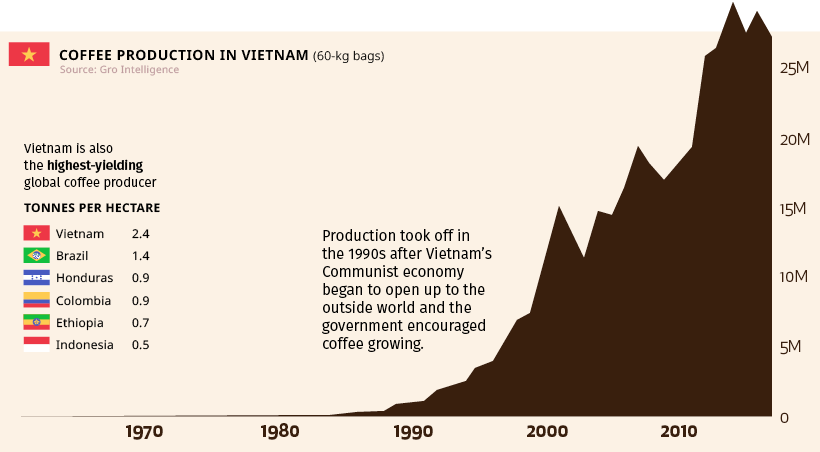
Though coffee has been grown in the region for well over a century, production skyrocketed through the 1990s after Vietnam’s communist government introduced economic reforms (known as Đổi Mới).

coffee production in vietnam

Today, Vietnam accounts for more than 40% of the world’s Robusta bean production.

Coffee cultivation in Vietnam is also extremely productive. The country’s coffee yields are considerably higher than other top coffee-producing countries.

3. Colombia

A popular advertising campaign featuring a fictional coffee farmer named Juan Valdez helped brand Colombia as one of the most famous coffee-producing nations. A coveted drink of choice, Colombian coffee is prized for its aromatic, mild, and fruity flavors.

4. Indonesia

Some of the rarest coffees in the Western world originate in Indonesia, including Kopi Luwak—a type of bean that has been eaten and defecated by the Asian palm civet. Coffee made from these coffee beans might cost you anywhere between $35 to $100 per cup.

5. Ethiopia

Known for its full-flavored, down-to-earth, and full-bodied coffee beans, Ethiopia is the country that gave us the Arabica coffee plant. Today this type of coffee is considered to be the most widely sold in cafes and restaurants across the world.

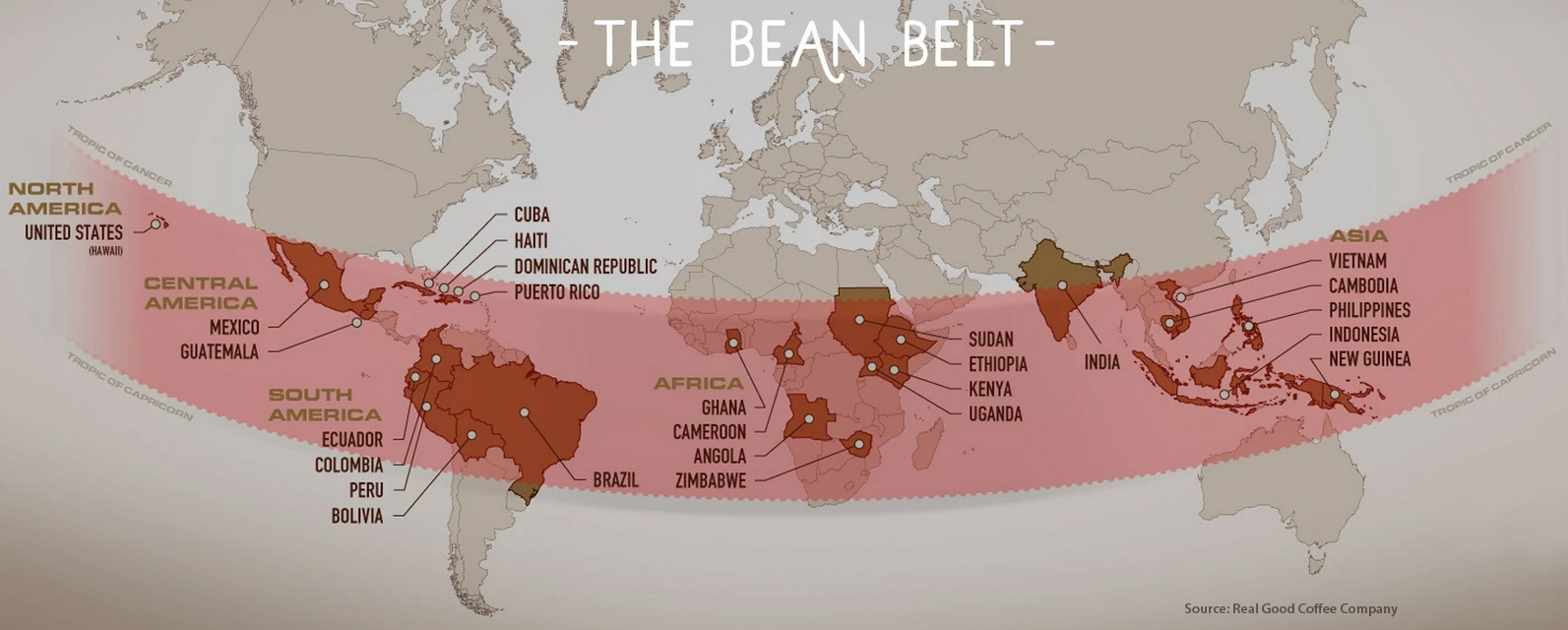
All of these top producing countries are found in the so-called “Bean Belt”, which is located between the Tropic of Cancer and the Tropic of Capricorn.

coffee bean belt

The Future of Coffee Production

With global temperatures on the rise, good coffee may become increasingly challenging to grow. To future-proof good and continued growth of coffee beans, finding newer and hybrid blends of coffee beans is essential.

Several studies and research missions have found wild species of coffee growing off the coast of Côte d’Ivoire and in certain regions of Sierra Leone, which could be the answer to our coffee production problems. Coffee from these coffee plants tasted similar to the famous Arabica bean and also grew at higher temperatures.

Though the future of coffee production around the world is somewhat uncertain, our collective love of the morning cup of coffee will drive innovative solutions, even in the face of changing climate patterns.


Of Indigenous Peoples, Environmentalism, and Atonement

Shoshone rock art, Lava Beds National Monument. Photo: Jeffrey St. Clair.


BY 

As America struggles with its history of systemic racism, the environmental movement faces questions of its own over the extent to which policies that were racist, genocidal, or entailed ethnic cleansing played a role in early American conservation. Much of the western United States is federal public land, but all of the United States was once Indigenous land, much of it continuously occupied for as much as 24,000 years. The lands that became our nation – public and private alike – were cleared of their native inhabitants through warfare, genocide, and removal.

Early conservation figures often reflected the racist views of their times. In most cases, lands protected for environmental conservation gained official designation long after their Indigenous inhabitants were exterminated or deported to reservations. Nonetheless, all of these lands were occupied at one time or another, sometimes continuously, by Indigenous cultures.

Today’s environmentalists are wisest when we approach this issue with humility, recognizing the original inhabitants’ relationship with the land, so much more mutualistic environmentally sustainable than our own. Certainly, Indigenous peoples set fires to improve hunting and habitat for game species, and in some North American regions even engaged in intensive crop farming and (here I include present-day Mexico) built complex cities. Overall, the native ecosystems and the biodiversity of native life that existed, for example, when the Lewis and Clark expedition crossed the Northern Plains, was far more diverse and abundant than anything we have seen since. With EuroAmerican settlers came market hunting, single-crop farming on a vast scale, deforestation, fires far beyond what the land had heretofore seen, predator extermination programs, fencing of open lands, acid mine drainage, invasive weeds, wagon roads and railroads and ultimately highways, and later powerlines and oilfields and strip mines. It was environmental devastation and extinction on a continent-wide scale, and the best efforts of environmentalists over the past two centuries have thus far succeeded in protecting or restoring only a tiny fraction in a relatively natural state.

The treaties emplaced, typically during the late stages of these campaigns against Indigenous peoples, to relegate them to reservations and cede the best and most productive lands to white settlers, were systematically violated by the federal government. Reserved lands were encroached upon, further invaded, or taken away. Promised annuities of foodstuffs were often of inferior (even worthless) quality, or purloined by unscrupulous Indian Agents. Reservation lands were forcibly allotted to impoverished tribal individuals so they could be sold to whites, and tribal mineral interests were mismanaged such that immense sums of royalty payments were withheld. Tribes lacking treaties were deprived of both lands and rights, and sometimes “terminated,” losing federal recognition. These widespread violations of treaty agreements by the dominant culture reduced the legal process of cession of Indigenous lands to a swindle.

“Genocide” officially means any of the following acts committed with intent to destroy, in whole or in part, a national, ethnical, racial or religious group: Killing members of the group; causing serious bodily or mental harm to members of the group; deliberately inflicting on the group conditions of life calculated to bring about its physical destruction in whole or in part; imposing measures intended to prevent births within the group; and/or forcibly transferring children of the group to another group. There can be no doubt that Indigenous peoples in North America were subjected to genocide by the United States government and its citizens, with repeated appalling incidents including the following:

+ The 1856-1859 Round Valley Massacres in California, in which white settlers staged unprovoked attacks against the Yuki inhabitants of Round Valley in present-day Mendocino County, including abductions into slavery, extirpating the entire tribe of 16,000-20,000 people. The attacks came after the California Governor called in 1851 for a “war of extermination” until “the Indian race becomes extinct.” The State of California recently officially recognized these events as genocide, and offered apologies.

+ The 1863 Bear River Massacre, in which a militia staged a January attack against a starving camp of Shoshone in Idaho’s Cache Valley, killing as many as 493 people.

+ The 1864 Sand Creek Massacre, in which a Colorado militia led by John Chivington surprised at dawn a peaceful camp of Cheyenne and Arapaho, attacking them in their tipis and slaughtering most of the entire group. They were flying a white flag of truce, showing they were there by executive agreement. The militia gutted pregnant women and smashed the baby’s heads, cut the testicles off some of the men and the breasts off of women, and used them as saddle decorations.

+ The 1868 “Battle of the Washita,” in which the U.S. 7th Cavalry attacked the camp of Cheyenne, Arapaho, and Lakota led by Black Kettle, while they traveled to a reservation.

+ The 1870 Marias Massacre, in which the U.S. 2nd Cavalry attacked a camp of Piegans led by Heavy Runner, who was considered peaceful and carrying an official letter of safe conduct from the U.S. government. The Indigenous camp on Montana’s Marias River was attacked while asleep, and an estimated 200 men, women, and children were killed.

+ The 1890 “Battle” of Wounded Knee (more properly termed the Wounded Knee Massacre), in which U.S. 7th Cavalry attacked, without provocation, a band of peaceful Lakotahs as they traveled across their own Pine Ridge Reservation. The Cavalry surrounded and annihilated the band, killing at least 250 men, women, and children.

Don’t doubt it, genocide took place right here on American soil, and our federal and state governments were the prime perpetrators. Under today’s international law, many – if not all – of these events would properly be recognized as war crimes. They are representative of a deeply shameful period of American history, the legacy of which still haunts our nation.

In addition to genocide, the United States government pursued a policy of ethnic cleansing, featuring the removal of Indigenous peoples from their native lands, relegating them to reservations (which in early years they were not permitted to leave), removing their children by force from families and transporting them to boarding schools to be re-educated in white cultural norms (forcibly stripped of their long hair and native dress, and punished, often savagely, for using their native language), but most important, removing them from their lands which identified them, on which their very language is based. President Ulysses S Grant engaged in a purposeful campaign to eradicate bisonfrom the West, to subdue Indigenous peoples by destroying their main supply of food, hides, and other lifeways. As Henry Kissinger would put it a century later, “Who controls the food supply controls the people.”

During this period of American history, racism and discrimination was not just tolerated, but an officially sanctioned policy, and a pervasive and socially dominant element of American culture. Indigenous peoples were treated as subhuman, and official correspondence of the period by politicians and military leaders of the time refers to the original Americans in these terms. Racism against Indigenous peoples continues to this day, and is disturbingly pervasive across the American West. Western Watersheds Project condemns racism in all its forms, and in particular against the peoples who have the only legitimate claim to being “natives.”

Racism, including against Indigenous peoples, was sometimes openly expressed by early icons of the conservation movement. Offenders now recognized to be racist include John Muir, John James Audubon, Madison Grant, and William Temple Hornaday. In fact, it is difficult to find a prominent 19th Century conservation figure without some overt link to racism. It is hard to learn that the heroes of your movement had major character flaws. Whether or not environmentalism is inherently racist, however, is a choice to be decided today – and each day – by the ever-evolving environmental movement. And that movement is increasingly moving toward admission and reparations.

Apologists for the American policy of “Manifest Destiny,” the conquest of the North American continent by peoples of European descent, typical ignore the fact that Indigenous peoples had thriving subsistence economies and rich cultures and civilizations long before the first Anglo-American set foot on this continent. Environmentalism was more than a credo to the Original Peoples, it was a sacred imperative, and sustainability was a way of life. Today, Natives retain environmental leanings, and in a January 2021 poll, Indigenous respondents scored higher than whites on environmental values for practically every environmental issue.

Indigenous peoples are natural allies to environmental conservationists, and they prove it every day. Indigenous leaders are at the forefront of many of today’s biggest environmental fights: Standing Rock and the Dakota Access Pipeline, Arctic drilling, the Pebble Mine, Oak Flat, and Bears Ears National Monument, to name a few. And with the nation’s first Indigenous Secretary of Interior, native leadership in environmental issues is poised to vault to center stage.

Western Watersheds Project is an environmental conservation group. Founded in 1993, our organization was not there to witness the early years of EuroAmerican colonization of the West. Like EuroAmericans in general, we’re latecomers, even though we’ve been here a while. It makes sense for us to reach out to potential allies among Indigenous communities, to advance our common interests when our goals align with each other. We’d like to be on our best behavior, to not only atone for the racism that came before, but to find cohesive and correlative remedies, a horizon of equity. Through our work, we aim to honor the cultural heritage of the Original Peoples, respect the sovereignty and treaty rights of tribes, and work together with Indigenous peoples for a more environmentally sustainable future.

Erik Molvar is Executive Director of Western Watersheds Project, a nonprofict environmental conservation group dedicated to protecting and restoring wildlife and watersheds throughout the American West. Marsha Small (Tsistsistah (Northern Cheyenne)) advises against mentions of the words “white” and “black”, saying that even naming skin colors reinforces colonialist divisions and barriers between people.