Sri Lanka: One Island Two Nations

Search This Blog

Monday, 1 November 2021

Chomsky: Build Back Better Fiasco Exposes How Both Parties Serve Corporate Power

Senate Minority Leader Mitch McConnell reacts after Senate Majority Leader Chuck Schumer walks in front of him to speak at a weekly news conference on August 3, 2021, in Washington, D.C.

Senate Minority Leader Mitch McConnell reacts after Senate Majority Leader Chuck Schumer walks in front of him to speak at a weekly news conference on August 3, 2021, in Washington, D.C.

The United States is an abysmal outlier among its economic peers when it comes to social protection programs. Consider, for example, paid parental leave. According to a survey of the parental leave systems of 41 members of the Organization for Economic Cooperation and Development (OECD) and the European Union, the U.S. was the only country that does not mandate a single week of paid parental leave. It also has an infrastructure bordering on the verge of collapse, including crumbling roads and bridges, water and energy systems.

For specific historical and political reasons, the U.S. never developed a European-style social welfare state. However, since the election of President Joe Biden, and thanks to pressures from the progressive wing of the Democratic Party, bills have been introduced to fill some glaring gaps. The Build Back Better budget reconciliation bill, in particular, focuses on a long list of social programs that would help close the U.S.’s gap with its liberal-democratic peers when it comes to social protection programs. It would also help fight the climate crisis. But so-called moderate Democrats (actually right-wingers) in Congress have been opponents of such progressive policies from day one and threaten to derail the best opportunity available to transform federal priorities and move U.S. society away from its traditional dog-eat-world mentality.

In the interview that follows, world-renowned public intellectual Noam Chomsky assesses the ongoing drama in Congress over President Biden’s spending bills and the political ramifications of the Democrats failing to carry out sweeping social and climate reforms.

C.J. Polychroniou: Noam, more than two decades after the “end [of] welfare as we know it,” Democrats have the chance to reshape the country’s safety net and close the gap with the U.S.’s liberal-democratic peers on social protection programs, as well as fight the climate crisis. However, in perhaps a rather unsurprising development, it looks like the obstructionist elements inside the Democratic Party will make sure that the U.S. remains a noticeable outlier among developed countries by not having a major social welfare state. Indeed, Joe Manchin, one of the Democratic senators standing in the way of the passage of the reconciliation bill, said that the U.S. should not turn into an “entitlement society.” How do you assess all the drama in Congress around the $3.5 trillion in infrastructure, social programs and combatting the climate crisis, and what does this whole experience reveal to us about the state of U.S. politics in the post-Trump era?

Noam Chomsky: It’s not post-Trump, unfortunately. Former President Donald Trump’s heavy hand has not been lifted. He owns the increasingly radicalized voting base of the Republican Party. The leadership slinks to his Mar-a-Lago palace to plead for his blessing, and the few who dare to raise their heads have them lopped off quickly.

The right-wing Democrats (mislabeled “moderate”) follow along for their own reasons. These are not hard to discern in some cases: It’s not a great surprise that a coal baron who is Congress’s leading recipient of fossil fuel funding (Manchin) should proclaim the fossil fuel industry’s “no elimination” slogan, or that a top recipient of donations from the pharmaceutical industry (Sen. Kyrsten Sinema) should be holding back badly need drug pricing reforms. That’s normal in a political system mired in corruption.

But the rot runs deeper.

It’s often been observed that the U.S. has a one-party political system — the business party — with two factions, Democrats and Republicans. In the past, the Republican faction has tended to be more dedicated to the concerns of extreme wealth and the corporate sector, but with the resurgence of the one-sided class war called “neoliberalism” under President Ronald Reagan, the leadership has been going off the rails. By now they barely resemble a political party in a functioning democracy.

Since the late President Jimmy Carter years, the Democrats have not lagged far behind, becoming a party of affluent professionals and Wall Street donors with the working class handed over to their bitter class enemy.

One of Trump’s occasional true statements was that Republicans could never win a fair election on their actual programs. Recognizing this, since President Richard Nixon’s Southern strategy, the party has been mobilizing voters on “cultural issues” — white supremacy, abortion, guns, traditional patriarchal families, God (favoring the evangelical Christian variety)… anything that doesn’t lift the veil on their loyal service to their prime constituency. That way they can at least stay in the running, exploiting the deeply undemocratic features of the electoral system with its built-in advantages for their largely rural voting base.

All this and much more has been extensively discussed elsewhere. We need not elaborate here. It’s playing out in the halls of Congress right now. The extent to which the U.S. is an “outlier” glares at us wherever we look, sometimes in ways that verge on obscenity. Take paid maternity leave. In the U.S.: none. In the next largest country in the hemisphere, Brazil: about four months. That’s in addition to the universal health care, free higher education, and other public benefits that are found almost everywhere.

To be fair, the richest country in the world, with unparalleled advantages, is not alone in denying paid leave to new mothers. (Fathers? Forget about it.) The U.S. is joined by the Marshall Islands, the Federated States of Micronesia, Nauru, Palau, Papua New Guinea and Tonga.

Recently a lead columnist for the London Financial Times quipped that if Sen. Bernie Sanders was in Germany, he could be running on the right-wing Christian Democrat ticket. Not just a witticism, and not a comment on Sanders. Rather, on the socioeconomic system that has been created in the one-party state, dramatically so in the era of vicious class war since Reagan.

It was not always thus. In the 1930s, while continental Europe succumbed to fascism, the U.S. forged a path toward social democracy on a wave of militant labor activism, lively and diverse politics, and a sympathetic administration. Years earlier, the U.S. had pioneered mass public education, a major contribution to democracy and social justice; Europe lagged far behind.

It’s beyond irony that now Europe is upholding a tattered social democracy while the U.S. declines to Trump-led proto-fascism, or that under Trump, the secretary of education sought to dismantle public education, carrying forward the neoliberal principles that underlie the sharp defunding of public education aimed at its elimination. All this is rooted in the “libertarian” doctrines of Milton Friedman, James Buchanan and other leading figures of the movement, closely linked from its origins to the attack against government “overreach” by desegregating schools.

It’s worth recalling that these doctrines had their origin in bitter class war in interwar Austria, as we’ve discussed before. They are well-suited for its resumption in the neoliberal era.

The Biden effort to move the U.S. somewhat toward the humane norms of other OECD countries is still not dead, but it has been virtually neutralized in Congress. The Republican organization is rock-solid opposed. Its red lines include preservation in full of their one legislative achievement under Trump, “the U.S. Donor Relief Act of 2017,” as Joseph Stiglitz termed the wholesale robbery, which punched a huge hole in the deficit (for a “good” cause, so OK). By charming coincidence this near-$2 trillion gift to the very rich and the corporate sector is about the same as the measly remnants of the Biden reconciliation bill (spread over 10 years) that have barely survived the right-wing assault.

This time the “deficit threat” is definitely not OK, as is loudly proclaimed. Not a good cause this time. Wrong recipients: the poor, workers, mothers and other “unpeople.”

Should the progressives remain opposed to the infrastructure bill if Congress refuses to pass the social safety net bill in its original version?

It’s question of tactics, not principle. That’s not to say that it’s unimportant. Choice of tactics can have very far-reaching consequences. Rather, it means that it’s not easy to answer. There are many imponderables, not least, how it will affect the coming elections. In earlier years, it was often not too important which faction of the business party took power. In recent years, it has been. Proto-fascism is on the march. Worse still, as we’ve discussed elsewhere, we’re are advancing to a precipice from which there will be no return. Four more years of Trumpism might well tip the balance.

Which answer to the question you raise will reduce the likelihood of impending disasters? I don’t see an easy answer. The question may by now be moot, with the vicious cuts in the reconciliation bill.

Won’t there be grave political consequences if Democrats blow the chance to reshape federal priorities? After all, the majority of U.S. people seem to be in support of Biden’s Build Back Better Act.

The Republicans have been pursuing a careful and well-thought-out policy of maintaining power as a minority party dedicated to great wealth and corporate power. It has been openly announced by the most malicious and politically powerful of the gang: Senate Minority Leader Mitch McConnell, repeating what worked well for his reactionary cause during the President Barack Obama years (helped by Obama’s quick betrayal of those who believed the pretty rhetoric about “hope and change”).

So far, it’s working. If it does work, with Trump and acolytes returning to power thanks to this malevolence, we will be well on our way to proto-fascism and to falling off the precipice. Failure of Biden’s efforts to reshape federal priorities will have a terrible human cost. Beyond that, it will also provide a weapon for the McConnell strategy of harming the country as much as possible and blaming the outcome on the Democrats.

Brutal, but not stupid.

Is there a way to fend off these grave political consequences? Not within the confines of the deeply corrupt and undemocratic political system. The only way that has ever worked, and can work now, is mass popular pressure — what the powerful call “the peasants coming with their pitchforks.”

Trump has been out of office for several months, yet his influence among Republican voters remains unwavering. What continues to drive the pro-Trump crowd?

We’ve often discussed it before, and there has been extensive investigation by social scientists — most convincingly, in my opinion, by Tony DiMaggio.

It’s not just Trump, though he has shown real genius in tapping poisons that run deep in U.S. history and contemporary culture, and in portraying himself as “your savior” — even “the chosen one” — while stabbing you in the back. That’s no small accomplishment for a person with few talents other than chicanery, fraud, and wielding the wrecking ball to destroy everything he can’t claim as his own.

But it’s not just Trump. We can also ask why Nixon’s racist Southern strategy succeeded, or Reagan’s quite overt racism — in his case, apparently sincerely held. We can ask why the abortion and gun frauds took hold, or why in the face of overwhelming evidence, segments of the left join the far right in anti-vax campaigns, at enormous human costs, or why “more than half of President Trump’s supporters [in 2020] embraced the QAnon conspiracy theory of a global satanic pedophile ring that was plotting against the 45th president of the United States,” who was valiantly trying to save the children from such “prominent pedophiles” as Biden, Hillary Clinton, and other “Deep State” suspects.

The signs of collapse of the social order are too numerous and familiar to review once again. To a large extent, it can be attributed to the impact of the one-sided and vicious class war of the past 40-plus years. There are deeper cultural and historical roots. It’s not just the U.S. European racism and xenophobia is even more malevolent in some respects. One sign is the corpses in the Mediterranean, victims of the frenzy of Europe’s dedication to torture the survivors of its centuries of destruction of Africa.

The effort to reveal the roots of such pathologies is no mere academic enterprise, and not just these. We can add the pathologies of the rich and powerful, including the deplorables who hurl the epithet at others. These have been far more consequential. Efforts to understand are of value primarily as a guide to self-reflection and to action to find remedies.

And quickly. Our strange species doesn’t have a lot of time to spare.

Supreme Court Hints That It May Allow Challenge to Texas Abortion Law

In two arguments on Monday, the justices considered challenges from abortion providers and the Biden administration to a law that bans abortions after about six weeks.

Credit...Stefani Reynolds for The New York Times


By Nov. 1, 2021Updated 4:21 p.m. ET

WASHINGTON — After almost three hours of lively arguments on Monday at the Supreme Court, a majority of the justices seemed inclined to allow abortion providers — but perhaps not the Biden administration — to pursue a federal court challenge to a Texas law that has sharply curtailed abortions in the state.


That would represent an important shift from a 5-to-4 ruling in September that allowed the law to go into effect. Justices Brett M. Kavanaugh and Amy Coney Barrett, who were in the majority in that ruling, asked questions suggesting that they thought the novel structure of the Texas law justified allowing the providers to challenge it.

Justice Kavanaugh said that permitting a challenge might amount to closing a loophole. Justice Barrett said the law was structured to prevent the providers from presenting a “full constitutional defense.”

A decision to allow a challenge would not conclude the case or address whether the law itself is constitutional. Instead, it would return the case to lower federal courts for further proceedings. Moreover, it was not clear whether the court would temporarily block the law while the case moved forward, if it allowed either the providers or the administration to sue.

The law, which went into effect on Sept. 1, was drafted to evade review in federal court, a goal the state has so far achieved. The law, which bans most abortions after about six weeks and includes no exceptions for pregnancies resulting from rape or incest, has caused clinics in the state to turn away most women seeking the procedure.

There is little question that the ban itself is unconstitutional under two key Supreme Court precedents, Roe v. Wade in 1973 and Planned Parenthood v. Casey in 1992. Those rulings prohibited states from barring abortions before fetal viability, or about 23 weeks.

The question for the justices was whether abortion providers and the Biden administration are entitled to challenge the law in federal court. Officials in Texas say the novel structure of the law, known as Senate Bill 8, forbids such challenges.

Lawyers on both sides said the stakes were very high.

“To allow Texas’ scheme to stand would provide a road map for other states to abrogate any decision of this court with which they disagree,” said Marc A. Hearron, a lawyer for the providers. “At issue here is nothing less than the supremacy of federal law.”

Judd E. Stone II, the solicitor general for the state of Texas, said allowing the providers to sue would “alter bedrock doctrines organizing the federal courts.”

The four justices who dissented in September — Chief Justice John G. Roberts Jr. and Justices Stephen G. Breyer, Sonia Sotomayor and Elena Kagan — did not seem to have changed their minds about the law. And Justices Clarence Thomas, Samuel A. Alito Jr. and Neil M. Gorsuch asked questions that suggested they thought the federal courts had no role to play.

Chief Justice Roberts asked a telling hypothetical question about the law, which allows plaintiffs who sue under it to win an award of at least $10,000 if they prevail.

“Assume that the bounty is not $10,000 but a million dollars,” Chief Justice Roberts said, adding, “Do you think in that case the chill on the conduct at issue here would be sufficient to allow federal court review prior to the end of the state court process?”

Mr. Stone said no. That answer did not seem to satisfy the chief justice.

“Nobody is going to risk violating the statute,” he said, “because they’ll be subject to suit for a million dollars.”

Mr. Stone said the Texas law “is capped at much less than that.”

“Yeah,” Chief Justice Roberts said, a little irritated. “My question is what we call a hypothetical.”

Justice Breyer listed six ways in which suits brought under the Texas law differed from ordinary ones. “Anybody can sue,” he said. Second, they can sue anywhere in Texas, he added, noting that the state is bigger than Rhode Island.

Third, winning once is not a defense in a subsequent suits, he said. Fourth, prevailing plaintiffs are entitled to payment of their legal fees, he said, while defendants who win must pay their own lawyers. Fifth, he said, were the $10,000 bounties. Sixth, he said, were the law placed on defendants’ ability to defend themselves on constitutional grounds.

“Is there a seventh?” Justice Breyer asked.

Mr. Hearron added two more: the damages awarded to plaintiffs and the injunctions they are entitled to if they win are unrelated to the harm they suffered.

Justice Kagan said Texas should not be rewarded for drafting a clever law.

“The fact that after all these many years, some geniuses came up with a way to evade the commands of” an important precedent, she said, and “the even broader principle that states are not to nullify federal constitutional rights and to say, ‘Oh, we’ve never seen this before, so we can’t do anything about it’ — I guess I just don’t understand the argument.”

The law bars state officials from enforcing it and instead deputizes private individuals to sue anyone who performs the procedure or “aids and abets” it.

That makes it hard for challengers to know whom to sue, as lawsuits seeking to block laws as unconstitutional typically name as defendants the officials charged with enforcing them. When the providers filed suit in federal court, they named, among others, every state trial court judge and county court clerk in Texas.

While it may be hard to sue to challenge the law itself, the law allows private citizens to file suits in state courts against doctors, staff members at clinics, counselors, people who help pay for the procedure and even drivers who take a patient to a clinic. Such plaintiffs, who do not need to live in Texas, have any connection to the abortion or show any injury from it, are entitled to at least $10,000 and their legal fees if they win.

People seeking to challenge laws they say are unconstitutional ordinarily sue the state officials responsible for enforcing them. A 1908 Supreme Court decision, Ex parte Young, allows such suits. But it said federal courts could not restrain state judges from hearing and deciding cases.

Mr. Hearron, a lawyer for the providers, said the solution was to issue an injunction addressed to court clerks handling suits under the Texas law.

That did not impress Justice Samuel A. Alito Jr., who had been in the majority in September. “A clerk performs a ministerial function,” he said. “Somebody shows up with a complaint, wants to file a complaint, and assuming the formal requirements are met, the clerk files the complaint. The clerk doesn’t have the authority to say, you can’t file this complaint because it’s a bad complaint.”

Officials in Texas said the procedurally proper way for abortion providers to challenge the law was to violate it, be sued and raise the unconstitutionality of the law as a defense. But a victory for a provider in such a case would set no general precedent unless the plaintiff decided to appeal and lost before the Texas Supreme Court or the U.S. Supreme Court.

In a brief filed on Friday, the abortion providers wrote that the threat of being hauled into what they called “these rigged, coercive and duplicative proceedings is a core part of the harm that S.B. 8 imposes,” calling the legal process created by the law “constitutional Whac-a-Mole.”

When the Supreme Court last considered the law, in response to an emergency application filed by abortion providers, a five-justice majority refused to block it in a one-paragraph, unsigned order issued just before midnight on Sept. 1.

“The applicants now before us have raised serious questions regarding the constitutionality of the Texas law at issue,” the order said. “But their application also presents complex and novel antecedent procedural questions on which they have not carried their burden. For example, federal courts enjoy the power to enjoin individuals tasked with enforcing laws, not the laws themselves.”

The majority in the Sept. 1 order seemed to invite other kinds of challenges. “This order is not based on any conclusion about the constitutionality of Texas’ law, and in no way limits other procedurally proper challenges to the Texas law, including in Texas state courts,” it said.

Suits brought by the federal government do not face the same procedural hurdles as ones brought by private parties, and one question for the justices on Monday was whether the Biden administration can do what the Sept. 1 order said the abortion providers could not.

When the court agreed to hear appeals in the two cases — Whole Woman’s Health v. Jackson, No. 21-463, and United States v. Texas, No. 21-588 — it put them on an exceptionally fast track. But the court said it would decide only the procedural questions of who is entitled to sue, not the constitutional one of whether the law violates precedents guaranteeing a right to abortion until fetal viability.

In December, the justices will hear arguments in a separate case, Dobbs v. Jackson Women’s Health Organization, No. 19-1392, which takes on a Mississippi law that bans abortions after 15 weeks. That case is a direct challenge to the constitutional right to abortion.

‘So many have gone’: storms and drought drive Guatemalans to the US border

The climate crisis has made life in many villages more precarious, leading some to risk joining an exodus

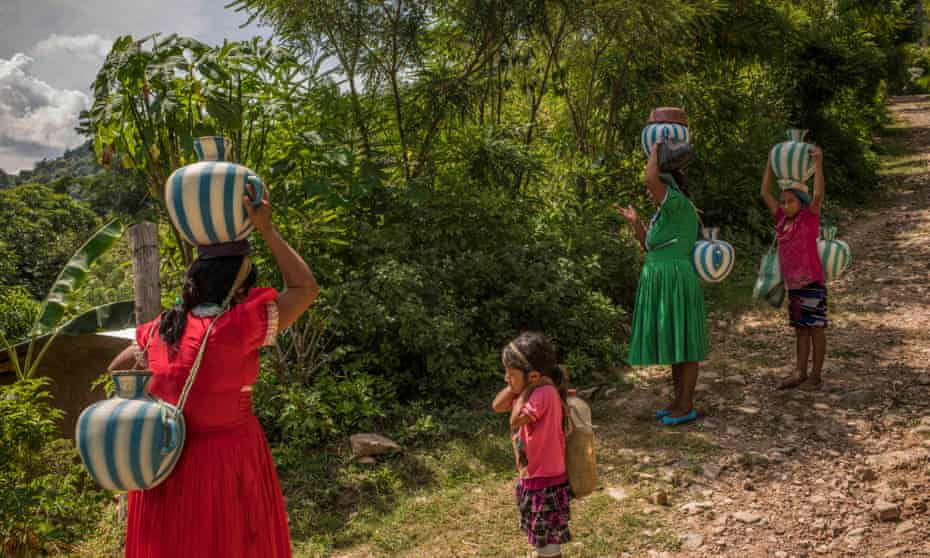
Women of Guaiabo village carry water to their houses. Guatemala has contributed very little to greenhouse gas emissions but its people are suffering acutely from their impact.

Women of Guaiabo village carry water to their houses. Guatemala has contributed very little to greenhouse gas emissions but its people are suffering acutely from their impact. Photograph: Daniele Volpe/The Guardian


Nina Lakhani in La Unión-Mon 1 Nov 2021 

For the Indigenous Maya Ch’orti’ people of La Unión in eastern Guatemala, the daily struggle for water involves catching every drop of rain that drips from sloping metal roofs and walking long distances to fill plastic containers from overused streams.

In this parched region, communities rely on rainfall to feed their families, and in 2019 worked together to build water reservoirs high in the mountains in order to better cope with increasingly frequent droughts and unpredictable rains which caused their maize and bean crops to fail.

But the following year brought the opposite problem. After years without enough rain, two powerful hurricanes, Eta and Iota, struck within a fortnight of each other, causing flash floods and landslides that left dozens of people trapped in partially collapsed houses.

“We always worried about not enough water, and then this abundance came. What a disaster,” said Yesenia Martínez, the village mayor.

It was around 9pm on a November evening when the concrete walls in Martinez’s own home started to collapse. It was pitch black. Children screamed as cracks opened in the floor and rain poured infrom all sides.

“We tried to fill the cracks with stones and plastic sheets, but the earth just gave way. We didn’t lose any lives, thank god – but we lost everything else,” said Martinez, 38, wiping away tears.

It took almost a week for neighbours to rescue Martinez and her family using ropes, sticks and planks of wood to cross the flooded river. The season’s bean crops were ruined, the soil too sodden for replanting. No government help ever arrived.

Yesenia Martinez in her provisional house.
Yesenia Martinez in her provisional house. Photograph: Daniele Volpe/The Guardian

Almost a year later, Martinez and some of her extended family are living in temporary rickety houses built from corrugated metal sheets and wood, far from the river. But there isn’t room for everyone, and so her four youngest siblings are back living in the derelict house.

“I cried when I came back here. The house could crumble at any moment or a rock could fall on us while we’re asleep. Of course we want to leave, but we’re poor and don’t have anywhere else to go,” said Mirna Martínez, 19.

Barefoot children, skinny dogs and noisy chickens mill about the partially collapsed structure, which is held together by wooden beams and crumbling concrete blocks. Two days before the Guardian’s visit, a landslide had gobbled up another chunk of the neighbor’s coffee crops just 50 meters or so away. It wasn’t even raining when the ground gave way.

Guatemala is one of five Latin American nations – along with Honduras, Nicaragua, Colombia and Haiti – identified among the 11 countries most at risk from climate chaos due to a combination of geography and poor governance, in a recent US government report on climate and global insecurity.

Eta and Iota marked the first time two major Atlantic hurricanes had been recorded in November, and came after six years of drought in Central America’s dry corridor, an impoverished region that is highly vulnerable to catastrophic extreme weather events such as storms, torrential rain, droughts and heatwaves – all of which are getting longer and more intense due to global heating.

Guatemala has contributed very little to greenhouse gas emissions but its people are suffering acutely from their impact.

Acute malnutrition in children under five has more than doubled since 2019 due to the hurricane related crop losses, volatile commodity prices and the pandemic. Many campesinos were unable to reach coffee plantations, where they can earn $5 to $7 a day, because damaged roads and bridges were left unrepaired for months.

A child in his house in Filincas hamlet of Guaiabo village.
A child in his house in Filincas hamlet of Guaiabo village. Photograph: Daniele Volpe/The Guardian

Figures show that the largest increase in acute malnutrition cases and child deaths occurred in the regions hardest hit by floods and landslides caused by Eta and Iota. As women cut back on food to provide more for their children, the rate of low birthweight babies also skyrocketed.

With few personal resources, little or no government assistance and NGOs struggling to cope with the unprecedented rise in food insecurity across Latin America, many Guatemalans have left in search of work and safety.

Martínez’s sons, Brian, 21 and Esban, 18, borrowed thousands of dollars to pay coyotes or guides to travel overland to the US. They were repeatedly detained by Mexican immigration officials, but eventually made it to Florida where they work in construction, and have started sending some money home every month.

“My sons had to go because we were left with nothing, so many young people have gone. There’s no work here, especially if you’re Indigenous,” said Martinez. One of her sisters also migrated, with her six-year-old daughter.

Almost 300,000 Guatemalans have been detained at the US southern border since Eta and Iota struck. It’s unclear how many succeeded in entering the country, but 2021 is on track to break the remittance record, with more than $11bn sent home by Guatemalans in the first nine months of the year.

“It’s evident from the numbers at the US border and remittances that the climate crisis and Covid economic downturn has led to a rise in migration as people try to get away from hunger – you can’t deny this. It’s already happening and the projections are not positive,” said Ricardo Rapallo, the Guatemala representative for the UN Food and Agricultural Organization (FAO).

At the UN climate talks in Glasgow this week, world leaders will hammer out what help and how much richer countries – those most responsible for greenhouse gas emissions – should contribute to cover the costs of climate impacts in lower- income countries.

But the lack of scientific data on climate migration is hurting vulnerable countries like Guatemala, said Edwin Castellanos, member of the IPCC’s scientific group on vulnerability and adaptation and dean of the research institute at Guatemala’s Universidad del Valle.

“The future is going to continue like this – very dry periods followed by very wet periods – so we have to adapt to both extremes. But the same socioeconomic conditions that make Central America particularly vulnerable also make us invisible scientifically and therefore least able to access funding needed to adapt.”

Community members during a meeting in Guaiabo village.
Community members during a meeting in Guaiabo village. Photograph: Daniele Volpe/The Guardian

Next year’s IPCC report on vulnerability and adaptation, which Castellanos helped write, will conclude that there is “low confidence” on the link between the climate crisis and migration, due to the dearth of scientific research.

“We know from journalistic reporting that climate change is causing migration, but we lack the hard data because we can’t get the funds to get the hard data, which makes accessing international green funds almost impossible. It’s a vicious cycle,” added Castellanos.

Maya Ch’orti’ territory extends south from La Unión in Zacapa to Camotán in the department of Chiquimula, where rural villages are scattered along dirt roads in the rain shadow of the picturesque Sierra de las Minas. Each house is flanked by clay pots and rows of colorful plastic jars and buckets used by women to collect water for drinking, washing and cooking.

Miriam Ávalos eats less so that her children have have more, but they are still chronically malnourished.
Miriam Ávalos eats less so that her children have have more, but they are still chronically malnourished. Photograph: Daniele Volpe/The Guardian

In one tiny canton, campesino Esteban Gutiérrez was sorting through the maize harvest in front of the single-room adobe house where he sleeps with his wife and six children. In 2019, the family was already struggling when the Guardian visited after consecutive years of drought had left them without enough food.

So far this year, they’ve had enough maize for Gutiérrez and the children to eat three tortillas three times a day – but not his wife, Miriam Ávalos, 25, who has two for each meal. She’s skinny, tired and breastfeeding four-month-old David, but must fetch water from the stream every other day when the communal tap runs dry.

The three oldest children, aged 11 to 6, are chronically malnourished, and have barely grown since 2019. The two youngest girls, aged 3 and 4, are acutely malnourished after repeated bouts of diarrhea; their hair is falling out in small clumps.

Guatemala has one of the highest malnutrition rates in the world with almost half of all children suffering chronic malnourishment, but rates are significantly higher among the country’s 24 Indigenous communities.

“It’s worse now than when you visited us before, the earth is so dry nothing grows,” said Ávalos.

Two years ago, Gutierrez was desperately trying to mortgage the family’s small plot of land to pay a coyote. He’s still trying to find away to migrate so he can provide his family with enough food. “We keep trying, we work hard, and hope the water comes in time.”

  • This story is part of a Covering Climate Now reporting series on climate migration called Flight for Their Lives. CCNow is a global journalism collaboration strengthening coverage of the climate story

 ‘Our main struggle has been protecting Ecuador’s territories from extractivism’, says indigenous people’s advocate


We were joined by Helena Gualinga from the Kichwa people of Sarayaku in Ecuador.

She is an advocate for indigenous people’s rights and the protection of the Amazon.

Many Voices from Global South Shut Out of U.N. Climate Summit as Vaccine Apartheid Limits Travel to U.K.


NOVEMBER 01, 2021

This year’s U.N. Climate Change Conference in Glasgow may be the whitest and most privileged one ever, with thousands from the Global South unable to attend because of lack of access to COVID-19 vaccines and travel restrictions. The global inequity in vaccine access mirrors the disproportionate impact of the climate crisis that has fallen mostly on poor countries least responsible for emissions, says climate activist Dipti Bhatnagar in Mozambique. “The people who need to be there, who need to hold people accountable, are not going to be there,” says Bhatnagar, climate justice and energy coordinator at Friends of the Earth International, who was unable to attend the climate conference in Scotland because of a lack of access to COVID-19 vaccines. “What is going to come out of this COP is going to be largely illegitimate because of the way that they’ve organized it and because of the intentions behind it.”


This is a rush transcript. Copy may not be in its final form.

AMY GOODMAN: This is Democracy Now!, democracynow.org, The War and Peace Report. I’m Amy Goodman.

Some 30,000 people are expected to take part in the two-week U.N. climate summit in Glasgow, but many warn the gathering will be the whitest and the most privileged climate summit ever, with thousands from the Global South unable to attend because of lack of access to COVID vaccines and visa issues.

We go now to Mozambique, where we’re joined by Dipti Bhatnagar, climate justice and energy coordinator at Friends of the Earth International. She is joining us from Maputo. And in a moment we’ll be joined by her colleague, Mary Church of Glasgow, Scotland, inside the COP, where we will join them virtually.

Dipti, thanks so much for being with us. It’s great to have you with us. Usually we’re together at the U.N. climate summit. Now we’re providing that global kitchen table for people to sit around and discuss and debate the most critical issues of the day. Can you talk about why you’re not at the U.N. climate summit in Glasgow this year?

DIPTI BHATNAGAR: Thanks, Amy. Great to be talking to you again. I definitely wish we were speaking in person, but this is what the pandemic has done. It’s been absolutely devastating for so many people across the globe.

And, as Asad was saying, the organization of this COP has been very deliberately done by the U.K. government to be this really exclusionary space, because they know that if the people from the Global South, if the progressive civil society from the Global South are not there to hold people accountable in the halls of power, it’s going to be a lot easier for them to get away with — you know, with carbon markets, with not putting the finance on the table, not putting the emissions reductions on the table. So, for so many people like me, I am so privileged compared to so many people around me here in Mozambique and in this continent of Africa. People have faced huge burdens to be able to get to the COP, and most people have just not managed.

So, the vaccine situation across this continent, you can quite imagine. People are calling it vaccine apartheid for a reason, Amy. People have not got access. I think the access rate in Mozambique currently is around 6 to 7% of people have access to the vaccine. And, of course, the visa burdens have been huge, and the changing rules, Amy, constantly changing quarantine rules. So, Mozambique was on the red list until a few weeks ago, and that was when, you know, we, Justice Ambiental, Friends of the Earth Mozambique, myself, we made this decision that we’re not going to be able to go. And things are constantly changing. And today, Amy, the red list has been ended by the U.K. And those who were still on the red list who were planning to go and do the managed quarantine, which was supposed to be paid for by the U.K. government, today the red list has ended. The quarantine hotel is not going to be paid anymore, so people who are already on their way have to now find accommodation of their own.

This is just one example of the type of barriers that have been put on the table, for which reason so many people who usually go there — because the COP is an exclusive space at the best of times — but people who usually go there, many, many have not been able to make it. And that’s why what is going to come out of this COP, because the people who need to be there, who need to hold people accountable are not going to be there — those who are there, we’re in solidarity with, our comrades who are on the ground there, but what is going to come out of this COP is going to be largely illegitimate, because of the way that they’ve organized it and because of the intentions behind it.

AMY GOODMAN: Explain more what this red list is.

DIPTI BHATNAGAR: So, the red list was a list of countries from which, if you traveled to the U.K., you had to quarantine for five days in England or 10 days in Scotland. And that was in a managed quarantine situation in a government hotel, and the U.K. government says, “OK, we will cover the cost of the hotel.” But for a woman like myself, I didn’t feel safe being in someone else’s space confined for five days, not knowing what the situation was. You know, for some people, it’s quite normal; this quarantine situation has been normalized for people who are traveling. For us, it’s not the case, and that’s why it didn’t feel safe to make those decisions.

I understand that we’re in a pandemic. We shouldn’t be hosting this COP right now. I’m not saying, you know, that there shouldn’t have been quarantine, because we need to protect also the people of Glasgow, so that they don’t have all these people coming into their city and possibly causing a superspreader event. We don’t want that. That’s why, as Asad said, in early September so many civil society organizations said, “This is not the right time to have the COP. And the U.K. government, the way you’ve been organizing it” — Amy, we don’t know anyone who actually got the vaccines under the vaccine scheme that the U.K. government promised. I know lots of people who applied for it. I don’t know a single person who actually got it. So these conditions leading up to the COP mean that it should not be held in this way.

And the images from this morning, Amy, people trying to get into the conference center, forget about social distancing. People are just all over each other, in the bitter cold, waiting to get in, because of how badly this has been planned. And for us, it’s not been planned badly just because; this is intentional, so that the voices that are challenging those power relations don’t get to be there, or get to be weakened while they’re there. That’s the idea.

AMY GOODMAN: Yes, we almost didn’t have Asad because he was in the security line for so long. But can you explain what net zero is and why you want to dismantle what you call the myth of net zero?

DIPTI BHATNAGAR: Absolutely. So, this is being called the net zero COP, because the U.K. government has, for the last two years, since the last COP happened in Madrid — has been trying to push this idea of net zero. And it sounds really nice to people. OK, there’s a zero in it. But net zero is not zero, because their entire idea, Amy, is that the polluters will keep polluting as long as they can sequester their emissions elsewhere. So it’s about emitting and then pulling it out of the air, so the net still becomes zero.

And the message that we’re giving, so many civil society across the world — there’s a new website that has been launched today: “Real Solutions, Not ’Net Zero.” There are some dashes in there. This is a civil society effort to say no to net zero, because this is an escape hatch for polluters to continue polluting. And not only that, they’re planning — where are they going to sequester these carbon emissions? They want the lands and the forests of communities in the Global South who are using those resources. They want those. So, this isn’t just about — you know, this is a rhetoric about the climate crisis, but it’s also the financialization of nature and grabbing more lands and having more resources in the hands of corporations and the elites. And that is what we are totally against.

Net zero is a Trojan horse also for geoengineering. This is really about all these unproven, untested, dangerous technologies that they’re trying to trot out, just because — just because they do not want to change status quo. They do not want to reduce their emissions. So they’re making us think that this is something that’s going to help, but it’s absolutely not. It’s going to make things worse. That is why we’re saying no to net zero, yes to real solutions, yes to system change.

AMY GOODMAN: And why are you concerned about the participation at the COP26 of Mark Carney, the U.N. special envoy for climate action, finance adviser to Prime Minister Boris Johnson, proponent of what’s called a voluntary mechanism for scaling up carbon markets? What message do you have for him, Dipti?

DIPTI BHATNAGAR: Sure. So, Mark Carney used to be part of the Bank of England, so you get an idea of the type of people that Boris Johnson has put in place to lead this task force on scaling up voluntary carbon markets, as you were saying. Carbon markets is so linked to net zero because carbon markets is about trading pollution. So that’s when you know that is their plan. They want to keep emitting, and they need a mechanism to be able to trade carbon, so that they can say, “Oh, someone else is sucking that carbon out of the air, so we’re fine.”

So, Article 6 negotiations, Amy, have broken down every year. The last time that we were there, in Madrid, civil society gave a huge push against Article 6, against the carbon markets negotiations, and the negotiations broke down. So, many of us who cannot be there this year, what it means is that they’re actually planning to push Article 6 carbon markets and close the agreement this year. This part of the agreement, they have not managed to decide since the Paris Agreement was signed six years ago.

So, people like Mark Carney, where they come from, the role that they play here is really pushing the — so, the idea is pushing carbon markets within the UNFCCC’s framework, within the Conference of the Parties framework, as well as the voluntary carbon markets that they’re trying to push. It’s all for financializing and commodifying nature. It’s for pretending to do something on the climate crisis but not doing it, while they strengthen financial markets on nature and grab lands. This is really the game that they’re playing here.

AMY GOODMAN: So, we’re talking —

DIPTI BHATNAGAR: And our people are going to be there to oppose it.

AMY GOODMAN: We’re talking to Dipti Bhatnagar, who is climate justice and energy justice and energy coordinator at Friends of the Earth International. She is with us from Maputo, Mozambique.

The Brexit dark money lobby has a new target – climate change action

Brexit showed that a few ruthless, well-connected people with big money behind them can change history. Now they’re at it again, and the stakes are even higher

Nigel Farage presents his first show on GB News channel in London| SOPA Images Limited / Alamy Stock Photo


Peter Geoghegan-
30 October 2021
 

If Brexit proved anything, it’s that a handful of people with powerful connections can go a long, long, way.

Over two decades, a steady drip feed of newspaper stories – and some well-timed political spending – turned a marginal interest into a British national obsession.


Surely it wouldn’t be possible for British politics to be captured like this again? Well, we might be about to find out.

Officially the UK government has committed to Net Zero by 2050, but behind the scenes an organised, well-funded opposition to climate change action is growing on the Conservative Right. And many of those at the vanguard – and their tactics – come straight from the veterans of Brexit.

A classic example of this appeared in The Telegraph this week: the day before the Budget, it reported a YouGov survey that found a majority of the British public “want a referendum on Boris Johnson’s net zero plans” by the next general election – a majority of those who expressed a preference, that is.

Even Remainers and young people wanted a public vote on Johnson’s carbon policies. Other outlets picked the story up, too. Self-styled “Brexit hardman” Steve Baker tweeted his support for a Net Zero referendum.

It is easy to scoff at The Telegraph, with its dyspeptic opinion pages filled with lockdown sceptics and cosplay libertarians. But the jewel in the Barclay family’s media empire matters. There is a reason Johnson is said to call the Telegraph his “real boss”.

The day after the Telegraph story, Nigel Farage told GB News viewers that a referendum on Green taxes “could well be my latest campaign”.

A question nobody was asking

Perhaps it’s because I spent so long looking at the dark money behind Brexit, but the first thing I thought while reading The Telegraph’s story was: “Who has paid a professional pollster to carry out a survey on a question nobody is asking?”

The answer is something called Car26.org. This, The Telegraph informed its readers, is a “new campaign group calling for a referendum on net zero proposals and a pause in eco regulations until such a ballot is held”.

Yep, you read that right. No climate change mitigation policies until a referendum on Net Zero. Sound familiar?

Brexit saw vast sums of money spent through ‘astroturf’ groups: campaigns posing as grassroots initiatives with no visible support but a deep-pocketed funder behind the scenes. A 20-something scriptwriter in Manchester spent a fortune on hard Brexit Facebook ads.

Before the 2019 general election nominally ‘third party’ campaigns spent £700,000 pushing Conservative talking points without declaring any donations.

Car26.org looks like it was lifted straight out of the same playbook. It was registered at Companies House only last month. Its public face and director – Lois Perry – is a representative for Reclaim, the culture war party fronted by Laurence Fox, the actor and anti-lockdown, anti-diversity activist, and bankrolled by Brexit donor Jeremy Hosking.

There’s more. At the bottom of the Car26 website – past the description of young people’s involvement in climate protests as “borderline child abuse” – there’s a note saying the site is “powered by Blue Sky”. Blue Sky Strategy is a tiny communications company run by a small group of Brexit veterans, including Rebecca Ryan, who is director of the astroturf Defund the BBC campaign and who used to work alongside Vote Leave’s former chief technology officer, Thomas Borwick. What a small world.

The new front

Brexit and climate change are, of course, very different issues. Many of those who supported the UK leaving the European Union also want action on climate change. But there are striking parallels between the Brexit playbook and the increasingly vocal opposition to action on climate change.

The taxpayer-funded European Research Group of Conservative MPs – which played a starring role in the UK’s exit from the EU – has largely morphed into the Net Zero Scrutiny Group. The Global Warming Policy Foundation — which long promoted climate change denialism — has been relaunched as Net Zero Watch. Wycombe MP Steve Baker, the “Brexit hardman”, is a leading light in both.

Net Zero Scrutiny Group MPs take pains to stress that they don’t deny climate science. But they do want to slow down – or halt – climate change mitigation policies. This has become the position of far-Right groups across Europe, too.

Just as they did when the Northern Irish border dilemma confronted them during the Brexit negotiations, Tory MPs are endlessly talking up technological solutions to the climate crisis.

Feted Teesside Tory mayor – and Donald Trump fan – Ben Houchen recently warned against Green levies, telling The Sun: “You don’t need taxation. You need to believe in the power of innovation and people to come up with the ideas and solutions.”

Black gold

This is music to the ears of the oil and gas industry. The financial ties between them and the Conservatives are, no doubt, simply a coincidence.

As openDemocracy recently revealed, the Tories have received more than £1m from the energy sector since the 2019 election; one MP alone, John Hayes, has received £150,000. The former energy minister has likened climate protestors to “radical Islam”.

It’s not hard to see Net Zero replacing Brexit as the major fissure in the Conservative Party in the coming years. While Johnson might wrap himself in Green rhetoric, Tory party faithful – who will choose the next leader – are far more sceptical.

The influential Tufton Street think tanks – fuelled by dark money and anonymous corporate donations – are increasingly vocal on Net Zero. The Institute of Economic Affairs, which once boasted to an undercover reporter that it was in “the Brexit influencing game”, told its newsletter readers this week that it would “continue to challenge the ropey economics” of Net Zero.

The unthinkable referendum

With COP26 starting in Glasgow on Sunday, much of the focus in the coming weeks will be on the high politics of climate change. But history would suggest we should keep a close eye on what’s happening far away from the plenary sessions and diplomatic meetings.

Referendums on Net Zero are fringe ideas now, but so was Brexit 20 years ago. What changed that was a handful of people with pockets full of dark money who poured it through a porous media and into an ossified political culture.

After Brexit, Matthew Elliott, who ran the Vote Leave campaign, penned a blog post reflecting on the lessons of his success.

“Major policy changes are never impossible,” Elliott wrote. “Who would have thought that a coalition of people working over two decades could convince a country to leave a major international organisation? But with a lot of perseverance, we managed to make history.”

Let’s make sure they don’t make history twice.

Climate Justice in America

Power plant. Photo: Jeffrey St. Clair.


A few days ago, President Biden was urging climate action when saying, we don’t have much more than 10 years. Fighting global warming is inextricably linked to what Bill McKibben and others call climate justice. Commonly, many like to distinguish between climate justice and ecological justice. Ecological justice is about non-human beings and the wild unspoiled by human interference. It is about animals and their moral entitlements to an adequate and safe habitat, for example.

By contrast, climate justice is about the interaction between human beings and nature. It is about issues like global warming understood as an ethical and political issue. Necessarily, climate justice involves social equality, human rights, collective rights, animal rights and our common responsibilities to prevent global warming.

Despite the recent flooding of sections of New York, it is clear by now that there are disproportional impacts of climate disruptions on the world’s most vulnerable people. The promise of capitalism as the solution to global warming might turn out to be a hallucination. Instead, many climate justice advocates have been in the forefront of critiquing policy measures that aim to implement emission reductions through so-called market mechanisms.

It is even worse when one considers that less than ten years ago, the wealthiest 10% of individuals worldwide were responsible for 59% of resource consumption and the poorest half of the world were…only responsible for about 7%. At around the same time, many became aware that the wealthiest 10% of the global population are now responsible for 49% of individual emissions.

One of the problems of the global imbalance may well be biofuel causing a massive expanse of land away from food crops, polluting and then capturing and locking up pollutants in some carbon prison is not a new idea. It is a brilliant marketing spin. Yet, the focus on fuel can have additional consequences.

Many environmental groups have chosen to be silent on the issues of large dams for example, as they must choose their battles and have prioritized opposition to fossil fuel. The conversion of nature into biofuel production, large dams, and marketing spin can be easily observed in a country like Brazil. In the era of the world’s most dangerous man, President Jair Bolsonaro, the oil industry’s expansion policy is focusing on the privatization of Petrobras, Shell, BP, Chevron, Total, Statoil/Equinor, Repsol, and other companies from Portugal, China and the US are directly investing in the new frontier, opened up by Bolsonaro.

To some extent, it is fair to say that what happens in Brazil also happens in India where climate change doesn’t make nouveau riche in Brazil, the USA, and elsewhere vulnerable. Instead, it provides new opportunities to grow even richer.

To camouflage rampant global environmental vandalism and to delay serious action on global warming, climate change mitigation, une idée fixe of resilience, as well as, short-term adaptations to climate change remain largely a chimera used to camouflage the rapidly advancing destructiveness of an impending Anthropocene or better yet, Capitalocene. Caused by global warming, a different problem emerged in a different corner of the world.

Scientists announced that five Solomon Islands have disappeared due to rising sea levels. It does not stop there. Despite Donald Trump, who was president in the year 2018, in that year, the US Department of Defense predicted that more than a thousand low-lying islands risk becoming uninhabitable by the middle of the century – or possibly sooner – because of rising sea levels.

In the USA, rising sea levels will also impact on Florida, Louisiana, California, New York, and New Jersey, as well as Guangzhou and Shanghai, China; Hong Kong; Mumbai, India; Amsterdam, Netherlands; Lagos, Nigeria; Manila, Philippines; Dakar, Senegal; and Ho Chi Minh City, Vietnam.

Much of this are the bitter consequences of a system that supports big businesses which is a system that, of course, also includes corporate lobbying where the oil, gas, and coal industries have spent a whopping $543 million on lobbying in 2009, while alternative energy companies spent less than $32 million. Outspending the people by 17-to-1, Big Oil, Kochland, etc. assures that US lawmakers pave the way towards the Uninhabitable Earth.

For those without corporate dollars, protest remains the preferred option to fight environmental vandalism and global warming. Many have been arguing that protest is more important than public opinion or legitimate advocacy in influencing federal environmental law. This is the case even when the other side operates what Earth First! Founder Mike Roselle calls, first they ignore you, then they sue you.

When all their corporate lobbying and court cases fail, polluting corporations offer compensation. Examining the case of African climate justice, the entire pathology comes to light when polluters offer compensation and when, as in one case, their initial offer of an annual $10 million was not enough to buy us coffins.

This is only going to get worse and it will do so not just in Africa. In Africa. Desmond Tutu once said, we are facing impending disaster on a monstrous scale condemning Africa to incineration. This is what global heating means for the vast areas of the world – incineration. Perhaps Greta Thunberg, in her usual clarity, was not wrong when saying, either we choose to go on as civilisation or we don’t. We are in the beginning of a mass extinction and all you can talk about is money and fairy-tales of eternal economic growth.

Yet, climate justice also relates to issues such as the impact of privatization of water can have on local communities. The people in and around Detroit, for example, not only suffered from lead contamination of the water but also from Detroit’s water shut-offs impacting mostly on the poor. Privatization is all but yet another mechanism of an ever increasing financialization of nature.

On a much grander scale, it means that, the Paris Agreement is a trade agreement, nothing more. It promises to privatize, commodify, and sell forested lands as carbon offsets in fraudulent schemes. Essentially, those responsible for the climate crisis do not only get to buy their way out of compliance but they also get to profit from it as well.

On much of this, ecofeminism would argue that we need a transition from life-denying capitalism to a life-affirming, post-capitalist commons. Ecofeminists might also say that all over the world, fossil capitalism has violated human rights and the rights of nature. It undermines local subsistence and communal social relations. Supporting this, climate justices would argue that we must resist the neoliberal imperatives for scalable solutions or one-size-fits-all roadmaps.

Overall however, there is no evidence that the environmental and climate change problems that we face today, or any complex social and economic problems of this scale, can be effectively tackled by economic incentives of the sort offered by capitalism – a sobering thought.

In the end, the concept of climate justice offer a theoretical or even philosophical discussion on how to understand global warming. Climate justice remains indispensable to the debate on global warming.