Sri Lanka: One Island Two Nations

Search This Blog

Wednesday, 1 June 2022

Is the 21st A another political farce?

Protesters at GotaGoGama have many demands and abolishing the Executive Presidency features prominently among them 


1 June 2022 

  • Public polls suggest that a majority of people now want the Executive Presidency abolished
  • It appears that the SLFP is not supportive of all provisions of the 19th Amendment and that shows the contradictions in the Gotabaya-Ranil Government
  • The 19th Amendment to the Constitution enacted in 2015 brought about a radical transformation of the Constitution of 1978
  • The Draft 21st Amendment will require ministers to be appointed on the advice of the Prime Minister


On April 21 Sri Lanka’s Main opposition Samagi Jana Balawegaya (SJB) presented the draft 21st Constitutional

Amendment Bill and one of its main proposals includes the abolishing of the Executive Presidential system. Subsequently a month later, the draft Amendment was presented to the Cabinet for approval. However, several factions have expressed concerns over the draft as having excluded vital provisions including the President’s power to prorogue or dissolve Parliament and the power to retain subjects and functions of ministries. Legal experts say that these provisions would strengthen the Presidency further. The Party leaders meeting to discuss the draft 21st Amendment was held last Friday (May 27). However due to the absence of Tamil National Alliance (TNA) the final meeting was rescheduled to June 3 to finalise the draft. 

Reintroduce 19A to create some confidence in people: Wijenayaka 


“What we need is the reintroduction of the 19th Amendment,” opined Attorney-at-law and former Chairman of the Public Representations Committee Lal Wijenayake. “The promise made was that. But when you go through the provisions you see that some of them have been retained such as the President’s power to dissolve parliament. These can be misused. Another important matter is with regards to the independent commissions. The decisions by these commissions should be above the President,” said Wijenayake. When asked if there would be a majority to pass the Amendment, Wijenayake said that there is an understanding in Parliament to bring back the 19th Amendment within two months. This is to do away with the Presidential system and bring back a Parliamentary system. What needs to be done is to reintroduce the 19th Amendment, but I don’t know why they are not doing it. This way it will create some sort of confidence in people as well,” added Wijenayake. 

“Majority of the public wants the Executive Presidency abolished”: Dr. Wickramaratne


President’s Counsel Dr. Jayampathy Wickramaratne said that two key provisions of the 19th Amendment have been dropped in the new draft of the 21st Amendment. “One of them was that the 19A precluded the President from assigning to himself any subjects or functions. But since this has not been included he has the power to retain ministries and assign to himself any subjects and functions and take over subjects and functions of any Minister. This will strengthen the Presidency. The President’s power to prorogue and dissolve Parliament has also been retained and this way he can unilaterally take a decision in Parliament. This too strengthens the Presidency. The 21st Amendment doesn’t address the demands of the protesters and people,” said Wickramaratne. 


Two other key provisions of the 19th Amendment were dropped at the Committee stage at the interest of the political parties. “One is the expulsion of MPs from Parliament. When they don’t have a party membership due to a crossover etc., the Party will take disciplinary action. The 19th Amendment proposed that lower courts such as district courts have no jurisdiction to issue any interim order and that it’s the Supreme Court decision that determines the expulsion from the Party. This provision was dropped.


“On the other hand, the 17th Amendment to the Constitution included that the Constitutional Council will comprise three MPs, namely the Prime Minister, Speaker and the Leader of the Opposition in addition to seven other non-MPs. But the opposition wanted this 7:3 ratio reduced to 3:7. 


“The 19th Amendment also includes several inherent contradictions. Originally when Maithripala Sirisena was contesting as the Presidential Candidate he signed an MoU with Ven. Maduluwawe Sobhitha Thera and 49 other organisations and agreed to abolish the Executive Presidency. But the very next day he signed an MoU with the Jathika Hela Urumaya. A ministerial sub-committee headed by the Prime Minister decided that the President would be the head of the government and would act upon the advice of the Prime Minister. But all these provisions were taken away due to pressure from SLFP and other parties in the Opposition. Ven. Sobhitha Thera was disappointed with the dilution of the original 19A.


“Events during the past few months that led to an economic and agricultural disaster resulting in the breakdown of law and order could have been averted if there were collective decisions taken in Parliament rather than unilateral decisions taken by the President. Public polls suggest that a majority of people now want the Executive Presidency abolished. This shift is due to the experiences of the past few months,” said Wickramaratne. 


When asked if the Amendment would be passed by a majority, Dr. Wickramaratne said that it depends on the SLPP MPs. It appears that the SLFP is not supportive of all provisions of the 19th Amendment and that shows the contradictions in the Gotabaya-Ranil government. 

Vital provisions excluded : BASL

In letters addressed to the President, Prime Minister and Justice Minister Wijeyadasa Rajapakshe the Bar Association of Sri Lanka (BASL) recommends following provisions included in BASL proposals to be included in the 21st Amendment. These include; 

  • A provision for the members of the Monetary Board to be appointed with the approval of the Constitutional Council (in addition to the Governor of the Central Bank)
  • A provision for the appointments of the Secretaries to the Ministries, Governors of the Provinces, Ambassadors and Heads of Missions be done on the advice of the Prime Minister in consultation with the Cabinet of Ministers
  • A provision to require Presidential Pardons to be done according to the recommendation by a body established by law, appointed by the President on the recommendation of the Constitutional Council
  • A provision to enhance the financial independence, transparency, and accountability of the Independent Commissions.

The BASL further recommends that the number of members of the Constitutional Council who are not members of parliament to be increased from 3 to 5 and numbers of members of parliament in the Constitutional Council be reduced from 7 to 5.

Draft 21st Amendment a major disappointment: Prof. Ratnapala 


“The Draft of the 21st Amendment to the Constitution now before the Cabinet is a major disappointment,” opined Prof. Suri Ratnapala, Emeritus Professor of Law at the University of Queensland. “It (21st A) will not be a meaningful step in the path to constitutional redemption and, if unaltered, will be a bitter betrayal of the popular struggle for a more responsible and less corruptible form of democracy. 


“The BASL by its letter of May 23, 2022 addressed to President Rajapaksa made a number of critically important observations concerning the Draft 21st Amendment. I am in substantial agreement with the BASL’s comments and commend the President and Members of the BASL for their work and commitment to democracy and constitutional government,” said Prof. Ratnapala. 


“The protest movement that has grown around the country under the catchphrase ‘Gota Go Home’, as I understand, has the following primary aims: Removing President Gotabaya Rajapaksa from the Office of the President and Replacing the authoritarian system of the Executive Presidency with a form of government more responsive to the public interest and constrained by checks and balances against corruption and the abuse of power. Restoring the supremacy of Parliament with a titular President is seen as central to this transformation.
“The 21st Amendment if enacted as drafted will not achieve these aims,” he added.


Prof. Ratnapala said that the 19th Amendment to the Constitution enacted in 2015 brought about a radical transformation of the Constitution of 1978. “It was all the more remarkable for being enacted near unanimously by Parliament. Its principal object was to curtail the executive power of the President to a minimum and return the nation to a parliamentary form of government. This was sought through two critical changes to the 1978 Constitution.


“First, the 19th Amendment rewrote Article 43 of the Constitution to require the President to appoint ministers of the Cabinet solely as advised by the Prime Minister. An exception was created for the incumbent President Mr. Maithripala Sirisena to retain the subjects of Defence, Mahaweli Development and the Environment. (Section 51 of the Act) Despite some textual ambiguity, most legal experts interpret these provisions to mean that the persons who became President after Mr. Sirisena were disentitled to retain any subjects, except perhaps, Defence of Sri Lanka which is a responsibility directly vested in the elected President by Article 4.


“Second, the 19th Amendment amended Article 70 to remove the President’s power to dissolve Parliament within the first four and a half years of its term unless Parliament so requested by a resolution passed by not less than two thirds of all members. These two changes were reversed by the 20th Amendment,” he emphasised.


“The Draft 21st Amendment will require ministers to be appointed on the advice of the Prime Minister. However, the President’s power to retain or assign to himself subjects of his choosing remains unchanged. Its silence confirms the authoritarian features that the 20th Amendment inserted. I hope that these omissions are drafting oversights and not purposeful omissions. If it is the latter, it would be a bitter betrayal of the national interest and the desperate struggle of the people to establish a responsive and accountable system of government,” Prof. Ratnapala underscored.

Expedite enactment of 21st Amendment: Ven. Sobhitha Thera 


Speaking at the inaugural press conference organised by the People’s Assembly, Ven. Omalpe Sobhitha Thera said that if the prevailing crisis is to be resolved the Parliament and the Judiciary should receive more powers. “We continuously said that the unlimited powers of the President should be limited and as a result the public has pressured the Parliament to enact the 21st Amendment. We urge the government to expedite the enactment of the 21st Amendment. If delayed all 225 politicians will have to face many consequences,” said Sobhitha Thera.


Rectify loopholes in the draft 21st Amendment: Fr. Cyril Gamini


Adding his comments at the media briefing, Fr. Cyril Gamini Fernando said that the 21st Amendment is important to bring about political stability in the country. “What people expect is to re-enact the 19th Amendment. But there seems to be certain loopholes in the draft 21st Amendment and these loopholes need to be rectified prior to its enactment. This Amendment should ensure a secure future for the people. If it is to be a progressive Amendment it should include the demands of the people rather than giving more powers to a person or a political party. We request the 225 politicians to represent the people’s voice,” said Fr. Gamini. 

21A will not go beyond 19A: Dr. Rajapakshe


When asked about the draft 21st Amendment and provisions that retain powers of the President, Minister of Justice, Prison Affairs and Constitutional Reforms Dr. Wijeyadasa Rajapakshe said that the 21st Amendment will not go beyond the 19th Amendment. “If so it will be exposed to a referendum and the entire process will be futile. The BASL has proposed the independence of commissions and is seeking the approval for diplomatic positions. Already there’s a high post committee headed by the Speaker. The proposal regarding the appointment of members to the Monetary Board is under consideration. The foundation of the Constitution is the Executive Presidency and the legislature is there separately,” said Dr. Rajapakshe. 
He further said that the draft Amendment has specific provisions to prohibit dual citizens from sitting in Parliament and that applies to the present Parliament as well.

Sri Lanka hopes for a rising tide

 Following the worst economic crisis in Sri Lankan history, the magic of the Rajapaksa clan is on the wane. Ranil Wickeremesinghe is now the go-to man


by Ashok K Mehta-
Wednesday, 1 June 2022

It’s Day 54 of ‘Gota Go Home’ protests. The protestors representing all sections of society have thinned but the resolve to get President Gotabaya Rajapaksa to step down has strengthened. Ranil Wickremesinghe, a single National List seat Prime Minister rejected by the electorate, is now being opposed by protestors as ‘No Deal’ referring to payback by Gotabaya for Wickremesinghe protecting the family when he was the Prime Minister.

The words ‘incredible’, ‘impossible’ and ‘unthinkable’ pop up in relation to the impending political demise of the Rajapaksa clan and apparent rise of Wickremesinghe. In 2013, Mahinda Rajapaksa, the patriarch who was forced to resign last month, when asked by Al Jazeera about the Rajapaksa magic, said: “What can I do? People elect us! They can also throw us out.” That is certainly their fate in or before the next elections. Gotabaya has not done what he had promised: A 15-member all-party interim Government. Instead, it is a full Government dominated by his SLPP, defectors from SLPF and Tamil EPDP. Wickremesinghe has been appointed Finance Minister (no one wanted the job), Minister for Stabilisation and National Politics.

The protestors’ profile is interesting: Educated and savvy on social media, they are blocking entry to presidential secretariat, PM’s residence and are arrayed on the iconic Galle Face Green. Most Colombans come to walk on a straight track along the seashore created by Charles Ward in the 19th century to keep Sri Lankans fit. Protestors want an interim Government for economic stabilisation; repeal of 20A which restored extraordinary powers to President; and early elections with a new electoral system. The draft of 21A is to be presented in Parliament shortly.

This economic crisis is the worst in Sri Lankan history. The euphoria after the triumph in the ethnic war led to reckless spending focused on development, with China being the favoured source of funding and construction. A bankrupt Colombo is to start negotiations with IMF and World Bank for a debt relief package. For Sri Lanka, it is India’s 1991 moment. IMF conditionalities will lead to more pain and hardship for the people who are enduring power cuts and shortage in food, fuel and medicines. Two immediate IMF requirements will be rollback of tax cuts in 2019 and reduction in the defence budget, calls for which are being made since the war was won on May 18, 2009.

For former Colonel Gotabaya Rajapaksa personally, defence cuts will be most challenging. Already UN agencies have been demanding dismantling of several task forces led by Generals and equivalent, created by him. Sri Lankan Army’s 100,000-force will have to take a haircut. So will the 1.93 per cent defence budget which is 12.3 per cent of Government spending. IMF will want defence spending shaved by nearly 1 per cent, which Gotabaya will be unable to do. But his successor may do it at the risk of antagonising the military, which was placed on a pedestal by the Rajapaksas. Remember, Sri Lankans respect and revere their soldiers who terminated the 30-year-long war against LTTE.

Meanwhile, Wickremesinghe is preparing an interim six-month budget while working on debt restructuring and a macro-economic plan. China is unwilling to restructure its debt. Wickremesinghe is trying to forge an international consortium for assistance and has called for bridging funds. India has emerged the leader in reaching out with relief assistance “guided by democratic norms and interest of Sri Lankans”. This is a far cry from the IPKF era where everything Indian was suspect and abhorred. India, which has extended a $3.5bn assistance package since January is well on its way to retrieving lost goodwill and strategic dividends won by China. Similarly, Tamil Nadu has provided assistance to the Tamil North. Further, India and Japan — once the biggest donors to Sri Lanka — have decided to jointly help the island nation. Japan was rebuffed twice when two awarded projects — Eastern Colombo Terminal in a trilateral venture with India and Sri Lanka, and a light rail project in Colombo — were rescinded.

In ongoing debate among protestors and other Sri Lankans, the unprecedented uprising is not considered politically driven, despite goons instigated by the establishment leading the counterattack against protestors demanding Rajapaksas’ resignation. These attacks and reprisals are seen as the State creating fear and insecurity to retain power. Interestingly, Tamils have not joined the protests though on May 18, for the first time, Sinhalese took part in remembering Tamil victims of the Colombo war. This is the first positive step towards reconciliation. Wickremesinghe has appointed a committee for protection of protestors and given them a voice on national policy in Parliament.

Social media has played a pivotal role in the demolition of the Rajapaksas. It has been credited with national awakening to the failures of politicians. The Rajapaksas are known to have used a TV channel owned by their friends to propagate their narrative. But it was outed. India has also come under the scanner. It is being accused of supporting the corrupt Government. But India House in Colombo was quick to reiterate that it was being guided by democratic norms and the interests of the Sri Lankans. This is India’s moment to seize.

Wickremesinghe has taken the pressure off President Rajapaksa. But it can’t last long. The Rajapaksas have been found out.

(The writer, a retired Lt Gen, was Commander, IPKF South, Sri Lanka, and founder member of the Defence Planning Staff, currently the Integrated Defence Staff. The views expressed are personal.)

Why not ask dumb questions


Thursday, 2 June 2022 

We stay in a queue to prove that “I came before you”. Queues are there because there is a supply shortage. Almost 20 years ago this was the situation at private hospitals. To get an appointment from well-known doctors one had to stay in the queue from very early in the morning. Then came echanneling.com, and the rest is history.

Just imagine applying the same platform. Equate a petrol shed to a hospital, fuel pump to a doctor and register with your phone number and book a fuel pump based on the availability of stock. The shed can allocate about 80-90% for this and balance for any drive-in clients. Then there will be no waiting for hours and days in petrol ques. 

Until we bring some stability to our forex issue we will have to bring some rationalisation of usage of fuel. We must prioritise as to who should be given fuel first based on usage. Experts can come up with a scoring system to determine how much each category user can receive for a given period. Public transport, health and essential services, agriculture, commercial transport, private transport, and by the engine capacity of the vehicle such rationalisation can be implemented.

When it comes to kerosene oil, which is subsidised, has a domestic application as well as legal as well as illegal commercial applications. By implementing a system like this such illegal usage can be restricted and differentiated pricing can be applied by providing the subsidy only to those who deserve it, like the urban and plantation poor who use kerosene oil for cooking.

Even if we have to use such a system for a few years that will bring the required equitable use of limited resources and give away the archaic system of waiting in queues for long hours.

Even if 80% of vehicle owners register, this app will have a massive database that can be an excellent platform in app sales and marcom strategies. Thus, this can be a commercially viable proposition even for a social innovator.


We need disruptive thinking to find solutions to the current cooking energy problem, without taking it as an LPG problem – Pix by Ruwan Walpola


Community kitchen

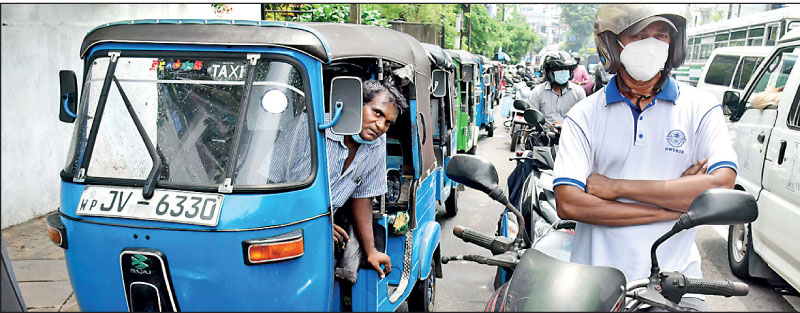
The hardest hit from the shortage of domestic gas are the urban people who live in small homes and in mid and low income apartments where they have very little alternative options.

For such communities we should facilitate through municipal councils, temples, churches or such welfare organisations a system of community cooking.

What is suggested is that community kitchens are set up at a location close to a community in a permanent or a temporary building where a number of large 35-litre industrial gas cylinders are connected to a series of cookers. Those cookers can be fixed with meters so the usage can be monitored. The residents will have to bring ready to cook food items and use the cookers and pay for usage. Well one can say this is not practical, but far better than having to sleep overnight at gas queues. 

Once we start such a facility there might emerge new businesses such as cut and prepared vegetables for people to buy. Some will have scraped coconut, etc. There can even be utensils to hire. And this can eventually be a wonderful community experience. It will certainly be economical for the consumer as one would pay only for the gas used. This will in the medium term reduce the burden on the system. Otherwise currently there must be a couple of ship loads of gas in households.


Alternative stoves

We see a few efforts by local inventors who have come up with stoves that work on coconut charcoal and firewood. But I am not sure whether they can directly compete with the gas cookers. We need to come up with an alternative solution that does not use LP Gas or electricity in cooking, that is clean, and the temperature can be controlled. Development of such a product needs different fields of science working together. This can be a massive marketing opportunity. 

Just to stimulate thought let me share a case study.


Chotukool

(https://www.youtube.com/watch?v=IUADltOgj3w)

Godrej India used disruptive innovation concepts when their sales of refrigerators was not growing. They set out first to make a small fridge for low income households. But the market surveys reveal that those people could not afford traditional fridges even though they are small. Above all most of them did not have a reliable supply of electricity. Their requirement was to preserve vegetables for a few days.

So the company defined the problem as “finding a solution to keep the vegetables fresh for a few days without having to depend on regular power supply and that is affordable to poor”.

In that process they replaced the conventional compressor of a fridge with a 4mmx4mm chip that managed the temperature and a rechargeable battery that can power the equipment. It was a small box that was similar to a cool box in a car. It revolutionised the market.

We need such disruptive thinking to find solutions to the current cooking energy problem, without taking it as an LPG problem.

Cooking is such an essential activity of our existence, and how come we have to depend on a ship from some other country to boil my vegetables! What kind of food security is that? Now is the time to ask such dumb questions.

148 Israeli violations against Palestinian journalists in May: NGO

A press member holds the photo of Al-Jazeera journalist Shireen Abu Akleh who was killed by Israeli forces,13 May 2022 [Nedal Eshtayah/Anadolu Agency]

A press member holds the photo of Al-Jazeera journalist Shireen Abu Akleh who was killed by Israeli forces,13 May 2022 [Nedal Eshtayah/Anadolu Agency]


June 1, 2022 

An Arab NGO has documented 148 Israeli rights violations against Palestinian journalists in the occupied Palestinian territories last month, Anadolu News Agency reports.

In a statement on Wednesday, the Journalists Support Committee said the month of May witnessed a surge in attacks on Palestinian journalists by Israeli forces and settlers.

It termed the attacks as "an attempt to prevent Palestinian journalists from covering Israeli assaults against Palestinians and their holy sites."

According to the NGO, the Israeli violations varied from arrests, intimidation, shooting, verbal and physical assaults to car-ramming incidents.

It said 11 journalists were detained by Israeli forces in the West Bank during May, while the custody of five others was extended without trial.

READ: Shireen Abu Akleh's family seeks international probe into her murder

"Israeli forces, in collaboration with settlers, disrupted the work of 61 journalists and media institutions while covering Israeli violations in the cities of Jerusalem, Hebron and Jenin," it added.

The NGO also noted that the social media accounts of 11 Palestinian journalists were suspended for alleged violations of publication rules.

Last month, Al Jazeera journalist, Shireen Abu Akleh, 51, was shot dead while covering an Israeli military raid in the West Bank city of Jenin.

Palestinian officials and her employer, Al Jazeera, said she was killed by Israeli forces.

There was no comment from Israeli authorities on the NGO's report.


Palestinians in Masafer Yatta made homeless twice over by Israeli demolitions

The Israeli military bulldozed tents housing 21 Palestinians on Wednesday morning, whose original homes had already been destroyed last month.

Israeli police stand in front of a bulldozer demolishing homes in Masafer Yatta in front of the occupied West Bank, June 1, 2022. (B'Tselem)
 

By Basil al-Adraa and Yuval Abraham June 1, 2022

On Wednesday morning, the Israeli military carried out another round of demolitions in Masafer Yatta in the occupied West Bank, in a continuing escalation of Israel’s efforts to forcibly expel the area’s Palestinian residents. The military bulldozed tents that had been home to 21 residents of al-Markaz and Fakheit, two villages in the area. 

The demolitions, which targeted families whose homes had already been destroyed in May and who had set up the tents in order to have somewhere to sleep, came in the wake of a High Court ruling last month that paved the way for Israel to proceed with a long-postponed expulsion on the grounds that Masafer Yatta sits within an army firing zone. The military’s previous demolition operation in the area destroyed the homes of 45 residents.

“The aim is to send us into despair,” said Muhammad al-Najjar, a resident of al-Markaz. “They came straight away to carry out demolitions against everyone whose homes they’d already destroyed.” After carrying out a demolition, the Civil Administration — the arm of Israel’s military government that governs the 2.8 million Palestinians in the occupied West Bank — can return to demolish buildings in the same spot without the need for a demolition order or legal proceedings.


The current wave of demolitions comes in the wake of the High Court’s ruling last month that allowed the army to proceed with the expulsion of thousands of Palestinians in the Masafer Yatta region of the West Bank, on the grounds that the area is located within an army firing zone. The demolitions came just one day after dozens of Democratic senators and congresspeople in the United States signed a letter calling on President Joe Biden to stop the expulsions.

“The army flew drones over us the day before yesterday — I was afraid they were coming,” said Safa al-Najjar. She, her children, and her grandchildren all lived in a tent that the army had destroyed, after having demolished their home earlier in May. On Wednesday morning, once al-Najjar realized that the military was conducting demolitions in nearby Fakheit, she told her children to quickly dismantle their tent and hide it in a cave. That made little difference.

“The soldiers came and searched for the tent,” al-Najjar explained. “They went into the cave, took the tent, and put it in front of the bulldozer, which drove over it until it was destroyed.” The soldiers crumpled the tents and covered them in sand and rocks, so that they would be unusable.

The military tried to prevent journalists from documenting the demolitions, claiming that they were in a firing zone and that entry was forbidden. An army officer at the scene threatened to forcibly arrest +972’s Basil al-Adraa (who co-authored this report) if he did not leave the area, despite the fact that he had identified himself as a journalist and presented his press card.

Demolished homes in Masafer Yatta in the occupied West Bank, June 1, 2022. (Yuval Abraham)

Soldiers also tried to bar journalists from entering the area by car, again on the grounds that it was forbidden for them to enter a firing zone. Since the High Court’s ruling, residents have reported increasing restrictions on vehicles entering the area.

Both al-Markaz and Fakheit look like a warzone. Only a few houses remain of the hamlet, and most of the village is in ruins. The scene in Fakheit is the same: the majority of its homes have been demolished, with only the elementary school in the center of the village still standing. Its students were in class when the bulldozers arrived on Wednesday; their playground is now surrounded by rubble.

Some of the families who have been left homeless by the demolitions will be sleeping in caves on Wednesday night. But the conditions inside the caves — which are ancient and can be found in every village in Masafer Yatta — have deteriorated significantly over time.

“It’s like going to sleep inside a tomb,” said Muhammad al-Najjar. He and his three young children expect to spend Wednesday night in the cave as well, until they manage to gather enough funds for another tent. His mother, who is approaching 70, said that she is “frightened of the cave” and will sleep outdoors instead. Her grandchildren, after coming back from school, discovered that they no longer had a home, and dragged their bed out from the ruins of the tent.

China Threatens to Downgrade Relations with Israel over Jerusalem Post Interview

Chinese Foreign Minister Wang Yi. (Photo: CANCILLERES ECUADOR / CHINA, via Wikimedia Commons)


June 1, 2022

 A senior Chinese diplomat is threatening to downgrade relations with Israel and cut ties with the Israeli newspaper The Jerusalem Post, unless it deletes an interview with Taiwan’s Foreign Minister published on Monday.

The paper’s Editor-in-Chief, Yaakov Katz, announced on Twitter yesterday that he “got [a] call from [the] Chinese embassy,” revealing that he is “supposed to take down the story or they will sever ties with The Jerusalem Post and downgrade relations with the State of Israel. Needless to say, the story ain’t going anywhere.”

In the exclusive interview with the Taiwanese Foreign Minister Joseph Wu, he warned that Israel is relying too much on China and that Beijing is also preparing to invade Taiwan.

This is not the first time the paper has angered China or received condemnation from its embassy, as it was previously condemned after an opinion article was published on 10 May which covered Chinese authorities’ genocide of the Uyghur Muslim population in the north-western province of Xinjiang.

Slamming what it called an “anti-China article written by a ‘Xinjiang independence’ separatist”, the Chinese embassy in Israel stated back then that “We firmly oppose and strongly condemn that the Post, in disregard of the fact that Xinjiang is an inalienable part of the Chinese territory, served as a platform for ‘Xinjiang independence’ separatists by publishing their anti-China article.”


Advanced rocket systems are to be used “on the battlefield in
Ukraine” – that’s the pledge from President Biden as he reversed America’s previous stance and agreed to supply Ukraine with weapons with a range of nearly 50 miles.

The president insisted he was not “encouraging or enabling” Ukraine to strike beyond its borders but the Kremlin accused America of adding fuel to the fire.

Ukraine’s military hope it will help them hold the line in the east of the country and the onslaught.

Civil Rights Orgs Challenge Racist “Insular Cases” Used to Legally Discriminate Against Puerto Rico


JUNE 01, 2022

Civil rights groups are challenging a series of racist U.S. Supreme Court rulings that have been used for over a century to legally justify discrimination against people in Puerto Rico and other U.S.-occupied territories. The rulings are known as the Insular Cases and have allowed the federal government to deny Puerto Ricans living on the island voting rights, access to public social programs like Medicaid and food stamps, and other equal protections guaranteed to those residing on the mainland. The renewed effort to overturn the Insular Cases comes after the Supreme Court sided with the Biden administration to continue denying Supplemental Security Income benefits to seniors and people with disabilities living in Puerto Rico. We speak with Lía Fiol-Matta, senior counsel for LatinoJustice PRLDEF, which is helping to lead the new campaign, and with Democracy Now! co-host Juan González, who has long reported on this issue. “The Insular Cases established a doctrine that has no constitutional basis,” says Fiol-Matta.


This is a rush transcript. Copy may not be in its final form.

AMY GOODMAN: This is Democracy Now!, democracynow.org, The War and Peace Report. I’m Amy Goodman, with Juan González.

We continue to look now at a new campaign by civil rights groups urging the federal government to overturn a series of U.S. Supreme Court rulings that have for over a century been used as the legal justification to racially discriminate against people living in Puerto Rico and other U.S. territories. The rulings are known as the Insular Cases, which opponents have long denounced as some of the most racist U.S. Supreme Court rulings, firmly rooted in white supremacy to protect U.S. colonialism. The Insular Cases have allowed the U.S. federal government to deny Puerto Ricans living on the island voting rights, access to public social programs, like Medicaid and food stamps, and other equal protections as those residing on the mainland U.S.

The renewed efforts to overturn the Insular Cases come about a month after the Supreme Court sided with the Biden administration to continue denying SSI — that’s Supplemental Security Income — benefits to seniors and people with disabilities living in Puerto Rico. The lone dissenter was Justice Sonia Sotomayor, whose parents were born on the island. She referred to the 8-to-1 ruling as “irrational” and “antithetical.” But what came as a surprise in this case was a 10-page concurring opinion written by the conservative Justice Neil Gorsuch calling on completely overthrowing the Insular Cases.

In part, Gorsuch wrote, quote, “A century ago in the Insular Cases, this Court held that the federal government could rule Puerto Rico and other territories largely without regard to the Constitution. It is past time to acknowledge the gravity of this error and admit what we know to be true: The Insular Cases have no foundation in the Constitution and rest instead on racial stereotypes. They deserve no place in our law,” the ultraconservative Justice Neil Gorsuch wrote.

Well, for more, we’re joined in New York City by Lía Fiol-Matta, senior counsel for LatinoJustice PRLDEF, where her work focuses on economic justice and issues related to Puerto Rico. LatinoJustice alongside the American Civil Liberties Union and other civil rights groups have joined forces in this renewed effort to overrule the Insular Cases. Also with us is Juan, Juan González, the co-host of Democracy Now!

Juan, when you first responded to the Supreme Court decision and pointed out what Neil Gorsuch had said, in addition to Sonia Sotomayor, this was one of the most popular commentaries on our website. And so, we want to ask Lía, for starters: What is this campaign all about? How are you organizing? And why are you doing it?

LÍA FIOL-MATTA: Good morning. It’s such a pleasure to be here.

This campaign is pretty much coordinated between LatinoJustice, Hispanic Federation, the ACLU and Equally American, as well as other allies, but these are the main organizations. And we have embarked on a strong campaign, which started before the Vaello Madero decision was even issued, against the Insular Cases through public education, presentations, media contacts like this one, as well. And also we are embarked on a campaign to pressure — continue pressuring the Biden administration to denounce the Insular Cases and for federal courts to stop relying on them, as well. Our main concern, obviously, at this moment is to have the Supreme Court finally overrule the Insular Cases in a case that has been filed for cert, for consideration of the Supreme Court, which is Fitisemanu v. the United States. But also we want to pressure Congress to pass legislation to also support federal benefits programs, to treat residents of the territories equally.

JUAN GONZÁLEZ: And, Lía, I wanted to ask you about the Fitisemanu v. United States case. This is a case of U.S. citizens from American Samoa. Can you talk about that case and how it’s similar to the issues raised in Puerto Rico and in other U.S. territories?

LÍA FIOL-MATTA: Well, first of all, the American Samoans are not Americans citizens, and that is at the crux of this case. They are considered United States nationals. So the case is to request or to demand U.S. citizenship, but also directly for the Supreme Court to overrule the Insular Cases. The organization that I represent, LatinoJustice, and others have joined in an amicus brief, a friend-of-the-court brief, asking the Supreme Court to take on the case, particularly because it is a frontal attack on the Insular Cases. And that is because the 10th Circuit Court of Appeals relied on the Insular Cases, even though they denounced them also and criticized them, but they said that the Insular Cases gives Congress the authority to make decisions about the territories, and therefore, relying on the Insular Cases, the 10th Circuit reversed a district court of Utah that had agreed with the plaintiffs that American Samoans should enjoy all citizenship rights as other territories of the United States.

JUAN GONZÁLEZ: One of the things that has struck me over the years on the court decisions regarding Puerto Rico is the absence of the so-called liberal justices on the Supreme Court. Ruth Bader Ginsburg, when she was on there, Stephen Breyer, Justice Kagan have not really dared to tackle the precedents set by the Insular Cases in any frontal way. I’m wondering your thoughts on that and how this might conceivably change, especially now that an extreme conservative justice like Gorsuch has taken such a strong stand?

LÍA FIOL-MATTA: Absolutely. You know, in Vaello Madero, civil rights activists, we were not necessarily expecting for Vaello Madero to prevail. We were hoping that that would happen. But due to the conservative court, we were not really very much expecting that outcome. But we were terribly disappointed that the — like you mentioned, that the other liberal justices did not join the dissent, the strong and fantastic dissent of Sonia Sotomayor. So, we are also grappling with that.

And hopefully in this next case that is pending, which is Fitisemanu, hopefully we might have a change, because, as you know, in the Vaello Madero decision, like you mentioned, both Sonia Sotomayor and Justice Gorsuch denounced the Insular Cases. And Justice Gorsuch had already hinted at this — well, not really hinted. He had pretty much, in oral arguments in November, asked the federal government: Why don’t we just overrule the Insular Cases? And the federal government, the solicitor general, kind of said, “Yeah, these are not great cases, but this is not the crux of this matter right now before you,” so they kind of skirted the issue. But Gorsuch had already signaled his opposition. And then, of course, in his concurrence in Vaello Madero, which is very long and extensive and detailed, he provides even the historical context of the court, and he denounces them very, very strenuously. So we’re hoping that both those justices and then hoping that the liberals, as well — now, obviously, we’re going to have a new liberal justice on the court at the time if this case is taken up by the court, so our fingers are crossed that this will be — hopefully, this will be the case that will finally have these cases overruled.

AMY GOODMAN: Juan, you know, when you shared this commentary on the Insular Cases, I was wondering if you could once again talk about why they’re called Insular Cases, this whole century history, and why it is Justice Gorsuch, how it fits into the ultraconservative philosophy of him to talk about these racist laws.

JUAN GONZÁLEZ: Well, I think the key thing to understand is that in the aftermath of the Spanish-American War, when the United States acquired the remaining territories of the Spanish Empire, including the Philippines, temporarily Cuba, as well, and Puerto Rico, that there was a debate as to, well, what’s the relationship between these noncontiguous territories of the United States, these new places where the American flag was planted, and the rest of the country. And so, between — in the early 1900s, in a series of decisions, a lot of them having to deal basically with tariffs and do tariffs apply — you know, it was a lot of commercial issues, but there were also individual issues as to what rights of the Constitution apply in Puerto Rico. So, several cases — Balzac v. Porto Rico, Downes v. Bidwell and a bunch of other cases — the court had to grapple with this, and essentially said that, yes, the Constitution only applies in these territories to the level which Congress decides it can apply and that Congress has complete power to decide how to run these territories. And so, basically, it established the legal basis for the holding of a colonial empire.

And so, that is really — has never really been challenged in a hundred years in any significant way, except in the last few years, with the crises in Puerto Rico especially, and there have been several cases, and now, of course, this American Samoa case. So, now for the first time, really, people are grappling with what it means, because in the meantime there’s been — and I’m sure Lía can talk much more extensively about this, how the Insular Cases have been used to provide second-class benefits to the people of Puerto Rico especially, because in some cases, even the Virgin Islands have been exempted by Congress from some of the more onerous second-class services that the government provides to the territories. Lía, if you could talk about —

LÍA FIOL-MATTA: Absolutely

JUAN GONZÁLEZ: — some of the concrete ways that this affects the people of Puerto Rico?

LÍA FIOL-MATTA: Absolutely. I would also like to say that the Insular Cases established a doctrine that has no constitutional basis, which is the territorial incorporation doctrine. And the five inhabited colonies of the United States are considered unincorporated territories, and only, quote-unquote, “fundamental rights” apply to them, and those are decided by Congress arbitrarily.

So, in terms of Puerto Rico specifically, we know that the Vaello Madero decision denies SSI benefits to the neediest Americans, the poor, disabled, blind and elderly American citizens that reside in Puerto Rico. And there are other federal benefits, as well, that were not considered in that case, but there were other cases — for example, Peña Martínez v. the Department of Health and Human Services. That case involved SSI, as well as SNAP and Medicare, other benefits in which Puerto Ricans, the residents of the island, are treated unequally to the other states of the United States. And unfortunately, that case, which was being appealed at the 1st Circuit, I guess, pretty much is moot at this point, as well as other cases in addition to that one.

So, yes, absolutely, the benefits in the decisions that have been applied to the different territories are very arbitrary. I want to point out that the Northern Mariana Islands, they do have SSI. And that was part of the deed of cession that was decided with the United States —

AMY GOODMAN: Lía, we just have 10 — we just have 10 seconds. What can Biden do specifically now? Ten seconds.

LÍA FIOL-MATTA: President Biden needs to denounce the Insular Cases, needs to instruct federal — well, he cannot instruct them, but needs to exhort federal courts to stop utilizing and relying on that and needs to also —

AMY GOODMAN: Lía Fiol-Matta, we have to leave it there, senior counsel for LatinoJustice PRLDEF. I’m Amy Goodman, with Juan González.