Sri Lanka: One Island Two Nations

Search This Blog

Wednesday, 30 September 2020

 My Role As Archbishop Of Canterbury & Appointing Bishop Of Colombo


By Archbishop of Canterbury Justin Welby –

Archbishop of Canterbury

The role of Archbishop of Canterbury is always surprising. It is a great humbling experience for those who would be foolish enough to believe that they were important. I have been told that I was too short, too untheological, and too English. 

The Anglican Communion is also a remarkable gathering. It arises from a history with many bad times to it, the history of colonialism and imperial rule. But in the power of God and through the teaching of Jesus Christ, the church slowly learned to separate faith and the flag and to become more what Christ designed for it to be, a holy people, belonging to God, who seek to bless the communities in which they live. 

There are about 80 million Anglicans in the world. The average one is not from the UK or the USA, but is a woman in sub-Saharan Africa, in her 30s, with a 50-50 chance of being in a place of persecution. She will be living in extreme poverty, probably on less than three US dollars per day.

The miracle of the church, for Christians, is not that it disagrees. After all, with over 2000 languages and cultures it is absurd to think that we would always be in agreement.


Fr. Dushantha Rodrigo

The miracle of the church is that we agree on the basics and the most important things, especially the obligation to love God and to love our neighbour. We agree on the nature of Jesus Christ. We agree on the love of God which reaches out to us. We don’t always, sometimes not often, practice what God has given us but we agree that when we do fail we are able to turn around and go in a different way, what Christians call repent, and seek the forgiveness of God and his power to do better in the future. 

So, what’s this got to do with Sri Lanka? Well, to go back to the first paragraph, one of the most surprising things about this job is I found that I had direct responsibility as what in the church is called a Metropolitan in all sorts of parts of the world. One of those was Sri Lanka. The Church of Ceylon had not joined in with the Church of South India when that was created in the late 1940s and had not formed its own independent and autonomous church at any time later. The Anglican Communion has 41 provinces and although if it were a province the Church of Ceylon would not be by any means be the smallest, it does need to form at least one possibly two more dioceses (area overseen by Bishop) in order to reach the minimum size. 

For historical reasons that had not happened and therefore a few weeks ago I found myself with responsibility for choosing the next Bishop of Colombo, because the electoral college had nearly but not quite been able to get a sufficient majority to make their own choice. 

Read More

Uplift the service with PSR test


The service offered to the customer should be purpose-driven. Never do anything that does not add value for a customer. The companies need to understand what customers will value most, post-COVID-19, and develop new use cases and tailored experiences based on those insights. Hence, be ‘hands on’ with what is happening in the environment around and thereby, initiate solutions that fulfil the customers’ current needs – Pic by Upul Abayasekara 


Wednesday, 30 September 2020

The COVID-19 crisis has changed everyone’s life. It will continue to do so as nobody has any solid facts to predict when this pandemic will come to an end globally. Many now believe that we will have to live along with it for some time.

We are a country that has comparatively managed the pandemic very well. As a result, we observed over the last couple of months how the lifestyles of our people are gradually regressing to normalcy. Nevertheless, we are yet to experience whether there will be a change in customer behaviour once the moratorium offered by the banks comes to an end this October. 

Globally, some think ‘COVID 19’ is not just a virus causing people to suffer or die but a ‘strategy’ in itself. This article will discuss briefly what has to be done in setting up the service culture giving due emphasis to PSR namely; ‘People’, ‘Speed’ and ‘Relevance’ aspects.

People

People are the greatest asset to any organisation at all times. The entities will now have to rethink on their operating model based on how their people work best in the current situation. If a difference has to be made to an entity it has to be initiated with people first. Even a technology-based solution has to be instigated and conceptualised by human beings. Therefore, conceptualise with the existing talent in the organisation what steps have to be taken to strengthen and enhance the service culture in your own outfit during a crisis.

In the process understand the fact that the best ideas need not necessarily come from the top. Formulate either ‘Idea Generation Platforms’ (IGP) or ‘Make A Difference Teams’ (MADT) to come out with some workable ideas that ‘favor action over research, and testing over analysis’. When the staff is given the opportunity to come out with their own ideas, they tend to work with a sense of belonging.  This in turn will provoke the staff to achieve cost optimisation which is a prime need of the hour as well. Moreover, there is a self-motivation to their utmost to face the challenges ahead of them when creating value to all stakeholders. 

The fashion industry was badly hit with the pandemic. The ‘Make A Difference Team’ of one of the companies was exploring the possibilities of inventing something new. They found a scope to make the business active and get people to feel better by manufacturing Personal Protection Equipment suits and masks of all designs to help customers feel comfortable, safe and stylish. The team suggested a new tagline; ‘One size fits all but not all designs fit all’.

To meet these challenges, every company should craft a talent strategy across the entity to develop its employees. It should take care of developing and enhancing employees in their social and emotional skills, service mindset, critical digital capabilities, adaptability, resilience and efficiency. Now is the time for companies to go all out on their learning budgets and commit to reskilling. Developing this muscle will also strengthen companies to harness its future opportunities.  Generally, during and after crisis there is a remarkable drop in overall training expenditures. What this tells us is that if companies cut their learning budgets now, they are only delaying their investment, not netting a saving especially since the current crisis will require a significant skill shift with regard to more service orientation. We have observed at present that State sector entities are showing a keen interest in training their staff after COVID-19. Perhaps it may be due to the vital role that the public sector has to play currently in rebuilding the economy and the country. This goes hand in glove with the President’s mission of ‘Rata Hadana Saubhagyaye Dekma’. 


Speed

Everybody will have to be fast and make decisive adjustments to changing circumstances. The speed with which you react to the market need plays a vital role. The decisions have to be made promptly. Our experience was such that many new delivery channels emerged during the pandemic. As a result, today we can get anything from even ‘a pin’ to ‘a jewellery item’ delivered home within a short period of time.

During a crisis organisations should think about the capabilities of both their man power and technology to provide speedy solutions. I took my car for a valuation to De Silva Motors recently. With the increase in demand for vehicles, owing to the current import restrictions, many vehicles were queued up for valuations. The inspectors were conducting their examinations thoroughly and the valuation reports were issued quickly. To me, this was a clear demonstration of the efficiency in both the staff and systems put in place to provide a speedy solution. 

Amidst the uncertainty of the lockdown, a friend of mine decided to transfer some of his existing deposits to a different account in the same bank held by his daughter. The daughter’s account was opened 15 years ago when she was a minor. His experience was such that this transaction had virtually taken almost two weeks.

On clarification, he was informed that the delay was owing to converting the daughter’s minor account to a major account. He was questioning; is it due to a policy, process, people issue or combination of all of them? Nevertheless, the undue delay had disappointed the customer. His concern was that while I am living if this was the delay, I had to experience for such a minor matter, imagine what will be my daughter’s plight with this bank if there is a testamentary case when I am no more? The pandemic has accelerated the shift to digital. No point having the best technology in place if it does not put the customer at ease with regard to speedy solutions and convenience. Whilst the best companies are going further, by enhancing and expanding their digital channels, they should always remember to keep in mind that the customer is the centre of attraction at all times. 

Therefore, in designing speedy solutions, it is also important to develop a mindset that; ‘Today, is not yesterday’s tomorrow, but tomorrow’s yesterday’  


Relevance

The service offered to the customer should be purpose-driven. Never do anything that does not add value for a customer. The companies need to understand what customers will value most, post-COVID-19, and develop new use cases and tailored experiences based on those insights. Hence, be ‘hands on’ with what is happening in the environment around and thereby, initiate solutions that fulfil the customers’ current needs. 

In the process continue to identify and prioritise revenue opportunities whilst creating value to the customer. This may include launching targeted campaigns and activities to keep your existing customers with you. Instances such as Cargills Food City introducing a mobile mini super market and banks launching mobile ATMs became so popular amongst people during the pandemic. The mobile communication companies offering additional bonus data on activation of certain packages has a relevance in serving the current customer needs.

The people have begun to realise the importance of the local industries in facing the pandemic and also of the need to build the country’s economy. To what extent have the authorities fine-tuned the approval process to be relevant to the needs of the potential vendors? Moreover, have the banks thought of offering financial packages to such vendors which is relevant to fulfil their needs?


Conclusion

The entities must concentrate on the PSR (People, Speed, Relevance) test in the current circumstances. It is a little initiative to be made by the companies but it can create a significant value difference in providing a valuable service to the customers. In this process the ‘people’ factor will continue to play a vital role in the entity. How ‘quickly’ the business gets adjusted to fulfil customer needs matters next. Eventually, the solution offered should be ‘current’ that fulfils the exact need of the customer.

(The writer is a sought after ‘Service Excellence’ specialist in Sri Lanka. Over the last 25 years he has conducted nearly 3,000 inspirational and educational programs for over 750 organisations in 11 countries. His work can be seen at www.dhammikakalapuge.com)

 Is breast cancer preventable?


1 October 2020

There is no certain way of preventing breast cancer. However, according to the World Health Organisation (WHO), about 30-50% of cancers are preventable. Genetics account only for about 5% of cancer, known as hereditary cancers. Our lifestyle choices, the food we eat and our level of physical activity has a significant impact on the overall cancer risk. Since prevention offers the most economical long-term strategy for control of cancers, national policies in addition to treatment should also focus on raising public awareness to minimise exposure to cancer risk factors as well as promoting healthy lifestyles.


Breast cancer is the commonest cancer among females, affecting nearly 2.1 million females globally each year. While breast cancer rates are higher in the developed regions, its rates are increasing in the developing regions as well. In Sri Lanka, it is the most common cancer. Over 3,000 new breast cancer patients are diagnosed each year, which accounts for about 25% of all female cancers and nearly 15% of all cancers.


Female gender, advancing age, family history, early puberty and late menopause are some of the non-modifiable risk factors for breast cancer. In addition to the above, there are many modifiable risk factors, the control of which helps prevent breast cancer. Since October is Breast Cancer Awareness Month, and there is a global movement to increase public awareness about the disease, some frequently asked questions about breast cancer risk and prevention are addressed below.


1. Can a healthy diet reduce the risk of breast cancer?
A nutritious diet low in fat (less than 30 grams) can help lower the breast cancer risk. The diet should include at least 5 servings of orange vegetables such as carrots, pumpkins, sweet potatoes, papaya and oranges, as well as cruciferous vegetables such as broccoli, cauliflower and cabbage a week. A diet rich in fat triggers oestrogen production, which in turn increases the risk of breast cancer.


2.Can exercise reduce the risk?
Physical activity, in the form of moderate to strenuous exercise of more than three hours a week, has shown to reduce the risk by 30-40%. Exercise boosts one’s immunity and a 30-45 minute brisk walk per day is recommended.


3.Are breast cancers mostly familial or inherited?
Nearly 90-95% of breast cancers are sporadic, meaning it can affect a woman without a previous family history of cancer or genetic predisposition. Only a minority (5%) of breast cancers is familial and hereditary. Being a woman and getting older are the main risk factors for breast cancer.


4.Does smoking increase the risk?
Needless to say, in addition to heart and lung disease, smoking is a confirmed risk factor for many cancers including breast cancer. Both active and passive smoking are contributory. The benefits of quitting begin the day one stops smoking, and this advantage becomes greater as time goes by.


5.Does drinking alcohol increase the risk?
Having more than one drink a day, irrespective of the alcohol percentage and content, including wine, beer and other spirits, increases the risk. While there are claims of heart health benefits by drinking a glass of wine, alcohol increases the production of oestrogen in the body and the more you drink, the risk increases.


6.Does stress cause breast cancer?
Many affected women believe that stress and anxiety caused them to develop breast cancer. A large study conducted in the United Kingdom regarding this association found no link between breast cancer risk and stress. However, living a happy, satisfied and stress-free life can have a hugely beneficial effect on one’s health.


7.Does hormonal contraceptive increase the risk?
All hormonal contraceptives could slightly raise your odds of breast cancer. This should not be a reason to panic if you are on the pill. The risk is very small and is only significant in young women with a strong family history of breast cancers and in those who have been on the pill for more than 5 years. If you have a family history, you can discuss other options with your gynaecologist.


8. Is Hormone Replacement Therapy (HRT) linked to breast cancer?
Higher levels of oestrogens due to exogenous hormones taken as HRT in women with menopausal symptoms have shown to increase the risk of breast and ovarian cancer. Therefore, it is cautioned in females with a family history of these cancers.


9.Is obesity a risk factor?
Being overweight or obese greatly increases the risk of breast cancer. This is particularly so if obesity occurs later in life after menopause. If you are someone who has already gained weight, you will be interested to know that weight loss seems to help reduce this extra risk.


10.Does breastfeeding prevent breast cancer?
Breast-feeding might reduce the risk. The longer you breastfeed, the greater the protective effect.


11. Are nulliparous women at higher risk?
Women who haven’t given birth to a child have a 20-40% higher risk of developing postmenopausal breast cancer as compared to women who first gave birth before the age of 30 years.


12.Avoid exposure to radiation
Exposure to ionizing radiation is a well known long-established environmental risk factor for developing breast cancer. If you are working in a vulnerable risk environment with high radiation, such as in hospitals with radiological imaging including X rays and CT scans, it advised having a dosimeter to keep a check on the radiation dose one gets exposed to.


13.What foods are linked with breast cancer?
As countries become more westernised, their risk of breast cancer increases. Women who migrate from a country with low breast cancer incidence to a western country often experience a significant rise in their risk. One of the reasons for this appears to be a Western diet rich in sugars and fats as well as frequent consumption of fast foods, and not any particular food item or additive.


14. Do men get breast cancer?
Although rare, men too can get breast cancers. About 1-2% of all breast cancers are in males. Alcohol intake, liver disease, obesity, family history and radiation exposure are some of the risk factors that cause male breast cancer. Klinefelters syndrome is a rare genetic disorder in which a male has an extra ‘X’ (female) chromosome, leading to higher circulating levels of oestrogen. These males have a higher risk of breast cancers.


15. Do mammograms cause cancer? Are they safe?
Some women are apprehensive of being exposed to radiation during mammography. Don’t be afraid. This is superfluous anxiety. Modern-day mammography involves only a tiny amount of radiation, smaller than a regular chest X-ray.


Mammograms save lives. Detection of breast cancer in early stages reduces breast cancer deaths by 25-30%. Mammography is a quick procedure and the discomfort is very minimal in most women. Get a digital mammogram, they give superior images with higher detection rates.


Finally, I’d like to conclude by emphasising the importance of living a healthy active lifestyle, quitting smoking and limiting alcohol consumption. Besides, all women should practice monthly self-breast examinations, to familiarise one’s self with how the breasts normally look and feel. The self-breast examination helps in detecting cancer in the early stage when it is more likely to be treated effectively. If you find a lump in your breasts, don’t panic. On most occasions, they turn out to be benign (non-cancerous). However, to confirm the nature of such breast lumps, seek urgent medical advice.


The writer is a consultant in cancer surgery with an interest in breast cancer and breast disease.

BDS Victory: Columbia University Votes to Boycott Israeli Companies


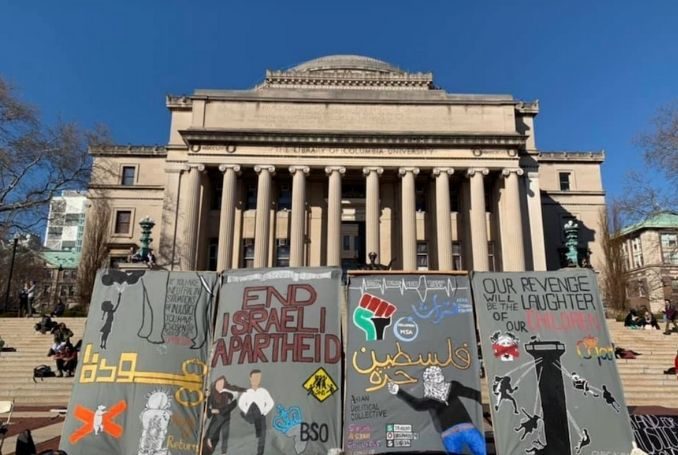
Columbia University voted in favor of boycotting Israeli companies complicit in violence against Palestinians. (Photo: via BDS website)


September 30, 2020

The Boycott, Divest and Sanctions movement recorded yet another win on Tuesday after Columbia University voted in favor of boycotting Israeli companies complicit in violence against Palestinians.

The university’s student body voted 61% in favor of divesting from companies that are complicit with Israeli crimes against Palestinians.

Some 27% of students rejected and 11% abstained, according to figures, JNS reported.

The referendum, which was passed last week, recommended the institution “divest its stocks, funds, and endowment from companies that profit from or engage in the State of Israel’s acts towards Palestinians that, according to the student group Columbia University Apartheid Divest (CUAD), fall under the United Nations International Convention on the Suppression and Punishment of the Crime of Apartheid.”

The move marks yet another victory for the Boycott Divest and Sanction movement.

The pro-Palestinian movement which comprises dozens of Palestinian civil society groups was established in 2005 as a means to promote various boycotts against Israel until it meets its obligations under international law and provides basic human rights for Palestinians.

Tuesday’s BDS win comes amid ongoing outrage over Arab normalization pacts with Israel.

On September 15, UAE and Bahrain have signed an agreement that is expected to lead to “full normalization of relations” between the Arab nation and Israel.

The agreement is considered a severe blow to Palestinian efforts aimed at isolating Israel regionally and internationally until it ends its military occupation and apartheid-like system in occupied Palestine.

Incoming ambassador to UK called for “expanding” Israel’s borders


Asa Winstanley -30 September 2020

Israel’s incoming ambassador to the UK has called for “expanding” Israel into neighbouring Arab countries, a video of an old speech shows.

In it, Tzipi Hotovely expressed her preference for right-wing Zionist anthem “Two Banks to the Jordan,” a Hebrew song which in 1929 laid claim to the entirety of Palestine and what became the state of Jordan.

Having earlier in the speech criticized some Israeli politicians for the “mentality that doesn’t look 20 years ahead,” she articulated her vision for what she has called Greater Israel.

She explained in the speech: “We must not settle for preserving what exists. We must always look forward and ask ourselves: What do we want for the next generation? Do we want to see our enemies continuing the Islamic revolution on our eastern frontline? Or do we want to see the state of Israel expanding?”

The song’s chorus goes: “Two banks has the [River] Jordan / This is ours and that is as well” before continuing in a verse exclaiming: “Let my right hand whither / If I forget the East Bank of the Jordan.”

Hotovely went on in her speech to imply that the “expanding” of Israel should also include Syria: “if only those people in Syria had a little bit of the rights that Israeli Arabs have.”

You can watch her comments above, or see video of the full speech below.

“Expanding” into Syria

The Irgun logo. The militia laid claim to the entirety of Palestine and Jordan. (Wikipedia)

As well as dismaying Syrians, the suggestion by Israel’s next UK ambassador that she would like to see Israel “expanding” on both sides of the River Jordan will also alarm Jordanians – at least half of whom are the descendants of Palestinian refugees expelled by Zionist forces in 1947 and since.

Israel already occupies a large tract of Syrian land – the Golan Heights, which it illegally annexed in 1980.

When Israel invaded in 1967, they drove out more than 95 percent of the population of the Golan – 130,000 Syrians – and systematically destroyed hundreds of villages and one city.

Since then, the refugees have been blocked by Israel from returning, while around 23,000 Israeli settlers now dominate the occupied territory.

Despite Hotovely’s claims, the remaining Syrians in the occupied Golan Heights today are still not treated with equality.

“Discriminatory Israeli policies continue to violate the basic human rights of Syrians who have become second-class citizens in the land of their birth,” the Syrian human rights group Al-Marsad says.

Hotovely gave her speech in 2012, addressing a radical group of West Bank settlers called the “Women in Green” at a conference at a settlement in Hebron.

“Jordan is a historic compromise”

One year later, as a junior minister, she told a Likud Party event that “the existence of [the state of] Jordan is a historic compromise” and that “whoever believes in the Greater Land of Israel has never been prepared to give parts of our homeland away for any purpose, not even for peace.”

A petition by British Jews launched in June calling for the UK to reject Hotovely as ambassador now has almost 1,900 signatures.

Although she was confirmed by the Israeli cabinet in August, current minister for settlements Hotovely is yet to arrive in the UK.

The last ambassador, Mark Regev, left the UK in June and the deputy ambassador has been serving as chargée d’affaires since. Regev returned to his position at the Israeli prime minister’s office in August.

Asked if she stood by the speech, Tzipi Hotovely and the Israeli embassy did not reply to requests for comment.

“Two Banks to the Jordan” was written by Vladamir “Zeev” Jabotinsky, the founder of right-wing Zionism and the ideological grandfather of the ruling Likud Party to which both Hotovely and Prime Minister Benjamin Netanyahu belong.

The logo of the Irgun militia founded by Jabotinsky includes a map of the entirety of Palestine and Jordan.

In her speech, Hotovely advocated for the right-wing Zionist anthem over another Hebrew song, “For All These Things,” by songwriter Naomi Shemer. The latter song’s most famous line urged: “Don’t uproot what’s been planted”.

The song became an anthem for settlers evicted from the illegal colony of Yamit when the Israeli occupation of Egypt’s Sinai ended in 1982.

But for Hotovely, it seems, refraining from “uprooting what’s planted” is not enough to satisfy her vision of an expanding Greater Israel.

Hebrew translations by David Sheen, with contributions from Dena Shunra.


Netanyahu could be suspended as PM, Israel Attorney General says

People gather in front of the parliament building to stage a protest the restriction on demonstrations against the Israeli Prime Minister Benjamin Netanyahu on September 24, 2020 [Mostafa Alkharouf/Anadolu Agency]


September 30, 2020

Israeli Prime Minister Benjamin Netanyahu could be suspended from his post if he used his authority to influence criminal proceedings he is facing in court, the Times of Israel reported today.

Attorney-General Avichai Mandelblit, who has previously said that Netanyahu does not have to step down, told the ultra-Orthodox Mishpacha magazine he could be suspended due to a conflict of interest.

“When you use your executive power as prime minister to influence your criminal [cases], that creates a serious problem,” Mandelblit was reported as saying in recordings aired by Israeli TV Channel 12.

“How do you handle that problem?” Mandelblit asked, noting: “It’s not math. I’m not rushing to anything, and I’m trying to be very considerate and very calm.”

Coronavirus and the Chinese Hypocrisy

More and more evidence are forthcoming  to show that the Virus though attributed to the bats in the Wuhan wet market, had actually come/leaked  from the Wuhan Laboratory. 


by Dr. S. Chandrasekharan-
September 27, 2020

On 23rd September,Xi Jinping  spoke at the United National General Assembly (virtual) meeting. His speech mostly covered the Covid 19 Virus and how China is actively involved with the international fight against Covid 19 and how China has contributed its share for upholding global public health security. 

Having unleashed the Corona Virus from Wuhan, Xi was playing the role of a “victim.”  He said that China will continue in sharing their epidemic control practices as well as diagnostic and therapeutics with other countries and actively “participate in the global research on tracing the source and transmission routes of the Virus.” 

What we need to know from China is not to learn control but “ how to cover up and spread the virus surreptiously” and ceratinly not to  help as to how to trace the source of the Virus but cooperate with international Scientific organizations to trace it.  

We cannot trust the WHO to do the job as it is getting clearer day by day that this organization was suspected to be involved in the “cover up”.  It is like making use of the accomplice to find out the thief! 

As Dr.  Jonathan Latham, Director of Bio Sciences Resoures Process said that the Chinese Government has access to samples and information that could prove or disprove the lab origin of the Virus and that the Government should provide access to all the materials in the laboratory for an objective and impartial enquiry into the origin of the Virus. 

Dr. Jonathan Latham also alleged that the WHO team which China approved for investigation has reportedly not investigating the other narrative of a Laboratory escape possibility of the Virus. 

Since the previous Corona Virus pandemics SARS 2002-2003 and MERs (2012) both probably came from Bats and could have transmitted to humans via an intermediary animal, the Wuhan wet market was conveniently used as the source though there is no evidence so far of the Virus having originated from that market. 

More and more evidence are forthcoming  to show that the Virus though attributed to the bats in the Wuhan wet market, had actually come/leaked  from the Wuhan Laboratory. 

As early as May 3rd, US Secretary of State, Mike Pompeo declared that “enormous evidence” exists of the possibility of the Virus having originated from a Laboratory in China. 

Dr. Li Meng Yan, who was a doctoral fellow in Virology and Immunology in the Hongkong School of Public Health said that the Corona Virus was developed in a Government Laboratory in Wuhan and that the WHO is very much a part of the cover up.  She said that the mention of the Wuhan wet Market was a smokescreen.  She claimed that she was in Wuhan to investigate a pneumonia outbreak and stumbled upon the in formation about the deadly Virus. 

Four PhD scholars including Dr Men Yan( the others are Shu Kang, Jie Guan and Shan Chang Hu) have published a report giving an alternate narrative to the origin of the Virus as man made( meaning modified by researchers) Virus variation.  The article is titled “Unusual Features of the Sars Cov. 2 Genomes suggesting sophisticated Lab modification rather than evolution and delineation of its probable synthetic route. 

The 26 page report says- 

Sars Cov 2 shows biological characteristics that are inconsistent with a naturally occurring Zoonotic virus. 

The report further describes a gnomic structural, medical and literature evidence which considered together strongly contradicts a natural origin theory.  The evidence shows that SARS Cov.2 should be a Lab product created by using bat Corona Viruses ZC45 and ZXC21 as a template and that a lab induced variety can be created within six month. 

The Virus thus produced may have accidentally leaked as the Wuhan Virological Research Lab is notorious for not adhering to strict safety standards although it is declared to be of P4 status. 

Dr. Giuseppe Tritto an internationally known expert in bio technology and Nano technology in his book on China- Covid 19 believes that the CCP is behind the spread of the Wuhan Corona Virus 19. 

Dr. Shi Zheng Li who is still living in China has forcefully ruled out the possibility of the Corona Virus escaping from the Laboratory.  We can only sympathise with an outstanding Scientist like her as she cannot but mouth the official stand of the CCP.   

One should recall the fate of the Real Estate Tycoon Ren Zhiqiang who has been sentenced to 18 years in jail.  His fault was in criticising the Government in handling  the Coronal virus in an Essay in which he referred to  “the clown stripped naked who still wants to be an Emperor”.  Though this refers to Xi Jinping but not named, Ren Zhiqiang who had very close connections within the party had to pay a heavy price for his indiscretion! 

In China offering to cooperate and join other countries to find the source of the Wuhan Virus, I am reminded of a Turkish proverb. An axe that is responsible for denuding the forests claimed solidarity with the forest as it had a ‘wooden handle’. 

I recall another saying of blog by Gajalakshmi Paramasivam who said - I quote Once we are true to ourselves - Truth does the rest”.  But will Xi Jining and his CCP come out with the truth ever about the pandemic that has led to immense  loss of a million lives and we are still counting?

The UK Tory “Covid Chumocracy”

Photograph Source: Gerry Lynch – CC BY-SA 4.0


by 


Media headlines in the UK have been dominated by the Tory government’s endless bungles and mishaps in its handling of the Covid pandemic.

The death toll of 50,000 (and rising), accompanied by a veritable cull of residents in care homes, to a promised “world beating” test and trace system that is still not running (even though third-world countries got similar systems to work months ago), to mixed messages on the lockdown protocols, to U-turns occurring on a weekly basis, it’s all there.

Here is a month-by-month capsule designation of the government’s confused and confusing flummery:

June – Do your civic duty and go to the pub while somehow maintaining social distancing inside.

July – “I want bustle” (BoJo Johnson), so go back to the office and help out coffee shops by buying a latte on the way.

August – Go to a pizza joint, and the government will give you a coupon to get it at half-price.

September – We’re on the cusp of a Second Wave, so this is your last chance to stop spreading the virus, or we may have to bring in the army to maintain the new rules on social distancing.

Largely airbrushed by the mainstream media during all of this has been a massive boondoggle as the Tories channelled public funds earmarked for dealing with Covid-19 into the troughs of Tory supporters and donors, often in the form of no-bid contracts.

In many cases these contracts were given to private corporations with no experience of producing protective equipment (PPE) or kits for testing.

Baroness Dido Harding, a failed businesswoman and wife of a Tory MP wanting the abolition of the NHS, failed to get the test and trace system running successfully, but was still picked to run BoJo’s new public health system.

The latest test and trace app, superintend by Baroness Dido, is still showing 1-in-3 false positives.

In addition, schools with hundreds of students and their teachers were given a ridiculous 10 emergency Covid testing kits at the start of term for those who could not get to test centres.

The National Education Union chief Mary Bousted said testing a teacher may avoid mixing classes or struggling to get in supply staff for teachers who test positive for Covid. Bousted said school attendance in just a few weeks since reopening is down from 97% to 88% as pupils struggle to find scarce ways to get tested.

The shameless baroness defended her incompetence by blaming the public for not trusting her botched system.

According to public health experts, Covid test confusion and disorder is due to the Government “sidelining” NHS labs in favour of failing private firms (who happen to be Tory donors in nearly every case).

Researchers are saying targets could have been met had the full capability of NHS pathology units been used.

Instead the Health Secretary Matt Hancock sidelined these NHS units possessing real proficiency, and pumped millions into firms without previous expertise and untrained employees.

Unite union, representing 7,000 experts in immunology, biochemistry, microbiology and virology, said NHS labs have been marginalized and under-utilized during the pandemic.

A survey of its members found only 38% of NHS labs have been working at full capacity and it is clear that the Tories have been sidelining long-established NHS facilities.

Unite specialists estimate each of the UK’s 105 NHS district general hospital path labs could have handled 500-1000 tests a day. Larger hospitals could have processed up to three times as many.

As a result, the government’s testing regime is now in chaos, with figures showing three quarters of a million Covid test requests are going unanswered every day.

Several reports also indicate that in many cases, those who manage to book a test are required to travel hundreds of miles and wait for hours to get their tests.

The national track and trace system in England is largely managed by outsourcing predator Serco and call-centre company Sitel. Serco’s CEO is Rupert Soames, the old Etonian grandson of Winston Churchill. It and other corporate beneficiaries such as Deloitte, KPMG and G4S already have long-established relationships with the Tory party.

These failing companies were initially contracted to run the system up to August 23rd. Since then, their contracts have been extended, miserable performance notwithstanding, up to the potential sum of £528m/$575m.

Last week protesters dumped a pile of horse shit outside Serco’s headquarters, waving a banner proclaiming “Serco Test and Trace Stinks!”, and warning that Serco’s “incompetence” is costing lives.

There are other examples:

+ Tens of thousands of people infected with the virus were incorrectly given the all-clear by England’s Lighthouse laboratories, a High Court trial will be told this week.

+ £130m/$142m to a Conservative donor for testing kits that turned out to be unsafe

+ £150m/$164m for facemasks that couldn’t be used by NHS staff

+ over £2.6bn/$2.9bn was handed over in so-called job retention bonuses, to businesses that were going to bring staff back to work anyway, on a plethora of outsourced contracts that failed to deliver. This is possibly the most outrageous scam of all: the business given the no-bid contract simply says that managers X or Y were being enticed to leave by rival companies, and lo and behold, had to be given outrageous job-retention bonuses, paid out of the public purse.

+ Meller Designs, a firm co-owned by a Conservative Party donor, has been given more than £350m/$382m in no-bid contracts.

+ A dormant firm, TAEG Energy, was handed contracts worth more than £52m/$57m, and a 44-day-old company granted a £122m/$133m contract.

So far the Tory government has forked-out £364m/$397m on protective overalls, of which a mere 432,000 have been delivered to health and social care services. This amounts to £840/$916 per garment, so they were either haute-couture creations of the Yves St Laurent fashion house (or something similar), or an insider well-connected with the Conservatives has found yet another gravy train.

A Survation survey, shared with HuffPost UK, shows 74% want local public health teams, rather than Serco and Sitel, to run NHS Test and Trace. The poll revealed that a mere 14% want the crucially important service to be run by a private company.

However, the government is about to bolster testing with more private companies, such as the piratical Jeff Bezos’s Amazon and the German DHL. It will also hire as managers hundreds of staff from consultancy firms, presumably with little or no public health or medical experience.

The Tory handling of the pandemic has been vitiated throughout by no-bid contracts for cronies; the lack of basic inspection procedures (e.g. requesting a vendor of face masks to submit prototypes for inspection would have preempted a situation in which hundreds of thousands of face masks were unusable because their ear straps turned out to be defective); inadequate consultation with hospitals and care homes; indecision and mixed messaging about social distancing; over-promising on targets and not-delivering; corruption, fraud, and criminality; and a fundamental lack of competence at all levels of the UK’s political (though not its underfunded public-health and medical) infrastructure.

While the Tories are foisting a “scamdemic” on ordinary Brits, no one has been put on trial, despite all of the above.

The UK is of course a monarchy, though many in the media say that to all intents and purposes it is now a banana republic after a decade of Tory misrule.

Kenneth Surin teaches at Duke University, North Carolina.  He lives in Blacksburg, Virginia.

 Canada: outcry after video shows hospital staff taunting dying Indigenous woman

Joyce Echaquan is seen grimacing as nurses call her ‘stupid as hell’, renewing calls for country to confront systemic racism


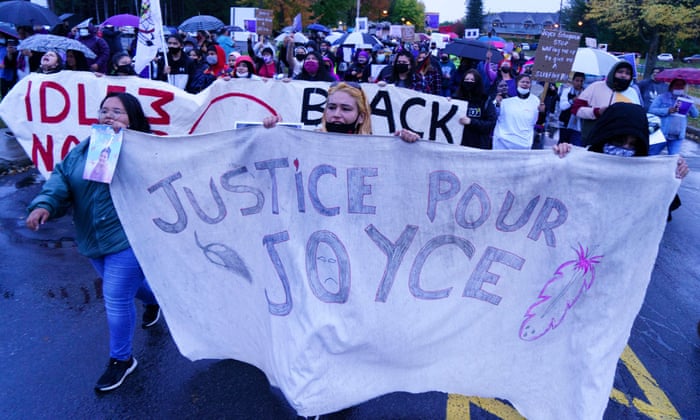
People attend a vigil in front of the hospital where Joyce Echaquan died in Joliette, Quebec, on 29 September. Photograph: Canadian Press/Rex/Shutterstock


Leyland Cecco in Toronto-


A shocking video showing hospital staff in Canada taunting a dying Indigenous woman has left a community in mourning and renewed calls for the country to confront the realities of systemic racism.

Joyce Echaquan, a 37-year-old Atikamekw woman, arrived at a hospital in the Quebec city of Joliette on Monday, complaining of stomach pain.

The mother of seven had previously suffered similar issues and told staff she had a heart condition. Echaquan started live-streaming her experience on Facebook as her pain escalated, and staff at the hospital appeared indifferent to her pleas for help.

In the footage, Echaquan is seen grimacing as nurses call her “stupid as hell”. “Are you done acting stupid? Are you done?” asked one nurse in French as Echaquan moaned in pain.

“You made some bad choices, my dear,” another nurse said. “What are your children going to think, seeing you like this?”

“She’s good at having sex, more than anything else,” the first nurse said.

Indigenous leaders say the video exposes the grim realities of systemic racism that have long gone ignored throughout the country.

“Discrimination against First Nations people remains prevalent in the healthcare system and this needs to stop,” the Assembly of First Nations national chief, Perry Bellegarde, said in a statement.

The Quebec premier, François Legault, condemned the actions of the staff, telling reporters at least one of the nurses had been fired.

But the premier rejected the notion that Echaquan’s death was representative of a broader problem of racism within Quebec, despite a public inquiry concluding the opposite.

“I really don’t think we have this kind of way of dealing with First Nations people in our hospitals in Quebec,” he said.

The province’s coroner office has announced an investigation into the circumstances surrounding Echaquan’s death. The local health board is also investigating.

‘‘We will not tolerate any remarks of that type from our personnel,” the board said in a statement.

Marc Miller, federal Indigenous services minister, extended his condolences to the community who were traumatized by the “gut-wrenching” video.

“This is the worst face of racism,” Miller told reporters. “This is someone who is at their most vulnerable. And they are dying, having heard racist words expressed towards them.”

Contrary to remarks by Legault, however, Miller said Echaquan’s death was reflective of broader barriers Indigenous peoples still face in Canada.

“This is not an isolated event,” said Miller, pointing to the case of a hospital in British Columbia, where staff allegedly bet on the blood alcohol content of incoming Indigenous patients.

For those who have experienced similar treatment to Echaquan’s, the video marked a jarring reminder of the inequities present within the country’s healthcare system.

“I’m not sure I can adequately explain how watching the video of #JoyceEchaquan’s last moments is weighing on me. As an Indigenous woman w/ chronic illnesses the treatment she endured is my ultimate fear,” tweeted Frances Elizabeth Moore, an outreach worker from Timiskaming First Nation.

“I always need to advocate for myself. At times, I’ve brought others to appointments b/c I did not feel safe going alone. This isn’t new. This isn’t unheard of. You just haven’t been listening. I hope some serious reform comes from Joyce’s heroic actions. Rest well sister.”

COVID U.S. Death Toll Tops 205,000 & 7M Infections as Trump Mocks Biden’s Mask, Attacks the ACA


SEPTEMBER 30, 2020

During the first presidential debate, former Vice President Joe Biden repeatedly criticized President Trump over his handling of the coronavirus pandemic, which has killed over 205,000 people in the United States — the highest death toll in the world. Trump mocked Biden for wearing a mask, while claiming that a vaccine would be available within weeks. “It was very bizarre,” says Marc Lamont Hill, author and professor of media studies and urban education at Temple University. “The idea of not erring on the side of caution is representative of the entire Trump administration’s handling of the COVID-19 crisis.”

This is a rush transcript. Copy may not be in its final form.

AMY GOODMAN: Marc Lamont Hill, you had COVID, and I want to turn to the issue of healthcare and the pandemic. On Tuesday night, Joe Biden rejected accusations that he supported Medicare for All, and acknowledged many people would not even be covered under his plan to create a government-sponsored public option. But as he tried to explain his plan, the debate descended into chaos.

JOE BIDEN: The vast majority of the American people would still not be in that option, number one.

PRESIDENT DONALD TRUMP: Joe, you agreed —

JOE BIDEN: Number two —

PRESIDENT DONALD TRUMP: — with Bernie Sanders’s far left —

JOE BIDEN: Number — I —

PRESIDENT DONALD TRUMP: — on the manifesto, we call it.

JOE BIDEN: We knew — manifesto —

PRESIDENT DONALD TRUMP: And that gives you socialized medicine.

JOE BIDEN: Look, hey, I’m not going to listen to him.

PRESIDENT DONALD TRUMP: Are you saying you didn’t agree?

JOE BIDEN: The fact of the matter is, I beat Bernie Sanders.

PRESIDENT DONALD TRUMP: Not by much.

JOE BIDEN: I beat him a whole hell of a lot.

PRESIDENT DONALD TRUMP: Not by much.

JOE BIDEN: I’m here standing, facing you, old buddy.

PRESIDENT DONALD TRUMP: Pocahontas would have left two days early —

JOE BIDEN: Well, I tell you —

PRESIDENT DONALD TRUMP: — you would have lost every primary.

JOE BIDEN: All he knows how to do is hurt people.

PRESIDENT DONALD TRUMP: On Super Tuesday, you got very lucky.

JOE BIDEN: Look, here’s the deal. I got very lucky. I’m going to get very lucky tonight, as well. And tonight I’m going to make sure —

PRESIDENT DONALD TRUMP: With what? With what?

JOE BIDEN: Because here’s the deal. Here’s the deal. The fact is that everything he’s saying so far is simply a lie. I’m not here to call out his lies. Everybody knows he’s a liar.

PRESIDENT DONALD TRUMP: But you agree —

JOE BIDEN: I just want to make sure —

PRESIDENT DONALD TRUMP: Hey, Joe, you’re the liar.

JOE BIDEN: I want to make sure —

PRESIDENT DONALD TRUMP: You graduated last in your class, not first in your class.

JOE BIDEN: I — God. I want to make sure —

CHRIS WALLACE: Mr. President, can you let him finish, sir?

JOE BIDEN: No, he doesn’t know how to do that. He has —

PRESIDENT DONALD TRUMP: You’d be surprised.

JOE BIDEN: You know, you picked —

PRESIDENT DONALD TRUMP: You’d be surprised. Go ahead, Joe. Go on. Go on, Joe. Go.

JOE BIDEN: — the wrong guy, the wrong night, at the wrong time.

PRESIDENT DONALD TRUMP: Listen, you agreed with Bernie Sanders —

JOE BIDEN: Here’s the deal.

PRESIDENT DONALD TRUMP: — for the manifesto.

JOE BIDEN: The whole idea —

PRESIDENT DONALD TRUMP: Now you’re disavowing it.

CHRIS WALLACE: Let him speak.

JOE BIDEN: There is no manifesto, number one.

CHRIS WALLACE: Please let him speak, Mr. President.

JOE BIDEN: Number two —

PRESIDENT DONALD TRUMP: He just lost the left.

JOE BIDEN: Number two.

PRESIDENT DONALD TRUMP: You just lost the left! You agreed with Bernie Sanders on a plan —

JOE BIDEN: Folks —

PRESIDENT DONALD TRUMP: — that’s absolutely agreed to.

JOE BIDEN: Folks, do you have any idea what this clown’s doing?

PRESIDENT DONALD TRUMP: And under that plan, you have socialized — they call it Medicare for All.

CHRIS WALLACE: Mr. President.

JOE BIDEN: Do you have any — do —

PRESIDENT DONALD TRUMP: Socialized medicine.

CHRIS WALLACE: Mr. President.

JOE BIDEN: Well, I’ll tell you what. He is not for any help for people needing healthcare, because his —

PRESIDENT DONALD TRUMP: Who isn’t? Bernie?

JOE BIDEN: — because he, in fact, already has cost 10 million people their healthcare, that they had from their employers, because of his recession, number one.

PRESIDENT DONALD TRUMP: Oh. Oh, yeah. Yeah.

JOE BIDEN: Number two, there are 20 million people getting healthcare through Obamacare now that he wants to take it away. He won’t ever look you in the eye and say that’s what he wants to do.

AMY GOODMAN: During the debate, Joe Biden repeatedly criticized President Trump over his handling of the COVID-19 pandemic, that’s killed over 205,000 people in the United States — by far the highest death toll in the world.

JOE BIDEN: Look, you folks at home, how many of you got up this morning and had an empty chair at the kitchen table because someone died of COVID? How many of you were in a situation where you lost your mom or dad and you couldn’t even speak to them, you had a nurse holding a phone up so you could in fact say goodbye?

PRESIDENT DONALD TRUMP: You would have lost far more people.

JOE BIDEN: How many people? That is —

PRESIDENT DONALD TRUMP: Far more people.

JOE BIDEN: And by the way, your own —

PRESIDENT DONALD TRUMP: And you would have been months late.

JOE BIDEN: His own —

PRESIDENT DONALD TRUMP: You were months behind me, Joe.

JOE BIDEN: His own CDC director says we could lose as many as another 200,000 people between now and the end of the year. And he held up — he said, “If we just wear a mask, we can save half those numbers. Just a mask.” …

PRESIDENT DONALD TRUMP: He wants to shut down the whole country.

CHRIS WALLACE: President Trump, you have begun to increasingly question the effectiveness of masks as a disease preventer. And in fact, recently you have cited the issue of waiters touching their masks and touching plates. Are you questioning —

PRESIDENT DONALD TRUMP: No, I think masks are OK.

CHRIS WALLACE: — the efficacy of masks?

PRESIDENT DONALD TRUMP: You have to understand, if you look — I mean, I have a mask right here. I put a mask on, you know, when I think I need it. Tonight, as an example, everybody’s had a test, and you’ve had social distancing and all of the things that you have to. But I wear masks —

JOE BIDEN: Just like your rallies.

PRESIDENT DONALD TRUMP: — when needed. When needed, I wear masks.

CHRIS WALLACE: OK. Let me ask —

PRESIDENT DONALD TRUMP: I don’t have — I don’t wear masks like him. Every time you see him, he’s got a mask. He could be speaking 200 feet away from me, and he shows up with the biggest mask I’ve ever seen.

AMY GOODMAN: President Trump mocking Joe Biden for wearing a mask.

Still with us, Temple University professor Marc Lamont Hill, author of the forthcoming book We Still Here: Pandemic, Policing, Protest & Possibility.

Marc, you had COVID. Respond to this discussion and what — well, we’ve seen President Trump’s record. If you can talk about that and what Joe Biden is recommending?

MARC LAMONT HILL: Yeah, it’s a fascinating thing to watch the president of the United States mocking someone for wearing a mask too much. It was almost like a high school bully. It was very bizarre. The idea of publicly representing the importance of the masks, to me, is a good idea, even if one were to overuse it, if that’s even possible. To me, I’d rather err on the side of caution than not. But the idea of not erring on the side of caution is representative of the entire Trump administration’s handling of the COVID-19 crisis.

Trump didn’t really defend himself against the fact that 200,000 people have died. Instead, he simply argued that more would have died under Joe Biden. He didn’t address the fact that this was entirely preventable. He pats himself on the back for saying that he was able to stop people coming in from China, largely playing on xenophobia, but ignores the fact that he didn’t block any sort of travel from Europe. And when we look at a place like New York City, the bulk of the people who had COVID right here, where I am right now, the strains that they found were from Europe and other parts of North America. So, again, he smuggles in his racism and his xenophobia into his handling of a public health crisis.

The issue around masks isn’t just about Trump’s wearing of the mask; it’s about the level of direction that came out of the White House regarding what we should do in a public health crisis. He lies on Fauci, essentially, by suggesting that Fauci was saying that we shouldn’t wear masks, when in fact Fauci was speaking to the scarcity of the masks. But the scarcity of the masks emerges because Donald Trump didn’t follow the pandemic playbook that Obama left, which suggested that we need tens of millions of masks in — not in storage, but in reserve. And yet Trump ignored that, along with every other dimension of this.

Trump could have aggressively stopped this, but, again, once we found out that vulnerable people, economically vulnerable people, poor people and the elderly were the most vulnerable and the most — the largest demographic of people dying from COVID-19, suddenly they were rendered disposable, and the Trump administration did very little.

And as far as the public health part — or, rather, the healthcare part of this, this is an interesting moment. Trump decides — spends the entire debate painting Joe Biden, a neoliberal, as a radical socialist. I mean, at the same debate where Biden is defending police and saying he doesn’t want to defund police and doesn’t support the Green New Deal and doesn’t support Medicare for All, he’s still being painted as a socialist. Now, he’s a much better alternative to Trump, and I’m certainly going to vote for him for that reason, but it’s fascinating to watch Trump use this language.

The truth here is, is that Trump has not engaged in any kind of plan or practice that will allow more Americans to be covered, that will allow more Americans to be safe. Yes, he signed an executive order to get us cheaper insulin, but that addresses 2% of the population of people who need insulin. So, no, it’s not coming into America like water. His attempts to address preexisting conditions through an executive order do nothing to address what the ACA did. He has essentially undermined any chance at universal healthcare, any chance at protecting the American public, but especially the most vulnerable. Biden’s plan isn’t great. It’s not perfect. But it’s considerably better than Trump’s. And that’s what we have to deal with right now at this moment, is the reality that Trump has consigned us to death if we continue to follow his plan.

AMY GOODMAN: And, of course, the ACA, the Affordable Care Act, goes before the Supreme Court on November 10th, remains to be seen whether there will be a ninth justice, Amy Coney Barrett, who has criticized the Affordable Care Act.