Sri Lanka: One Island Two Nations

Search This Blog

Sunday, 31 October 2021

Remembering the Eviction of Northern Muslims

Disruptions, Livelihoods and Coexistence:


Given this troubling past these women expressed their desire for the younger generation to advance in education and be free from poverty and destitution


30 October 2021 

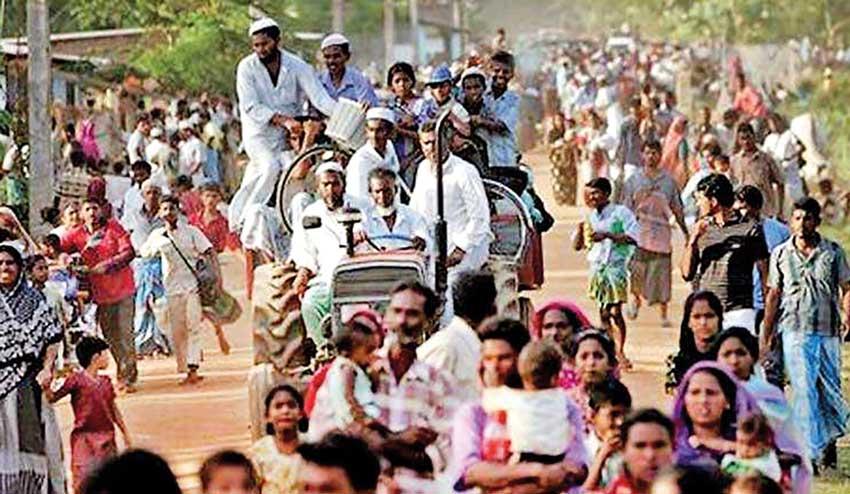
One of the darkest moments of the long war in Sri Lanka was the eviction of the Northern Muslims. In October 1990, the LTTE in an act of ethnic cleansing forced the entire Muslim population of the North to leave behind their homes, assets, livelihoods, and their way of life itself, in a matter of hours if not days. This horrendous disruption of a community haunts the North to this day even as their return after the war has been fraught with problems. 


Some research on the predicament of this vulnerable community had been undertaken by the late Prof. Shahul Hasbulah and his colleagues. Much of that research had focused on the crucial issue of land. Even as many activists worked to secure the housing rights of the resettling Muslim community, Hasbullah put forward a broader vision of reconstructing the Muslim quarters; for example, reconstructing Moor Street in Jaffna as a heritage area with sensitivity to its historical vibrancy.  


Drawing on similar engagement with the returning Muslims’ economic issues, we are part of a larger group of researchers working to document livelihood challenges of Northern Muslim communities and its implications for co-existence. We present here the concerns raised by Northern Muslims living in Musali region of Mannar, Mulliyawalai region of Mullaithivu, and Moor Street area of Jaffna. 


Displacement and education
The long displacement lasting decades, and attempts to resettle with little support from, and in some cases worrying obstacles placed by, state officials, have disrupted the lives of a few generations of Northern Muslims. For many Muslim women, who were children during the eviction, education was a sorrowful loss. Most of the families had displaced to several areas in Puttalam; schools there conducted classes in the evenings for the “displaced children”. However, many girls had to give up on their studies as they could not travel to evening school. Girls were also burdened with taking care of their younger siblings while their parents laboured in coconut estates.

Furthermore, many boys dropped out of school to engage in waged labour to support their families. 


This disruption of education, years later, has a serious impact on their economic possibilities and social mobility. Given this troubling past these women expressed their desire for the younger generation to advance in education and be free from poverty and destitution. However, education of the returning Northern Muslim children are still sour grapes for many reasons. Most of the schools in Musali, Mulliyawalai, and Moor Street lack adequate infrastructure and teachers for many subjects. Even those schools that have comparatively better facilities lack committed teachers. 


Next, flawed planning of resettlement schemes have pushed these families to resort to low income generating activities. Parents having to move between Puttalam and their resettled areas to earn a living further disrupts the education of their children. The economic background of and limited livelihood opportunities for returning families have greatly affected their social life and hopes for the future.


Land and resources 
Lack of access to land and natural resources is a significant factor determining livelihood possibilities. There is a broader need for residential land due to the increase in population with the newer generation of families. Most families are dividing their already small plots of land to share it with their sons and daughters. Such fragmentation of land ownership as well as contestations over ownership, for example, displaced Tamils squatting on their lands, have made residential land a central concern for sustainable resettlement. In this context, some families have attempted to build houses and settle on agricultural land. However, the local land and agricultural officers have been partial; they are vigilant on laws and regulations with respect to the Muslims but lenient and look the other way when it comes to Tamils. 


In Musali, land grabs by the state – through military and “environmental” gazettes – have limited access to residential land as well as agricultural land. Muslims from Silavathurai Town in Musali, have been relocated from their land because the Navy, Army, and more recently the Police have occupied about 36 acres of prime land. Residents were given barren land where there is no water or firewood, and distant from access to basic services like the hospital. Furthermore, the Forest Department has grabbed much of their agricultural and pastoral lands; this limits their engagement in food production and livestock breeding. Meantime, local fishermen in Musali are subject to a pass system, which makes the access to sea difficult.


In Mulliyawalai, Northern Muslims are marginalised from accessing their agricultural lands in Thannimurrippu and Murrippu. Due to limited public transport services, women in particular find it hard to travel to these lands located about 8 km from their residences. Despite having documents to prove land tenure for agriculture, the local state officials are denying them the required permits. This discrimination in documentation have serious consequences for the community; they become ineligible for state grants for wells and other agricultural supports. As a result, they limit their production to one season that depends on the monsoon. Furthermore, insufficient land with their homes inhibits Muslim women from raising livestock—a livelihood they engaged in prior to their displacement and while in Puttalam. Resettling Northern Muslim communities have requested authorities at many levels for land and other resources, but those concerns have fallen on deaf ears. 


Women and coexistence
Northern Muslims are as heterogeneous as any other community and engage in various livelihoods and income generating activities. As with any other marginalised community, a single person’s income is barely sufficient to run a family, all the more so during the current economic crisis. These families engage in livelihood activities like agriculture, fishing, different forms of wage labour, trade, poultry and cattle farming, home gardening, tailoring, selling food packets, dry fish production and selling sea food. While these activities allow them to survive on a daily basis, most of them struggle to ensure a decent standard of living for their families. 


In order to expand their engagement with their livelihood activities, there is a need for credit. However, they do not have adequate assets to meet the conditions of banking services, neither do such banks provide services considering the religious beliefs of the community where interest payment on loans is considered usury. 


In this context, Muslim women in the North are striving to support their families through not just home-based income generating activities but also by forming self-help groups; to increase savings and provide emergency loans to each other. In Mullaitivu and Jaffna, a few Muslim and Tamil women have come together to support each other’s livelihood initiatives by forming informal women’s development centres. These centres are also spaces of social support for women, including to address domestic violence by providing care homes and legal assistance. 


As we remember the eviction, it is crucial to explore possibilities of how Muslims and Tamils in the North can forge inter-ethnic relations even as they struggle together to build sustainable livelihoods. The joint initiatives of Muslim and Tamil women to provide support and relief during times of individual and community crises is a beacon of hope for coexistence. 

Sri Lanka: Now AG ( living a Parallel Universe) says he has not withdrawn indictment against former Navy Commander Karannadoga

Image: A protest was held against AGs decision in front of the court on 29th.

Additional Solicitor General, Nerin Pulle PC, had told the Court of Appeal that the Attorney General had not withdrawn the indictment against former Navy Commander the then Vice Admiral Wasantha Karannagoda in respect of the alleged abduction and disappearance of 11 Tamil youth in 2008, reports The Island.

He had said that when a writ Application, filed in the Court of Appeal by the parents of 11 children against the alleged withdrawal, was taken up yesterday (20 Oct).

But while local as well as international media reported that AG has withdrawn the charges against Karannagoda Human Rights organisations issued statements condemning AGs decisison’

Few such examples are given below:

“Sri Lanka drops charges against ex-navy chief over 11 killings” was the lead of a  news report report appeared on Internationally acclaimed Al Jazeera TV. it said:

“Sri Lankan authorities have dropped charges, including conspiracy to murder, against a former navy chief linked to 11 killings that drew international condemnation, the country’s attorney general has announced.

The investigation against Admiral Wasantha Karannagoda was part of a case that cast a spotlight on extrajudicial killings during Sri Lanka’s 37-year ethnic war that ended in 2009.”

Amnesty International issued a press released captioned Sri Lanka: Authorities falter on accountability in ‘Navy 11’ case and said that the Sri Lankan Attorney General’s Department today decided not to proceed with charges against  Wasantha Karannagoda, a former Navy commander, over his alleged role in the abduction of 11 Tamil youth in 2008 and 2009. The Sri Lankan Navy is alleged to have been behind the forcible disappearance of the “Navy 11”

The very same The Island said that “Disappearance of 11 persons:” AG withdraws indictment against Karannagoda”

Lawyer Niran Anketell came to Court of Appeal to argue that there was no reason to prosecute retired Wasantha Karannagoda was at ‘UNHRC advocating accountability in some times back!

President’s Counsel Romesh de Silva, who appeared with Niran Anketell and Sugath Caldera for the petitioner Karannagoda, has told the Court of Appeal that there was no reason to prosecute retired Karannagoda.

The Attorney General had only said he had to decide whether he could prosecute Karannagoda in the High Court, the Additional Solicitor General has  said.

Counsel Rohan Bopage, who appeared for the petitioner parents of the missing children, has said that the AG could not withdraw any indictment without giving reasons.

The petitioners had complained of a possible withdrawal of the indictment in the High Court against Karannagoda. The order on the issue argued yesterday will be given on November 01. The bench comprised Justice Sobitha Rajakaruna and Justice Dhammika Ganepola.

It looks like Attorney General Department id living in a parallel universe now a days, a senior lawyer told Sri Lanka Brief.

Sri Lanka debt restructure: A critique from a third eye

Foreign exchange reserves in Sri Lanka decreased to $ 2,806 million in July from $ 4,060 million in June 2021. Source: Central Bank of Sri Lanka

The Government, being the sceptic, has strongly denied and dispelled the notion of Sri Lanka’s debt crisis, citing debt payments were up to date for the past two years


Monday, 25 October 2021

Abstract

After watching the webinar, sponsored jointly by FT and ICCSL and broadcasted over social media, repeatedly rewinding and fast-forwarding, has created an enthusiasm to write a review of the proceedings. 

It is evident that there is an immediate need to acknowledge, accept and assess the volume of the debt crisis, formulate a strategy to restructure debt to a sustainable level, and thereafter, to implement a long-term process to maintain debt with financial discipline across the government sectors, cutting down unnecessary, unaffordable expenditures, and ensure efficient utilisation of capacity thus preventing future crises of this nature. 

The Government, being the sceptic, has strongly denied and dispelled the notion of Sri Lanka’s debt crisis, citing debt payments were up to date for the past two years (2020, 2021), and assuring to honour future payments on a Year-on-Year (Y-o-Y) basis with a credible homegrown solution.


Preamble


The traditional ratio analysis hitherto available for predicting financial distress of any organisation could be easily applied to the Sri Lankan situation at the macroeconomic level, which proceeds from cause to effect and deductive reasoning. No one can argue that the situation is normal as there were clearly visible signs of the development of cracks in the economy. In addition to quantitative deductions, one has to see the qualitative factors, too. 

A good example was bringing in a new Governor to the Central Bank (CBSL), where his predecessor’s term ended prematurely. Although COVID-19 had an impact on the economy of the size of Sri Lanka, it is an aberrant form of justification to mislead and cover up the mismanagement of the economy. 


Keynote addresses

The first addressee, Prof. Devarajan, stressed that there is a visible and developing debt crisis enumerating from key indices of SL economy, e.g., [1] fiscal deficit, [2] debt crisis, etc.

The current taxable earning is 9% of the GDP, and it is the lowest among the developing countries. To address this, there is a need to increase the tax base, cutting down waste in terms of subsidies given — mostly targeted to benefit the rich — enhance tax administration and increase the tax rate to pre-election level. He further stressed that the Government needs the political will and a concerted effort to educate the public getting the consensus as opposed to technocrats making decisions and merely passing down the decisions to the public, which often leads to dismay. In order to protect the poorer, it was also suggested to provide cash transfers to compensate for the tax increase. 

The second point was debt restructure. At the current level, SL has foreign reserves adequate only for two months of imports and it is barely sufficient. Debt restructuring also requires careful considerations and analysis of the legal and economic aspects to regain the confidence and assurance of stakeholders. Therefore, it was suggested the Government seek assistance from third parties, determining the percentage of debt to be restructured, and bring the residual debt to a manageable level. 

Once the groundwork is completed, involve the IMF, World Bank and ADB to mediate and work out modalities that the Government is keen to proceed with. Engagement of these international organisations will be a strength in negotiating with the debtors and creditors for favourable terms of repayment going forward. These measures of restructuring will stimulate growth to a sustainable level. He also named a few countries that have sought assistance and resurrected their economies.

The second addressee, Governor Cabraal, at the opening remark, dispelled the idea that Sri Lanka is currently having a debt crisis, quoting the debt payments that were honoured in 2020 and 2021. As such this speculation with no tangible evidence to support this notion by various quarters is an exaggeration to discredit. This attitude of complacency and groupthink clearly shows the Government has no humility to listen to opposing views. Moreover, he has not made any reference of how the Government paid the debts and the source of funding. However, there is enough public evidence that short-term currency swaps with India and Bangladesh and selling two prime lands in Colombo were the avenues through which the repayments were made. The currency swap is a very expensive financial instrument as it requires adjustment to parity rate and premium at the settlement, which is over and above the standard interest rate. 

He reiterated that the stagnation of GDP growth from 2015-2021 has badly reflected on the debt to GDP ratio, as such to take steps to grow the economy is an urgent need. One has to understand the reason for no significant growth. The reason for insignificant growth could easily be correlated to the past destructive events which de-stabilised the economy, [a] the coup attempt in October 2018 by the then President to overthrow the Prime Minster and install Mahinda Rajapaksa, [b] the Easter bombings, killing over 270 devotees and [c] the COVID-19 pandemic which has gone out of control due to the mere lukewarm action of the Government and promoting mythical approaches as opposed to recommended scientific treatments. Explaining further, the Governor highlighted the importance of removing the vulnerability of International Sovereign Bonds (ISB) by retiring significant debt through the Government-to-Government (G2G) loan scheme. But the risks associated with G2G need to be assessed as no country or government will act as a benevolent party to save us without their national interest or motives. This has been clearly seen in the Sri Lanka context with China and India competing to acquire prime Sri Lankan assets.  

The Governor repeated his opening statement, where he continuously denied the debt crisis and reiterated the promotion of a homegrown solution, more feasible in the Sri Lanka context, thus keeping the Government fully in control of the scheme. The proposed four pillars to improve the fiscal and foreign debts are illustrated below.

a. Monetise under-utilised assets;

b. Retire ISBs with G2G loan scheme;

c. Increase export revenue; and

d. Open for tourism upon reaching 90% double vaccination. This is assumed to earn $ 4.5 billion on a Y-o-Y basis. This is a very conservative figure as the outflows have not been mentioned and factored into the equation to assess net revenue.

On 1 October, the Governor unveiled a roadmap for recovery, bringing stability to the financial system, economy and price. This involves strengthening the legal and statutory framework, to assure enforcement and its applications. Under these four pillars, it is expected to grow the economy, retire debt from the current $ 13 billion to $ 11.5 billion, thus bringing down the debt to GDP ratio to an acceptable level by end 2021. This target is quite optimistic as the modalities have not been clearly expressed, despite saying there is a cocktail of financial instruments at their disposal. Could this be another cocktail of seven paupers jointly prepared for a grandeur meal, putting fistfuls of grain to a boiling pot? We should wait and observe.


Panel discussions 

Following are the concerns that were raised.

a) Relax the importation restriction on essential goods that retarded productivity and negatively affected growth

b) Curb handsome subsidies, especially benefiting the rich, and safety nets for the poorer 

c) Focus on export-oriented industrialisation in contrast to domestic-oriented industries. Industrialisation should be reformed with the aspiration and expectation to the current labour market and skills

d) Reform export strategy without abruptly terminating active trade agreements (TA), antagonising the other party. E.g. in the case of the Singapore TA 

e) Increase remittances earned from exports. Currently only 20% of the earnings are brought to Sri Lanka

f) Learn from countries how they came out of such debt crises. Lebanon, Ghana and Argentina did so through IMF, World Bank-sponsored rescue packages

g) Monetise under-utilised assets

h) Analyse limitation of homegrown solutions against the well-structured IMF, World Bank packages

i) Risks of G2G loans, specially targeted at retiring ISBs debts. It was revealed that ISB is a big chunk of total debt, standing at 45% 

j) Attract foreign direct investments (FDIs)


Crux of the debt problem

The mounting debts, as a result of heavy borrowings under the guise of growth in GDP, incapability and inability to utilise the assets for generating revenue at the right time, are the factors that have created instability in fiscal and monetary systems, reverberating an acute and serious debt crisis. 

The Government’s failure to admit and address this early on with a credible plan and the ineffective short-term measures hitherto taken have further exacerbated the situation. Debts, both foreign and local, have risen to unhealthy levels as a percentage of GDP, growing deficits of primary and current accounts, erosion of reserves, losing exchange parity rates, increase in ISB value, lack of confidence of legal and statutory frameworks, mismanagement of the economy, and especially, the stubborn stand of few technocrats led to the shattering of the financial system and markets.


Vital statistics and comparisons 

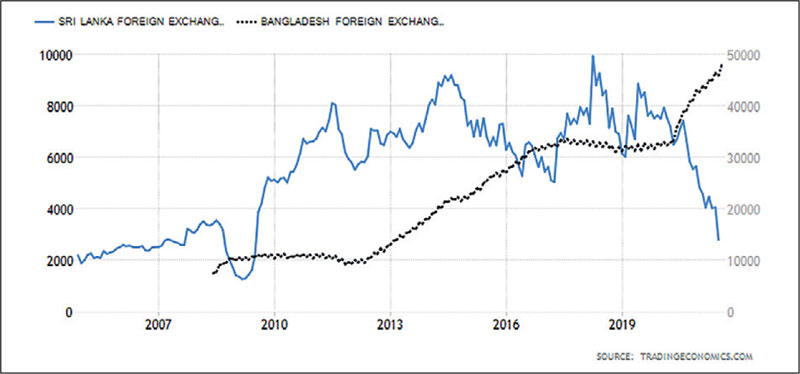
To illustrate the damage inflicted on the Sri Lankan economy over the recent years, the following data has been extracted to compare the economy of Sri Lanka against Bangladesh (SAARC region). Any further comparisons on various indices can be found by visiting the following URL https://tradingeconomics.com/

The graph [1] shows the status in terms of foreign exchange reserves. The scale on the left indicates Sri Lanka and right, Bangladesh. Bangladesh has a steady growth but Sri Lanka goes down after 2019, suggesting free-fall with no control. Sri Lanka has never achieved a high level of reserves, with its highest being nearly $ 10 billion compared to $ 48 billion for Bangladesh. 


Solutions proposed as opposed to homegrown solutions

It is important to first admit the size of the debt crisis rather than slipping away from reality. The majority view was to have political will and a solid plan to provide a credible framework and seek engagement and mediation of IMF and World Bank in restructuring a good percentage of debt, which is sustainable in the current economic climate. 

Engagement of the international organisations provides confidence and assurance among the stakeholders, viz: creditors, debtors, including bi-lateral lenders, hedge fund investors, and private ISB holders. The debt restructure is a plan developed by the respective governments and driven by them, dispelling the notion that it was an IMF plan. However, international organisations will actively monitor the progress, thus ensuring success. In the current political climate, such schemes have been branded as detrimental, with room for interference and ill-effects to Sri Lanka’s sovereignty. The book authored and published by Minister Bandula Gunawardena, titled ‘Handcuff on Sri Lanka Economy by IMF’ further culminated fears among ordinary folks. 

This program(s), in association with IMF, World Bank and ADB, etc., is the most preferable way in moving forward as Sri Lanka is currently facing a multitude of issues, including regulatory issues, legal risks, credit downgrades, high cost of debt issue, and obstacles in attracting FDIs.

It is also the general consensus among the panellists that it is of utmost importance to restore fiscal stability and balance both primary and current accounts. The fiscal system was badly subjected to a downturn with handsome tax cuts introduced soon after the Presidential election that was proven unaffordable and reduced the income to 9%, which is below par with growing economies. 

Export-oriented industrialisation has been a focus to balance the current account deficit. Questions were raised as to what changes are needed to align with aspiration and expectation — especially for the young members of the workforce — the necessity of modernisation with the proliferation of technology for growth, sustainability and scalability, viz: artificial intelligence and robotics, etc., and the need to explore service sector business ventures. It is also important to not abandon the agriculture and farming sectors but make them efficient with mechanisation, so that they may be self-sufficient. So many lessons have been learnt over the past two years as countries battled with COVID-19. It is critical to have food security and dependency with other countries. 

The way the Government handled TAs was also subjected to criticism, hence it was suggested that the export strategy be reviewed with emphasis on bi-lateral and multi-lateral dealings. Strengthening such deals will reinforce the export-oriented industries and growth. 


Summary and endnotes 

It is an undeniable fact that Sri Lanka is facing an acute debt crisis. All the indications and facts that have been put forward by the panel members clearly display the cracks formed in the economy and the various proposed solutions and pathways to overcome the crisis. The Governor’s ambitious proposals that spread across four areas are impracticable as they need initial groundwork to mitigate risks and articulate plans to regain confidence among local and international stakeholders. 

Export strategies must be reviewed to strengthen relationships and regain confidence with export partners, thus paving the way for sustainable growth in export-oriented industries. 

Flogging of assets under the guise of monetisation to foreign ownership requires a stable legal and statutory framework and enforcement. Graph [4] shows a dramatic downfall of capacity utilisation of assets in a period of one year by 20%. 

In terms of opening borders and reigniting tourism with the 90% of double dose vaccination, we have to live with COVID in years to come, so strict health guidelines need to be adhered to. I can recall one was saying even the well-disciplined country Singapore had issues controlling the spread of COVID-19. Hence, one can draw his/her own conclusion about the behaviour of Sri Lankans in terms of honouring the rules and guidelines. 

The Governor suggested retiring a substantial amount of ISB debts through the G2G loan scheme. This implied the inclination to borrow from China, considered as the benevolent country, at higher interest rate as in the past. We need to keep in mind that with the drop in the Sri Lanka sovereign credit ratio, many countries will not support this scheme. 

Replying to a question, the Governor indicated to negotiate and encourage exporters to bring total/substantial foreign earnings to Sri Lanka. This can only be achieved provided easy convertibility and parity adjustments when they require foreign exchange. Furthermore, without assessing the local and foreign content of the respective products being exported, it is hard to determine the percentages of forex to be brought back to Sri Lanka.


Conclusion

Weighing the pros and cons of both homegrown and IMF-sponsored debt restructure schemes, it is very clear that the latter provides a structured, progressive and transparent debt restructure plan compared to the local scheme explained by the CBSL Governor. 

Considering the track record of this Government over the past two years, promises have never been delivered, only ad hoc approaches. The approach should be progressive and the benefits must be seen in the short to long term. The successive Sri Lankan Governments were very good at making initiatives and plans that they broadcast over public media as an achievement. 

The success stories have hardly been heard and communicated. Before launching any scheme, the problems need to be identified and analysed, and then plan, implement, monitor, and adjust if needed and follow the cycle until the outcomes and benefits are realised. If the monitoring and assurance are in the hands of the same group of technocrats, success will hardly be achieved. This is the prime reason Sri Lanka needs a third party to monitor and adjust when warranted. As Dr. Devarajan said, it is not a weakness to approach IMF, with Sri Lanka being a member since IMFs inception, and it will be a strength to win the minds and regain confidence of the stakeholders of Sri Lanka to be engaged with currently and in the future. 

In terms of Modern Monetary Theory (MMT), printing money is an option to settle government Rupee debts. This again increases the money circulation and creates inflation if the supply and demand are out of balance. A country like USA or Japan will not have the same effect as Sri Lanka as their currencies can be used for international transactions. The two graphs, [1] and [2], show the rate of inflation and CPI in comparison with Bangladesh, which clearly illustrates the damage due to high money circulation. 

The success of the carved-out independent Port City investment zone is yet to be assessed as it is supposed to be managed and audited within, and there is no accountability to the Parliament. 

Finally, it is a regret to note that CBSL, being an independent body, what responsibility the Governor carries to outline the fiscal policies rather than explaining monetary policy settings (interest rate, inflation, stability of currency unemployment etc.) that has been given by the virtue of being the head of CBSL. Is this CBSL becoming a ‘Presidential Bank’ (PBSL) that has been recently reported in the electronic media?


The Inflation rates and CPI of both countries. The increase in inflation in Sri Lanka is contributed to high circulation of money, attributed ad hoc printing of Rupees


Capacity utilisation is a measure of the intensity with which a national economy (or sector, or firm) makes use of its resources. This graph shows an abrupt fall from 81% in 2019 to 2020, which is self-explanatory: the urgent need to monetise assets usage

(The writer is a Chartered Engineer and Fellow of IET UK.)
JVP stance on debt traps, fertilizer import bans, ports and PC elections

Nalinda-Jayatissa


by Saman Indrajith- 

The JVP says that the country is caught-up in what it calls ‘debt-trap diplomacy’ and warns that Sri Lanka is poised to lose more national assets in the immediate future. “Several rating agencies downgraded Sri Lanka’s sovereign credit ratings, the long-term foreign-currency issuer and senior unsecured ratings, while the long-term foreign-currency issuer default rating signalling concerns about the country’s ability to fulfil foreign debt repayments. In the face of this crisis, the government will either have to print more currency, borrow more or sell off national assets,” says former JVP Kalutara District MP and Politburo member Dr Nalinda Jayatissa in an interview with the Sunday Island.

Excerpts:

Q: Some ministers have made statements about the possibility of holding elections for provincial councils. Is your party ready for provincial council elections?

A: They started speaking of provincial council elections only after Indian Foreign Secretary Harsh Vardhan Shringla’s recent visit. The visit has jolted the government into action. The elections are to be held not because people have asked for them but because India wants the government to have them. This indicates the present plight of our nation. In 2019, Gotabaya Rajapaksa came to power under the slogan of ‘Rata Rakina Viruva’ (The hero who protects the country). Now that same hero has succumbed to pressure from India, the US and China and many other foreign powers.

Q: Energy Minister Udaya Gammanpila says that Trincomalee oil tank farm had been given to India by former governments in 1987 and 2003. The present government tries to show they are on a mission get the tanks back from India. What is your party’s stand on this?

A: We believe that Trincomalee harbour and the oil tank farm were the reason for India shoving the Indo-Lanka Accord down our throat in 1987. The then President was supportive of US camp while India was supporting the USSR bloc. President Jayewardene was considering giving Trincomalee to the US. India was upset and invaded the air space of this country, dropped parippu and sent Indian ships to our waters to terrorize that government and coerce it to sign the Indo-Lanka Accord.

The correspondence between Jayewardene and Rajiv Gandhi before the signing of the Accord shows that India would not let Lanka make independent decisions about the use of Trincomalee harbour without India’s concurrence. But such conditions are not included in the agreement. In 2003, Ranil Wickremesinghe’s government leased 99 oil tanks for 35 years to India for an annual fee of 100,000 US dollars. A Memorandum of Understanding was signed to reach an agreement in six months. It is only with the signing of such an MoU that the lease would have had legal effect. However there has been no such agreement since 2003. Therefore, India does not have any legal hold of the oil tanks and that land. Yet, they have paid the annual fee for the past 18 years.

Gammanpila is only putting up a show. The former ministers who had the Ceylon Petroleum Corporation (CPC) under their purview, Susil Premjayantha, Anura Priyadarshana Yapa and Chandima Weerakkody, got cabinet papers passed in 2011, 2014 and 2016 stating that those oil tanks belong to the Lankan government. India continues to hold those tanks illegally. One of our trade unions in 2017 filed a case at the Supreme Court against this. The decision is pending.

In terms of the provisions of the Ceylon Petroleum Corporation Act No. 28 of 1961, only the CPC can import petroleum to this country. Ranil Wickremesinghe broke that monopoly in 2004 and gave permission to Lanka Indian Oil Corporation (LIOC) to import fuel for 20 years with effect from January that year. That permission expires in December, 2023. Then the monopoly of petroleum importing, exporting, storing, refining, distributing and selling will return to the CPC. If government would not extend this permit, then India will lose its argument for the need to use Trincomalee Tank Farm. India’s present need is to get the oil tanks and the land they stand on for another 50 to 60 years. That was the primary objective of the Indian Foreign Secretary’s visit. Their actual target is the Trincomalee harbour and the oil tank farm gives them a foothold to move in that direction.

Q: So it’s all about Trincomalee harbour?

A: Yes, it is. Not a single harbour but many. The harbour in Trincomalee is considered one of the finest deep-sea, natural harbours in a strategic location. Sri Lanka’s geostrategic location is vital not only for the Asia-Pacific region but for the entire world. The importance of that location finally depends on the control of our harbours. We have three main harbours in Colombo, Hambantota and Trincomalee. What has happened to them? Hambantota is now owned by China for 198 years. It is China that controls the Hambantota port and its surrounding land of 15,000 acres. The Trincomalee harbour is being eyed by India. Then we have the Colombo Port, which is considered one of the busiest harbours in the Indian Ocean and is at No. 24 in the Top 50 World Container Ports list.

This position could be bettered if we could increase the depth of the access route to that port, deepen and expand the terminals and berths and increase the number of terminal operations opening the way for the world’s largest vessels to enter the Colombo Port. Now South Asia Gateway Terminal (SAGT) with berth of 18 meter depth is controlled by China. Mahinda Rajapaksa gave it to China for 35 years in 2012. Basil Rajapaksa recently brought a cabinet paper to give 13 acres of adjacent land to China to set up an operational and service center. So, even when the 35-year period ends, China will still have control there.

When China is given such hold, other countries also try to get a piece of the pie. The Selendiva project will enable selling many adjacent areas covering the Grand Oriental Hotel, Gafoor Building, York Building, Foreign Ministry and the old GPO. The Bank of Ceylon (York Street) is earmarked to be moved to Battaramullla, so that land too could be sold. There had been an attempt to give away the East Container Terminal (ECT) to an Indian company but it was suspended owing to protests. SAGT could be taken back by the Ports Authority in 2028. Currently it is under John Keells Holdings which is the local agent of India’s Adani Group that is involved in the West Container Terminal (WCT) development. After building that terminal, the two most important terminals of the Colombo Port will be controlled by China and India. This process shows how we have lost control of the three most important terminals during the past ten years. The income they earn is taken by foreigners to their countries leaving us with little.

Historical records show that the harbours have been among the most important feature in our civilisation. Recent archaeological findings yield evidence to prove that the Anuradhapura civilisation had been founded on the Mathota harbour which is said to be in Mannar. It was this harbour that supported the thriving Anuradhapura civilisation that constructed giant stupas and tanks during the 400 years from 150 AD to 250 AD.

During that period, South Indian traders invaded the Anuradhapura kingdom and ruled it intermittently when they had the control of Mathota and its resources. King Elara ruled that kingdom for 44 years and took away what it generated to South India. Later five other South Indian rulers before King Vattagamani Abhaya did the same. They took home what was earned from that harbour. They (the harbours) have been a principal prop of our civilisation.

Even when the Portuguese came here, they asked the King of Kotte only for one thing – that was to build a fort near the Colombo port. The present day rulers are depriving this country and its people the ownership of those harbours and thereby we lose the country’s geostrategic importance.

Q: The government describes those transactions as investments. Do not we need such investments?

A: China spent only USD 500 million to develop South Terminal of Colombo Port. The Lankan government took a loan of USD 1,400 million to build the Hambantota port. If the government took a loan of USD 500 million instead and developed the South Terminal of the Colombo Port, then we would have earned profits from there. China or India will not come here to invest in our health, transport or education sectors. Their investments have the objective of snaring us in a debt trap and taking control of our assets.

Even the previous governments used to have similar excuses. They used to say there were loss making enterprises which needed to be privatized. That has no place in the present times, so they use the word investments. For example, 40 percent of the Kerawalapitiya power plant is being sold to America’s New Fortress Energy (NFE). That plant is built and we could earn profits in the years ahead. Now it is being sold. The government is handing over the gas pipeline and floating storage system for the Kerawalapitiya power plant with the entire supply of gas to the NFE for a period of 10 years. There is massive waste, fraud and corruption in awarding this contract.

A contract has been awarded to the company without a tender to supply liquefied natural gas for 10 years at a cost of US$ 6 billion. Usually, we need electricity from the Kerawalapitiya power plant only between 6.00 pm and 12.00 pm. The ‘Take or Pay’ (TOP) deal to which we have committed ourselves is hugely disadvantageous as we will be paying for LNG we will not be using because we don’t need it. Could such deals be called investments?

This power plant is to supply around 35 percent of the power generated to the national grid. So NFE will have a near power supply monopoly in this country. It will also have the opportunity to place ships for floating storage near Colombo harbour permanently. These are not investments. If they really are investments, the government should have called for separate tenders for the floating storage and the pipeline and kept the ownership of the plant 100 percent. Gas could have been purchased at the world market prices through spot tender or term tender processes.

Q: The government says that there is economic instability therefore they are compelled to take such decisions. Is this true?

A: It is those whoz had governed this country since Independence, who should be held responsible for the current economic instability. As of now the country’s sum total of debt is nearly 17,000 billion rupees. Our total revenue is not sufficient to pay the loan and interest instalments. In this scenario, the government has solutions such as printing money, taking more loans and selling off national assets to pay the loans. It is said that the government has printed currency notes worth Rs 1,400 billions during the past 20 months. It is a sum equal to total government revenue for a year. This would certainly result in inflation.

People should ask the question why we have borrowed so much. We as a nation are trapped in debt raised for loans taken for mega projects some of which were not our priorities. A country with an economy like this should never have borrowed to build an International Cricket Stadium at Sooriyawewa, an International Convention Hall at Hambantota or the Lotus Tower in Colombo. These are neither essential nor priorities. The loans taken to pay for them were many times their actual cost with commissions ending up in the pockets of politicians. Whenever there are international exposés such as the recent Pandora Papers, many names of Lankans surface. They show how such commissions are stashed away in overseas accounts. What these political leaders do is show people a mega project and take their cut. When the loan cannot be settled they sell off national assets. This is the ultimate consequence of a process known as ‘debt-trap diplomacy’. We are in this plight because of a corrupt political culture.

Q: Hardly a day passes without a protest. Farmers stage protests everywhere in the rural hinterland demanding fertilizer. What’s the JVP standpoint on this fertilizer issue? Do you recommend continued use of chemical fertilizers?

A: The first excuse of the government when they abruptly stopped imports of chemical fertilizers, insecticides, weedicides and pesticides was that this was done to save dollars going out of the country. Then weeks later they said the ban was to save people from kidney disease and cancer. Organic fertilizers are fine but no country can switch from chemical to organic all at once. It is not feasible to ask farmers to go organic in the next Maha season soon after the end of Yala season. Farmers, agricultural scientists and everyone who dared to open their mouths in the Agriculture Ministry repeatedly said that this was not practical. But the President and the government did not listen. Now we are in a crisis. This will surely result in a food scarcity in a few months time.

The government says that it will compensate the farmers for crop losses if that happens. Such compensation would be sufficient only for few months for the farmers. But what about the food shortages? You cannot eat currency notes. This is just another example for the whimsical nature of this President. Apart from that there is a serious doubt whether this is just the beginning of a plan with the objective of compelling farmers to sell their land. When farmers cannot cultivate for two or three seasons, they have no option but to give up their livelihoods. They will have to sell their land or lease them to companies. This is an agricultural country. When agriculture is destroyed this country would go bankrupt in few years time.

 Gotabaya’s Inglorious Legacy: Sri Lanka’s ‘Nero’


By Vishwamithra –

It is rather rare that a current leader of the country is compared to an ancient ruler, for that matter an Emperor as powerful as the ruler of the Roman Empire. Whether the comparison is one of negativity or positivity, it is indeed seldom that such parallels are drawn and the respective historical contexts are explored. The necessity for such comparative studies arises from the sheer similarity of the responses and reactions of the rulers as well as those who are ruled. History contains many repetitions; those rulers whose names are mentioned in specific contexts can be compared one with the other, not only against the respective backdrops of their ruling tenures, but also with whom they participated in their enterprise of power politics.

Most Roman sources (including the Ancient Roman historians Suetonius and Cassius Dio) offer overwhelmingly negative assessments of Roman Emperor Nero’s personality and reign. The contemporary historian Tacitus claims the Roman people thought Nero compulsive and corrupt. Suetonius tells that many Romans believed that the Great Fire of Rome was instigated by Nero as a way to clear land for his planned palatial complex, the Domus Aurea. Also, according to Tacitus, he was said to have seized Christians as scapegoats for the fire, and had them burned alive, seemingly motivated not by public justice but by personal cruelty. Some modern historians question the reliability of the ancient sources on Nero’s tyrannical acts due to the overwhelming evidence of his popularity among the Roman commoners (especially in the eastern provinces of the Empire, where a popular legend arose that Nero had not died and would return). After his death, at least three leaders of short-lived, failed rebellions presented themselves as “Nero reborn” in order to gain popular support.

The exact acts, public responses and specific domain might be different, yet the contextual similarities and the fundamental character traits of the two rulers, Emperor Nero and our own Nandasena Gotabaya Rajapaksa are too much akin each other to discount and look the other way. However, the irony remains that our own ‘Emperor’ Nandasena might like himself to be compared with a Roman emperor, for however much the emperor is flawed in character and derisive in conduct, Nero was still an Emperor and had gone down in history as a significant character (utterly negative and deranged). Such is the fundamental feature of all narcissists. Their obsessive love with themselves and the elevated self-righteousness has begun the slow but terminal consumption of the subliminal humanity that might still be present within them.

The most salient feature of corruption that has been devouring the Rajapaksa family is that it seems to have taken ahold of their henchmen and henchwomen who happen to be scattered all over the globe. The blue-eyed boys, for whom Nandasena found lucrative jobs, both in Sri Lanka and abroad, as ambassadors and high commissioners, too have been infected with this deadly disease of corruption and power syndrome. The stories that roam around the rumor mill are not too tasteful and those who have been blessed or stricken with power to do good for the country and countrymen are going bonkers. They are indulging in so nauseous extravaganza, it’s unthinkable that such human folly is possible amongst some half-past-two-thirty vagabonds whose only qualification to hold such lucrative posts are they either made some financial contributions to Nandasena’s campaign or they did some campaigning during the last Presidential elections.

It is widely believed that Nero, the Roman Emperor, fiddled while Rome was burning. When the country was being gripped by a vicious pandemic and even a more vicious economic strangulation, our ‘Nero’ was partying with his diaspora friends in the western parts of the United States. A President of any country is a busy person; he or she does not have the luxury of resting time, especially when confronted with a crisis. Sri Lanka is not on that pedestal of comfort and absence-of-problems zone. She is in enormous trouble, politically, economically and socially. The country’s coffers are being emptied; its governance structure is falling apart and its social fabric is being torn apart by its ruling clan and the very identity of the country is receding into blurry shades.

When the country’s administrative structures are being threatened by total inefficiency and apathy, wise political leaders do resort to positive measures to circumvent such crises through time-tested strategies and tactics. Such an intelligent approach is totally non-existent today. Even a very finite problem could have infinite solutions, if only one chooses to look for them. Being bogged down in a bottomless pit of corruption and ignorance, today’s government led by this Nandasena Gotabaya Rajapaksa has chosen to grope for solutions where there no such solutions. Otherwise why on earth did this fellow appoint a convicted murderer to head the National Housing Authority and hand the helm of Task Force of ‘One Country, One Law’ to another convicted hooligan like Galagoda Atthe Gnanasara? We never even imagined that Nandasena is such an imbecile to distribute national treasures among criminals. Needless to say that ‘birds of the feather flock together’!

It is a great misfortune of all of us whose allegiance to our motherland is not only being cheapened, but insulted as well by our own leaders. In ‘The Gulag Archipelago’, Aleksandr Solzhenitsyn wrote: ‘In keeping silent about evil, in burying it so deep within us that no sign of it appears on the surface, we are implanting it, and it will rise up a thousand fold in the future. When we neither punish nor reproach evildoers, we are not simply protecting their trivial old age, we are thereby ripping the foundations of justice from beneath new generations.’

And in the context of Solzhenitsyn’s quote, it is time that we as Sri Lankans chose not to ignore, to use a cliché, the writings on the wall. Solzhenitsyn chose to act; he chose to write against one of the most powerful and vicious regimes in history, the Soviet Union. As another great Russian writer, Dostoevsky said “we all came out of Gogol’s ‘Overcoat,’” saying of Russian literature. We Sri Lankans have to come out of this free-fall and assume responsibility and resort to positive action. Being passive and apathetic is no option anymore.

They say that things are going to get much worse before they start to get better. We cannot wait for things to get any worse than this. When that ‘worse’ comes, it might be too late. Exchange of ideas in a very dynamic sense could be a beginning. Ideas change the world. Instead of following a person or persons, we must learn to follow ideas and ideals. If the idea is worthy enough and its intrinsic message is powerful, a leader or leaders will emerge. Remember, one can kill a leader but one cannot kill an idea.

Read More

Members of the secret police caught red-handed filming a suspect, who sort protection upon bailed

A team of lawyers representing a suspect has been able to uncover a Police intelligence  and Police STF team that secretly videotaped a suspect in front of the Moratuwa Magistrate’s Court yesterday (29)  morning.

The suspect, Kelum Indika Sampath, was produced before Moratuwa Magistrate Uddala Suwanduragoda  to finalised his bail conditions. He has been given bail by the High Court earlier.

He had been in detention for 3 years for a case related to fire arms. His  prison ID number is 1580 and court case number is 87019.

President’s Counsel Saliya Peiris, Senaka Perera and a team of lawyers appeared for the suspect. Saliya Peiris is also the current President of the Bar Association of Sri Lanka.

Following the assassination of a suspect, Lalith Pintu, after he was given bail in last July, both the legal and political circles fear that such suspects could be killed once they are released on bail.

In such a situation there will be no charges of custodial death. The killers of Lalith Pintu have not been found yet.

In this context President’s Counsel Saliya Peiris, who appeared for Kelum Sampath, requested the court to provide his client with maximum protection after granting bail.

After considering the request, Magistrate Uddala Suwanduragoda ordered the IGP to provide the necessary security  to Kelum Sampath.

Kelum Sampath’s mother, who was waiting outside the court told the legal team that a group of persons had videotaped her son getting off the prison bus.

The group had told Kelum Sampath’s mother that they had come to the court to appear in a case related to filming.

However, such a case was not on the list of cases heard yesterday.

The group of six were in plain clothes, unbuttoned shirts, wearing bungles.

Under these circumstances, suspecting a foul play legal team of about ten lawyers immediately surrounded the group.

At this time they told lawyers they wanted to talk to their boss Nadeeka Silva, who seem to be a higher official.

Due to the suspicious behavior of this group, the legal team handed them over to the police post at the Magistrate’s premises.

When questioned it was revealed that the group had not come to any court proceedings but  to videotape Kelum Sampath. They produced their Police IDs which showed that they  belonged to the State Intelligence Service and the Police Special Task Force.

One of the intelligence officers in the group was identified as Hidella Arachchige Sanjaya Priya Dharshana, with police ID number 41436. The names of all six have been recorded at the police post.

A lawyer present at the trial told Sri Lanka Brief  that Minister in charge of police Sarath Weerasekara should explain why a suspect who was to be released on bail was videotaped state intelligence officers masquerading as camera crew.

By Sri Lanka Brief-

A team of lawyers representing a suspect has been able to uncover a Police intelligence  and Police STF team that secretly videotaped a suspect in front of the Moratuwa Magistrate’s Court yesterday (29)  morning.

The suspect, Kelum Indika Sampath, was produced before Moratuwa Magistrate Uddala Suwanduragoda  to finalised his bail conditions. He has been given bail by the High Court earlier.

He had been in detention for 3 years for a case related to fire arms. His  prison ID number is 1580 and court case number is 87019.

President’s Counsel Saliya Peiris, Senaka Perera and a team of lawyers appeared for the suspect. Saliya Peiris is also the current President of the Bar Association of Sri Lanka.

Following the assassination of a suspect, Lalith Pintu, after he was given bail in last July, both the legal and political circles fear that such suspects could be killed once they are released on bail.

In such a situation there will be no charges of custodial death. The killers of Lalith Pintu have not been found yet.

In this context President’s Counsel Saliya Peiris, who appeared for Kelum Sampath, requested the court to provide his client with maximum protection after granting bail.

After considering the request, Magistrate Uddala Suwanduragoda ordered the IGP to provide the necessary security  to Kelum Sampath.

Kelum Sampath’s mother, who was waiting outside the court told the legal team that a group of persons had videotaped her son getting off the prison bus.

The group had told Kelum Sampath’s mother that they had come to the court to appear in a case related to filming.

However, such a case was not on the list of cases heard yesterday.

The group of six were in plain clothes, unbuttoned shirts, wearing bungles.

Under these circumstances, suspecting a foul play legal team of about ten lawyers immediately surrounded the group.

At this time they told lawyers they wanted to talk to their boss Nadeeka Silva, who seem to be a higher official.

Due to the suspicious behavior of this group, the legal team handed them over to the police post at the Magistrate’s premises.

When questioned it was revealed that the group had not come to any court proceedings but  to videotape Kelum Sampath. They produced their Police IDs which showed that they  belonged to the State Intelligence Service and the Police Special Task Force.

One of the intelligence officers in the group was identified as Hidella Arachchige Sanjaya Priya Dharshana, with police ID number 41436. The names of all six have been recorded at the police post.

A lawyer present at the trial told Sri Lanka Brief  that Minister in charge of police Sarath Weerasekara should explain why a suspect who was to be released on bail was videotaped state intelligence officers masquerading as camera crew.

 The ground beneath the President’s feet


1 November 2021

Continuing failures and confusion in policymaking and implementation are at the heart of Sri Lanka’s governance crisis
What has Gotabaya Rajapaksa achieved when he enters his third year in office as Sri Lanka’s President on November 18? A not-so-attractive record of failures in governance.
President Rajapaksa has also been losing much of the public support, popularity and trust that brought him into power in November 2019.


The present crisis which President Rajapaksa and his regime are facing has four interconnected dimensions — economic, social, governance, and legitimacy.
Sri Lanka’s worsening economic crisis is not Mr. Rajapaksa’s creation. Yet, he and his team of policy advisors seem to be at a loss even to comprehend its gravity and its disastrous consequences which the people are forced to bear.


While the impact of the protracted public health crisis caused by the COVID-19 pandemic on Sri Lanka’s economy may take a few years to manage, its social impact has been devastating. The absence of effective government interventions to alleviate economic hardships faced by the poor, the new poor produced by the pandemic, the working people and all strata of the middle class, both urban and rural, have a fresh social crisis too.

A strong leader

Mr. Gotabaya Rajapaksa began his tenure as President in November 2019 by promising the Sri Lankan people a fresh beginning for a future of stability, security, development, and prosperity. He was also open about his ideological project that gave primacy to the aspirations of Sri Lanka’s majority ethnic community, the Sinhalese Buddhists. He did not have any democratic pretensions either. Mr. Rajapaksa’s promise was for a ‘strong government’ under a ‘strong leader’ to ensure national security, law and order, political stability, and victor’s peace with the ethnic minorities.


Soon after assuming office, he launched a programme of restoring Sri Lanka’s personalised model of executive authoritarianism, which had been suspended by the previous government under the 19th Amendment to the Constitution. For this objective, Mr. Rajapaksa made use of the public health emergency caused by the COVID-19 pandemic in early 2020.
Bypassing the then Opposition-dominated Parliament, Mr. Rajapaksa concentrated a great deal of financial and administrative power into his hands, thereby re-establishing the presidential executive as the central institution of state power. In October 2020, Mr. Rajapaksa used the newly gained two-thirds parliamentary majority to abolish the 19th Amendment. Under the 20th Amendment, Sri Lanka was thus brought back to executive presidentialism, which has been the mainstay of Sri Lanka’s democratic decay for decades.

Civil-military ties

Mr. Rajapaksa also initiated a new trend in civil-military relations in Sri Lanka’s structures of governance. Appointing the Army Commander to head a new Presidential Task Force to manage the public health crisis and placing the military over the politicians as well as medical and civilian professionals were its first signs. In the new political and administrative order, serving and retired senior military officers are given key roles.
As critics insist, militarisation of public administration is a key component of Mr. Rajapaksa’s project of de-democratisation.


Continuing failures and confusion in policymaking and implementation are at the heart of an ongoing governance crisis since the second wave of the COVID-19 pandemic, mid last year. Having been persuaded by nativist ideologues and local conspiracy theorists, President Rajapaksa initially de-emphasised the urgency of launching a rapid vaccination programme throughout the country. His encouragement of magic and sorcery to combat the pandemic put the public health policy into disarray. It is only after the pandemic had reached crisis proportions by the middle of this year that President Rajapaksa turned to science, expert advice and vaccination.
Meanwhile, the current controversy caused by the President’s ideologically-inspired decision to ban chemical fertilizers and inputs in all spheres of agriculture epitomises the Rajapaksa regime’s record of inept and autocratic approach to initiating an economic and social transformation.


This inexplicably rash and inappropriate policy intervention has already caused much social unrest and discontent among very wide sections of the peasantry.
 Similarly, the recent mishandling of Sri Lanka’s chronic foreign exchange crisis, leading to further destabilisation of the country’s currency and economy, has caused fear among citizens that continuing economic policy failures might even trigger an economic collapse.


Moreover, the government’s repeated failures to intervene to bring the prices of essential consumer items down and manage the runaway cost of living, amidst uncertainties and confusion in policy decisions and their implementation, have further dented the President’s much-advertised claim to an efficient, result-oriented, professionalised, technocratic, and no-nonsense style of leadership and governance.

Core issues

Thus, the Sri Lankan government’s apathy towards the suffering of the people amidst rapidly declining income levels and erosion of living standards and economic insecurity caused by a rampant economic and financial crisis is just one among many instances of a serious failure in governance. Moreover, the severity of the economic crisis has also made it impossible for President Rajapaksa to initiate a state-sponsored social support programme for the poor, the new poor and vulnerable segments of the people. This, obviously, is at the mainstay of Sri Lanka’s growing social crisis at present.


 Amidst all this, what baffles the critics and the supporters alike of President Rajapaksa is the degree of insensitivity he and his government display to the consequences of his policy failures and the crisis of governance for people’s lives and their survival.
It is the accumulation of such failures at multiple levels of policy, governance, and leadership that has seriously eroded the popular support that Mr. Rajapaksa enjoyed just two years ago. It also constitutes the core of the legitimacy crisis he has to deal with at the personal level as well.


The Rajapaksa administration is now facing open defiance and protests by three large segments of citizens who may have overwhelmingly voted for him in November 2019: the rural farmers, the small producers engaged in export agriculture, and the public sector schoolteachers. As many of them are reported to have been saying at their protest rallies, defying police threats and the ridicule by ruling party politicians, they now regret that they have voted such a band of rulers to power.
It is this open expression of a generalised feeling of loss of political trust and public disillusionment with President Rajapaksa’s leadership that symbolises the acuteness of the legitimacy crisis he has to deal with in the weeks and months to come.

International relations

One area where the President has managed to secure some success is foreign relations. He seems to have taken note of the bad press he got locally, regionally and internationally for his regime’s close proximity to China at the expense of Sri Lanka’s traditional allies and friends. Mending of relations with India, Europe and America appears to be a recent policy shift he has engineered.
However, the President seems to be quite determined to stay in power till the end of his current term and beyond. If Charles de Gaulle and Lee Kuan Yew were the role models of former Sri Lankan leader J.R. Jayewardene, Lee Kuan Yew and Chinese President Xi Jinping are Mr. Rajapaksa’s idols. One crucial lesson that he seems to have learnt from all those leaders is that one term of office is hardly adequate for a ruler who thinks of himself as personifying the nation’s destiny.
Meanwhile, a weakened and politically unassertive parliamentary Opposition seems to be President Rajapaksa’s only credible political asset at the moment.

Jayadeva Uyangoda is Former Professor of Political Science, Department of Political Science and Public Policy, University of Colombo, Colombo, Sri Lanka. The views expressed are personal.
Courtesy: THE Hindu