Sri Lanka: One Island Two Nations

Search This Blog

Monday, 28 February 2022

PTA – Preserving It For A Potential Presidential Dictatorial Rule


By Thambu Kanagasabai –

Thambu Kanagasabai

The much widely criticized Prevention Of Terrorism Act (PTA) of 1979 described as draconian is doomed to live as long as Rajapaksas hold the reins of power in Sri Lanka. The demise of it by repealing will certainly ring the death knell of any designs of dictatorship in Sri Lanka and their hold on power.

PTA – 1979 was legislated as a result and consequence and aftermath of Janatha Vimukthi Peramuna [JVP] insurgency in 1971 to contain the rise and dominance of the Liberation Tigers of Tamil Eelam [LTTE] which embarked on armed resistance to stop the state sponsored violence and pogroms after the peaceful agitations and campaigns were ruthlessly crushed by the Sri Lankan Governments employing the full force of the armed forces.

PTA – 1979 was enacted to remain in force for three years to deal with the then situation. The continuing application of PTA meant to prevent terrorism is by all means and reasons is questionable and does not hold any compelling reasons under the current circumstances when no reports of terrorism threatening the security of Sri Lanka have been reported or detected except for the few acts of violence unleashed by some misled Muslim extremists who launched attacks on Christian worshippers and selected Churches in Colombo on 21st April 2019.

Security Forces succeeded in arresting some of those involved under the provisions of PTA though criminal laws of Sri Lanka and criminal procedure  code could have been resorted to.

The wide powers granted to the Minister, Defense Secretary and Security Forces under the PTA which are dictatorial and the 20th Amendment of January 2021 have further clothed  the President with impunity for any act or commission or neglect of duty while exercised by him during his term in Office.

Section 6 of PTA grants the security officials extensive powers to search and  seize any property including arbitrary arrests and detention while Section 15 A allows the Defense Secretary to decide the place of detention even after the conviction of an accused and also when the subject  person is in remand.

According to the Amendment, during the detention period of 12 months the Defense Secretary is vested with full discretion to choose the place of detention as he  wishes without proper notification providing openings for torture without judicial supervision during the 12 months period.

The new Amendment states that “If a magistrate thinks if a person might have been to subject to torture he may refer the person to the JMO for further examination.”

It is to be noted that this Provision is not a mandatory one for the Magistrate to strictly comply with but only a discretionary and regulatory one which which he can choose to execute or ignore it when he does not think to execute it. As such this provision of judicial supervision  is farcical and an eyewash to shield but only to license the  practice of torture which is a common and entrenched practice in Sri Lanka.

The following powers granted to the Defense Secretary and security officials under the: PTA – 1979 and under the recent Amendments are absolute and exercisable at the sole discretion of the Security Officials without supervision and reviews by the courts for any abuses.

[1] PTA allows authorities to make warrantless arrests without trial and searches of a person if suspected of involvement in a terrorist activity.

[2] PTA allows prolonged arbitrary detentions up to 18 months.

[3] PTA enables extracting false unsubstantiated confessions through torture as the suspects are in the hands and at the mercy of security officials.

[4] PTA particularly targets the minority communities and civil groups under Section 6 [1]. Under this section. a person can be arrested for nothing and for anything like printing pamphlets or posting pictures in the media while indefinite detention is bring permitted.

[5] There is no definition of terrorism in the Act and this enables security officials to make their own definition and decision with opportunities for killings and unenforced disappearances to happen due to their prolonged period of detention as happened to several detainees. It is learnt that more than 200 persons are under detention for several years like the several Tamil political prisoners.

As expected, the International Commission of Jurists  [ICJ], Human Rights Watch and Amnesty International [AI] have voiced their concerns. Human Rights Watch has particularly called for sanctions against Sri Lanka when 7th February 2022 it “It requested Sri Lanka’s trading partners to consider imposing sanctions on officials accused of human rights violations and to leverage trading schemes in order to pressure Colombo to comply with human rights objectives.

About the proposed Amendments, Human Rights Watch stated that “They leave the most often abused provisions of law intact and if enacted will do little to bring the PTA into compliance with Sri Lankas’ international human rights obligations”.

The Minister’s powers are founded on his “Reasonable belief” which is purely a subjective matter and would be difficult to ascertain objectively for any challenge in the courts on the grounds of unreasonableness. The power to arrest  any person notwithstanding anything in any other law to the contrary” clearly nullifies the provisions of Criminal Procedure Courts including Articles N0. 11, 12 &13 of the Constitution which enshrines the fundamental rights of freedom of thoughts, equality and prohibition of arbitrary arrests, detention and punishment.

The prolonged detention of a suspect without trial results in serious consequences including physical and mental health, suicidal tendencies and uncertain future for him/her and his/her family, besides ample opportunities for abuses like torture, degrading punishment and treatment including forced confession by prison and or security officials.

Read More

Sri Lanka: The Contempt of Court Law and Practice In Sri Lanka Violates the International Law and Sri Lankan Constitution


By Sri Lanka Brief-

Asian Human Rights Commission (AHRC) , a Regional Human Rights Organization, having seriouslyobserved and studied the manner in which the Contempt of Court law and the way it is practiceLin Sri Lanka, wish to express its deep concern over the violations of International law and the Sri Lankan Constitution itself, by depriving protection of law to the persons accused of this offence.

AHRC is particularly concerned about the manner Article 105 (3) Of Sri Lanka’s Constitution has been interpreted in a manner that violates International Law and the Constitution of Sri Lanka,

The reasons on which this concern is based are set out below.

The manner in which the power given to the Supreme Court under Article 105 (3) has been used in the recent past, requires a review, particularly regarding the case of Michael Emmanuel Fernando (No: 1189/2003 U.N. Doc. CCPR/C/83/D/2003 (2005)), the case of S.B Dissanayake (U.N. Doc. CCPR/93/D/1373/2005, Communication No. 1373/2005), and the case of Ranjan Ramanayake (SC Rule No. 1/2018).

Our concerns are as follows:

Disproportionate Punishment as illegal Detention

In all three of these cases, the sentences that have been meted out by way of imprisonment. In the case of Fernando, for one year rigorous imprisonment for allegedly talking loud in court; in the case of S. B Dissayanayake for speaking the word ‘‘shameful court’ in a public meeting outside courts, two years rigorous imprisonment; in the case of Ranjan Ramanayake referring to judicial corruption for which he was sentenced to rigorous imprisonment for four years plus the loss of participation in elections for seven years. In the first two cases, the United Nations Human Rights Committee, having considered the communications made to it by Fernando and Dissanayake, held that these sentences of imprisonments amount to disproportionate punishment and that under international law, disproportionate punishment amounts to illegal detention. Under Sri Lankan law, protection from illegal detention has been guaranteed by the constitution, which notes it is a violation of fundamental rights. Thus, this practice of disproportionate punishment itself is a violation of the international and the Sri Lankan law and the fact that no reasons have been given for such disproportionate and harsh punishments aggravates the situation. Thus, this use of disproportionate punishments, which is now getting established as a permanent practice, is a threat to the very idea of a fair trial and also the notion of the rule of law. It is likely to have a deadening effect on the entire system as lawyers, litigants and anyone else who is dealing with the system of administration of justice is likely to be seriously intimidated when they have to pursue their claims for justice under such circumstances.

Contempt of Court – An offence without a Definition

While Article 105 (3) of the constitution provides for the power to deal with contempt of court to the supreme court and the court of appeal and the discussion relating to punishment by way of imprisonment or fine or both, the offence of contempt of court has not been defined by any law in Sri Lanka. For all laws that carry criminal punishments in Sri Lanka, each offence is defined in terms of the element, which constitutes the offence and also the maximum punishment that the court is entitled to give in case the charge against the accused is proved beyond a reasonable doubt. Thus, the universal practice of defining an offence in Sri Lanka relating to all crimes including such serious crimes as terrorism, enforced disappearances, murder and rape and all such serious crimes, followed in the case of contempt of court offences.

Following is a Sample of How Crimes are Defined in Sari Sri Lanka, taken from the Penal Code;

Murder

Except in the cases hereinafter excepted, culpable homicide is murder

Firstly- if the act by which the death is caused is done with the intention of causing death; or

Secondly- If it is done with the intention of causing such bodily injury as the offender knows to be likely to cause the death of the person to whom the harm is caused ; or

Thirdly- If it is done with the intention of causing bodily injury to any person, and the bodily injury intended to be inflicted is sufficient in the ordinary course of nature to cause death; or

Fourthly- If the person committing the act knows that it is so imminently dangerous that it must in all probability cause death, or such bodily injury as is likely to cause death, and commits such act without any excuse for incurring the risk of causing death or such injury as aforesaid.

The title of an offence as different to its definition

As shown in the above paragraph the title of an offence is different to the definition of an offence. Contempt of Court is the title or the name of an offence. In Sri Lanka it has not yet been defined. What Article 105 (3) states is the title of the offence. To act under the said article, the offence needs to be defined.

Without a defined offence no trial can be conducted

This practice of conducting trials for undefined offences seriously undermines a fair trial because without an accused knowing exactly with what offence he is being charged, and the elements of that offence and the possible punishment all his rights when facing trial will become un-exercisable. Thus, a charge for contempt of court will be treated as a unique kind of charge unlike a person accused of any other crime. Among other things, this violates the basic fundamental rules of equality before the law which is also a fundamental right enshrined in the constitution of Sri Lanka and also one of the most basic human rights recognized under international law.

Previous case law in Chcchari Mudlier Vs, Mohomadu

Previously, Sri Lankan courts have defined that (See Chcchari Mudlier Vs, Mohomadu, (See 21 NLR 369) all the offences recognized in Sri Lanka are those which are being recognized under a statute. Thus, uniform practice of Sri Lankan courts is to recognize criminal offences only if they are defined in a statute, that is either in the penal code or by way of any other statute. This uniformly practiced legal provision is an entrenched part of the Sri Lankan legal system and a violation of it will have a serious impact on the whole idea of offences as understood in Sri Lanka within the framework of law.

A procedure for trial for Contempt of Court should be the same as other trials

There is also no procedure laid down for the conduct of a trial of contempt of court. Thus, it should be presumed that the same procedures as followed in the criminal procedure court regarding the conduct of a fair trial should also apply to cases of contempt of court. The basics that are laid down in the criminal procedure court is that investigations into a crime could begin only when basic evidence is placed before the investigating authority to the effect that a reasonable cause exists to undertake an investigation into a given offence. Thus, the existence of an offence in terms of law is essential to begin even an inquiry into an offence. Thereafter, it is investigated by procedures laid down in the criminal investigations division recognized under the law. After all the evidence have been collected, if there is adequate grounds to proceed to the filing of charges or indictment for a particular offence, then the charges would either so filed by the particular investigating authority if it is allowed by law, or all the evidence should be placed before the attorney general. The duty of the attorney general is to go through all the evidence and decide whether the elements that constitute an offence have been established through the available evidence and whether there is a likelihood of success of prosecution, which may be brought before the relevant court, which would hear the trial. No such investigations have been held in any of these three contempt of court cases. Thus, an examination of evidence by the attorney general was not possible as there was first of all no offence as defined by law and secondly no investigations were conducted, as required by the criminal procedure code.

The Accused in Contempt of Court cases has same rights as other accused

Once an indictment has been filed before the relevant court, the accused is entitled to receive all the evidence that would be used against him during the trial. Thus, the accused becomes aware of the accusation against him and he has time to prepare to answer to the details of evidence and thereby to make a reasonable defence. No such procedure was followed in any of these three cases. Therefore, these trials are regarded as some kind of special trials, but not as normal trials that are recognized under Sri Lankan law. Thus, once again the principle of equality and the principle of equality before the law has been violated. On the other hand, a fair trial is not possible without fulfilling the procedures set out above.

SC as a trial Court

The constitution only names the Supreme Court as a court that has the power to deal with contempt of court. In terms of the Sri Lankan law, this means that the supreme court has a power to hear trial before the supreme court itself or before the court of appeal on contempt of court cases. It only gives the power of hearing and determining a case. However, the manner in which the trial is conducted has to be in terms of the legal procedure in Sri Lanka, which applies to all offences. For example, the high courts of Sri Lanka have the power to hear and determine trials in very serious criminal offences. However, the manner in which the court hears and determines the case is determined by laws which require that a fair trial should take place. As far as the duty to follow procedures of a fair trial, there is no distinction between the power of high courts or a supreme court. The only difference in case of contempt of court is that the Supreme Court and the Appeal Court has the power to conduct the trial before that courts itself. Thus, apparently denial of fair trial procedures as mentioned above, can be excused in terms of Article 105 (3) of the constitution.

The Principle Against Unlimited Discretion

Under the same article 105 (3) the Supreme Court, or the Court of Appeal, there is discretion in giving sentences of imprisonment, or a fine, or both. The word “discretion” has no special meaning only for contempt of court cases. The word discretion of the courts has similar meaning as it is applied to any other court proceedings. In all court proceedings in Sri Lanka as well as within the common law, the basic principle is that the discretion must be exercised on the basis of laws that exist by way of statute. For example, in the normal criminal case, the statute will state that a sentence of not more than ten years could be given if the case is proved beyond a reasonable doubt. Within that context, the discussion of the court means that it could consider various mitigating factors or aggravating factors either to reduce the sentence or increase the sentence within the framework of the statutory limitations. However, since there is no statute laying down the maximum or minimum punishment in the case of the contempt of court, the court is not in a position to exercise discretion till such an offence is created and the sentence spectrum with limitations is laid down by statute. The laws and practices on the use of discretion has been well laid down in Sri Lankan case law as well as in Britain and other common law jurisdictions where the principles related to the exercise of discretion is well laid down.

The Right to appeal must be same as other criminal cases

In all criminal cases in Sri Lanka, there is a right to appeal. However, in the three contempt of court cases mentioned above, the right of appeal has been denied. In the case of Emmanuel Fernando, who applied for leave to appeal to the Supreme Court. The appeal was summarily dismissed. Now the rule that is followed is that there is no appeal against a judgment of the Supreme Court regarding contempt of court cases. This again is a fundamental violation of the right to a fair trial. In even the most heinous crimes such as terrorism, enforced disappearances, murder and the like there is a right of appeal. Only for this criminal offence of contempt of court, there is no such right of appeal. This again is a violation of equality before the law and also a violation of natural justice.

Problems relating to interpretation of Article 105 (3) of the Constitution

Therefore, there are very serious problems associated with the manner in which section 105 (3) of the constitution has been interpreted so far and this matter needs to be corrected to ensure the serious violation of the basic rights of citizens enshrined in the constitution by the highest courts in Sri Lanka itself.

The following definition of rule of law applies to Contempt of Court cases and trials as well,

“The core of the existing principle is… that all persons and authorities within the state, whether public or private, should be bound by and entitled to the benefit of law publicly made, taking effect (generally) in the future and publicly administered in the courts.”

Further to this, he articulated eight principles: (Lord Tom Bingham- Rule of Law)

1) The law must be accessible, intelligible, clear and predictable.
2) Questions of legal right and liability should ordinarily be resolved by the exercise of the law and not the exercise of discretion.
3) Laws should apply equally to all.
4) Ministers and public officials must exercise the powers conferred in good faith, fairly, for the purposes for which they were conferred – reasonably and without exceeding the limits of such powers.
5) The law must afford adequate protection of fundamental Human Rights.
6) The state must provide a way of resolving disputes which the parties cannot themselves resolve.
7) The adjudicative procedures provided by the state should be fair.
8) The rule of law requires compliance by the state with its obligations in international as well as national laws.”

The Loss of memory of basic notions of Criminal Justice

1. Loss of Memory of Basic Notions of Criminal Justice and Jurisprudence of Interpretation of the Constitution:

2. Perhaps due to the 43 years of practice of law under the 1978 constitution, basic notions of justice practiced under the Common Laws, including Rule of Law, is rapidly being lost in Sri Lanka. The result is the loss of the central concern for the protection of the individual. The accused in Contempt of Court cases are all entitled to protection under the law, All who act on behalf of the state, are bound by law and therefore should not exceed their power, Where this fails law can turn into tyranny,


The Welikada Prison Massacre Judgment: A Damning Indictment


Photo courtesy of The Morning


AMBIKA SATKUNANATHAN- 

In November 2012 a massacre took place at Welikada Closed Prison in Colombo during which 27 imprisoned persons were killed. On January 13, 2022 one of the three persons charged, Emil Ranjan Lamahewa former Superintendent of the Magazine Remand Prison, was held accountable for the murder of one person, Dewamullage Malith Sameera Perera alias Konda Amila.

The judgment is critical to the struggle for truth and justice for the victims of the massacre as it confirms that the massacre took place with the involvement of many state officials from multiple state institutions. In doing so, the judgment sets out the lack of accountability in decision making, which was driven by individuals and institutions acting and exercising powers outside their legally prescribed mandates. Despite judicial confirmation that state officials carried out pre-planned extrajudicial killings of incarcerated persons, there is no public outcry, and not surprisingly, no government action.

“Unknown/unidentified” men: the omnipresent perpetrators

The court found that imprisoned persons were taken away by men in civilian clothing and or army personnel and were later found dead. The court concluded there is strong evidence to deduce that those who took them away had acted as one with the intention of committing murder. Dispelling any doubt that the imprisoned persons were killed in a targeted manner, the court states, “Medical evidence has made strong revelations to confirm that shots had been fired targeting the head, neck, chest, places where a death would be immediate; the blood spatter pattern in the place where they were shot to death show that this was not caused by a random shooting, but a targeted shooting at close range, causing the deaths of these prisoners. Accordingly, strong evidence confirms that the deaths of these 8 deceased persons had happened as mentioned in the charges.”

The court accepted the prosecution’s case that, based on photographs of the killed persons taken at two different times, the dead bodies did not have firearms next to them when they were photographed at around 7.30 am. However, in the second set of photographs taken after 9.00 am, four T 56 weapons are found next to the bodies. This substantiates the pre-planned and targeted nature of the killings and the attempt by the perpetrators to create the appearance the persons who were killed were armed aggressors.

Although the court found Lamahewa had committed the murder of Konda Amila with the support of an army major, to date the identity of this major has not been revealed nor any investigation conducted into his involvement in the murder. Nor do we know those responsible for the murder of seven persons listed in the indictment or the 19 others who were killed. For instance, the judgment states that the three accused persons are alleged to have committed the offences set out in the indictment “with others, whom the prosecution is unaware of” and are “not known to the prosecution”.

State impunity: the untamable monster

The judgment confirms that  several individuals and institutions that had no authority to make decisions with regard to prisons were key players in the incidents that took place at Welikada Prison. These persons seemed to hold and exercise extra-legal authority which superseded that of prison officials, who were rendered disempowered spectators.

Even during Yahapalana, the focus was only on individual responsibility for the murders. The extra-legal authority exercised by entities such as the military and the Special Task Force (STF) and the gross abuse of power by individuals who made extra-legal decisions with impunity seem to have escaped the investigation. Issues such as command responsibility and the lack of institutional checks and balances were disregarded probably due to the normalization and public acceptance of the abuse of power by persons in authority, and the absence of a culture of holding state/government officials accountable.

The then Commissioner General of Prisons (CGP) P.W. Kodippili gave evidence that the decision to conduct the search operation led by the STF, which was the beginning of a series of events that culminated in the massacre, was made at a meeting held under the leadership of the then Secretary to the Ministry of Defence, Gotabaya Rajapaksa. Although an officer from the Prisons Intelligence Unit participated in the meeting, the CGP had no prior knowledge of the officer’s participation and assumed the officer must have been directly summoned without the CGP being informed of his participation.

During cross examination the CGP said that the letter he had submitted requesting the support of STF personnel was prepared at the Ministry (likely the ministry in charge of prisons as it is referred to elsewhere as such) using his letterhead. The letter wasforwarded to the Inspector General of the Police upon the instructions of the Minister. The CGP hence appears to have been more a figurehead than the decision maker.

Despite evidence establishing there was no agreement about which wards would be searched or the manner in which the search would be conducted, on November 9 at around 1.30 pm a STF contingent arrived at Welikada. The CGP stated he was at ameeting when he received information STF personnel had entered prison, indicating he was unaware of the exact time the search was to be conducted. Kuda Banda, a key witness in the case, who was the acting chief jailor of Welikada Prison at the time, was also unaware the STF was due to arrive to conduct a search.

The Court says the CGP’s evidence revealed he was displeased about outsiders coming inside prison to conduct a search operation and had not agreed to the chapel section, which houses persons on death row and those with long sentences, being searched. Furthermore the letter, which listed the places proposed for the search, did not include the chapel section. The reason for excluding chapel was because persons were housed in separate prison cells in the chapel section, either on their own or with only a couple of others and hence it was not difficult for prison officers to conduct the search of the section on their own.

When tensions mounted between the STF and the imprisoned persons, the CGP had requested a couple of hours to control the situation, but he informed Court his request was disregarded by “persons in charge of the army” who deployed the army insidethe prison. The CGP also stated that when he tried to enter the prison around 5.30 am on November 10 the army did not allow him to do so.

The judgment establishes that decisions regarding the search were made at a meeting which was led by someone whose portfolio did not include prisons. The Commissioner General of Prisons, the senior most official in the prison administration, appears to have had little power in relation to the decision making and did not appear to have even known when the search was supposed to be conducted. He, who had primary responsibility for the management of the prison and is legally accountable, was rendered powerless and was even prevented from entering the prison by the army, who had no authority to do so.

The judgment lays bare the failure to undertake credible investigation into the massacre, which was confirmed by several police officers. Chief Inspector of Police Mahinda Balasuriya, OIC of the Borella Police Station, said that even though his police station began the investigation, the death inquiry and reporting to the magistrate were not done and the investigation was not concluded. He was unable to give a reason for the delay in conducting the death inquest but acknowledged that a proper investigation had not been done. Another police officer, Superintendent of Police Adhikari, too acknowledged that the investigation was not conducted properly.

The court stated that investigations were not conducted to find the persons responsible given the involvement of prison officials, the army, the STF and officials of the relevant ministry. Instead, an investigation was conducted for the sake of appearance. It goes on to state that the fact the death inquests took several years to conclude confirms this. The court acknowledged that while investigations were not conducted properly, those who witnessed the incident had also not revealed details about it, probably due to fear of reprisals since senior officials were involved in the incident.

Several witnesses told court the investigation picked up pace after the change of government in 2015.

More questions than answers

The flawed and dysfunctional penal as well as governance systems that enabled the Welikada Prison massacre to take place remain intact. Since the Welikada massacre, two other incidents of violence have taken place; one at Anuradhapura Remand Prison in March 2020 and the other at Mahara Closed Prison in November 2020. To date, no one has been held accountable for the deaths or injuries resulting from these incidents. In August 2021, the then minister responsible for prisons, Lohan Ratwatte, allegedly entered Anuradhapura Remand Prison, sought out persons detained under the Prevention of Terrorism Act (PTA), held them at gunpoint and subjected them to degrading treatment. He still holds a ministerial portfolio.

All this demonstrates the vulnerability of incarcerated persons and the impunity with which elected and appointed public officials abuse power. Most importantly, while the judgment demonstrates there is a need to look beyond the three persons who were indicted to hold those responsible for the Welikada massacre accountable, the context as well as entrenched impunity tell us that the likelihood of this happening is slim to none.

Hullabaloo surrounding the CEB, CPC confrontations

  • A light in the distant dawn!


Tuesday, 1 March 2022

Today, electricity shortage, power cuts, fuel shortages and the resulting supply and transport problems, ships waiting to unload pending payment arrangements, the controversy of Dollar shortage are the most widely discussed public issues. Ukraine/Russia embroil, silence of the UN due to the influence of Powers with Veto rights, is also a topic of all. Parliamentarians are engrossed in embroils over bringing of flash lights into the House, during the very limited time available to them to engage in matters of national interest!

We read press reports about a developing conflict between the CEB and the CPC on the fuel crisis and its impact on power generation. The most recent report was about a special circular by the Central Bank Governor restricting bank lending to the CPC. This was immediately followed by another, reporting about the President directing to provide funds for an uninterrupted supply of oil to meet the needs of the country. 

The rationalisation of the CBSL Governor, is based on the view, “that the State’s banking system will not be able to operate in the future and may collapse due to continuing to provide loans to the CPC”. The rationale behind the directive of the President is that the Government has to ensure the supply of essentials to the public, come what. Public interest is growing to know the underlying truth of this state of affairs and whether there will be a sustainable solution to this mess. No one wants the banks to crash. At the same time people want to ensure an uninterrupted supply of their essential needs. 


The CPC’s role in the power generation squabble?


CPC has been the sole supplier of fuel for electricity generation. The country’s electrical generation is heavily dependent on the thermal power generated and supplied by the private power producers. It is the CPC that supplies fuel to CEB along with independent power producers for their thermal power generation.

The adverse weather conditions and the lackadaisical approach of the CEB to promote and venture into alternate power generation schemes heavily contributed to the increased dependability on electricity generation through thermal power. This led to an increase in the volume of fuel consumption and resulted in the increase of oil imports. The demand for oil needed for power generation increased by 45.37% against year 2018 resulting in an increase of the revenue generated from this sector by 58.75%. This sector was the second highest income generator of CPC accounting for Rs. 118.6 billion compared to Rs. 74.7 billion recorded in year 2018.

It is observed that 90% of the sales of the CPC is in SLRs. While the Import Loans and Interest payments are settled US $. This exposes the CPC to a very high exchange rate risk because the settlement has to be on the current exchange rates. Ironically, the CBSL annual report 2020 indicates this as “the banking sector profits improved … as a result of … the movements in the exchange rates…” As at 31-12-2019, total CPC loans in US$ terms amounted to $ 1.9 billion and the amounts due on LCs opened and bills payable was $ 1.5 billion. The total receivables including trade receivables according to the 2019 balance sheet was Rs. 173,047,909,000 million.                 

The Loans and Borrowings of the CPC were as shown in Table 1. 


  • PB Loan is guaranteed by a Treasury Guarantee of $ 7.725 million issued to PB on behalf of CPC
  • Self Financing loan facility obtained for the BIA project from the project construction joint venture partner Ms. China National Chemical Engineering No. 14 Construction Company Ltd. (CNCEC) and this loan is guaranteed by a serving guarantee of $ 43.775 million. Issued to CNCEC on behalf of the CPC.

By 2015 the total loans and borrowings stood at Rs. 361,664 million.

According to the CBSL report the accumulated loss of the CPC by end of 2017 amounted to Rs. 217.3 billion.


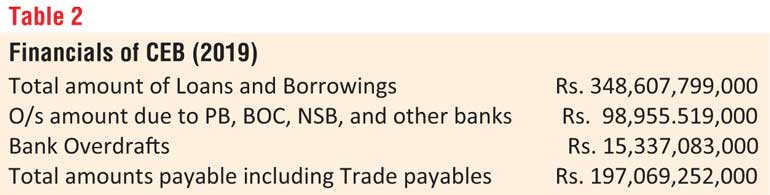
Financials of CEB indicate the following; (2019)

Refer Table 2 for financials of CEB (2019). Bank loans are repayable within a period of 5 years at interest rates ranging from 11.99% to 13.74% to these banks. It is presumed that the Trade Payables include amounts due to the CPC.

As at 31 March 2021 CEB’s Long-term loans o/s was Rs. 346.9 billion and Short-term loans of Rs. 36.6 billion.

The total accumulated losses of CEB for the period ending March 2021 stood at Rs. 176.6 billion


SriLankan Airlines

The other largest defaulter to the State banking sector is SriLankan Airlines. 

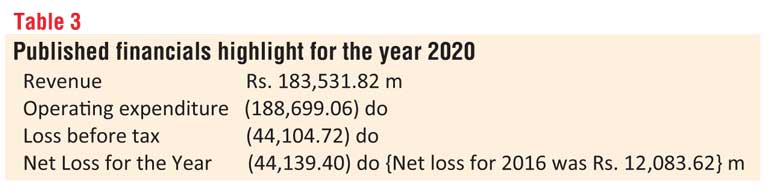
Refer table 3 for published financials highlight for the year 2020.

The total liabilities as at end of 2020 was Rs. 213,306.32 m 

Loans and bank overdrafts stood at Rs. 78,264.92 m.

The crisis we are facing today is something that has silently grown to this magnitude like a cancer. All previous regimes have contributed in some way or other to this disaster. 

Any one in authority who openly speaks will be the bad guy. Repercussions are important only to those who conduct their affairs with responsibility. Therefore, we have to look at things, more objectively and in a more introspective manner. 

State Banks, are in a dire state today. CBSL Governor’s move therefor is praiseworthy as a move essentially required at least as a step towards a last-minute course correction. 

We shall now examine some of the concerns relevant to the issu e.

1. How do the banks keep such large overdue balances as interest earning current loans and advances when they remain unpaid over a long period and when they have reported huge losses.

2. The hypothetically applied interests to these delinquent advances appear to have been a good source of income for the banks to show bloated profits.

3. What has been the role of the Bank Supervision Department of the CBSL in this regard. Loss making, long outstanding unpaid balances normally qualify to be categorised as NPLs and the resulting Impairment and Loan loss requisites under compliances by LCBs.

4. Did the auditors, apply the Securitisation yardsticks in respect of these advances? Banks have produced what are called “Letters of Comfort” to enable the auditors to treat these as government secured loans. There is a huge violation of norms in this process. A guarantee, of a loan by the Treasury tantamount to an obligation on behalf of the government. Can a letter issued by the treasury fulfil this requirement if the Minister of Finance has not obtained the cabinet approval for issuing such a guarantee? 

Can such liabilities be provided outside the limits of the provisions of the appropriation bill which approves the limit of liability and borrowing powers of the government?

5. The CPC, CEB and the SriLankan Airlines have been granted billions as new facilities while the previous facilities remained unpaid over long periods. There is no evidence to show whether several letters of comfort have been taken in respect of each facility ‘or’ whether one letter obtained once is being used to take any amount any time as unsecured advances from banks.

6. When banks show bloated profits with interest amounts unearned accounted for as normal interest earnings, it is a deception. Besides, there are other things flowing out of the assumptive profits. Affordability of super luxury vehicles to executives, special perks, high salaries and allowances beyond state sector parameters, and expenses disregarding procurement guidelines (as was highlighted in some parliamentary COPE) are some.

The services offered to the public through the important State Bodies such as the CEB, CPC and the National Flag Carrier will have to continue uninterrupted. We do not need the IMF to give us the jab in this regard. Accordingly, with the Cabraal Hypothesis under which restrictions are now imposed as an eye-opener, let us find a way out to wake up the State Banks from their ‘Rip-Van-Winkle’ moral. We should now invite them to come down from their ivory towers to serve the people. It is now time to revive the Extended Scheme of Rural Credit (PB) and the ASCs of BOC.

The CBSL will have to ensure that the concessions of policy adjustments (such as lowering of rates) impact the credit movement in the right direction. 

The lossmaking big SOEs have been continuing this deterioration through several decades developing to a stage of a point-of-no-return where normal reforms will not be able to bring about the needed transformation. Pumping in more public funds by way of grants and loans will never bring about the desired change. 

Hence a program should be implemented to minimise their increasing adverse effects to the Public without becoming parasites any-more. The seriousness of addressing the issue to find a lasting solution to a problem of this magnitude Is too important to be left in the hands of a few people.

Radical reforms are not so politically economical in a democratic system. Governments are reluctant to initiate anything that will be a hindrance for the retaining of their power base. 

But history and happenings elsewhere provide us good examples to follow. The directions of change can come from outside, the open society and not from the vested interests. Government can make it happen by opening a fair debate among the people. Knowledge, information, transparency and the emphasis of the need can favourably influence the acceptability of a change. Often, the change will be resisted by sources from within. But the reality is Public at large are the most powerful group to reckon.

What has to be done?

Sum up all the liabilities of these lossmaking SOEs. 

Offer a suitable Haircut based on the questionable profits banks have made from these SOEs.

Absorb the adjusted amounts (after the haircut) into a new unit in the treasury ‘Agency for Recovery of Defaulted Obligations’ – ARDO – and entrust the recovery process to this body.


Advantages of such a scheme

a) The SOEs as well as banks will have clean balance sheets

b) The banks would be free to lend to other sectors for the development purposes as expected under the Acts.

c) The ARDO will monitor these SOEs to prevent wasteful expenditure, frauds, adherence to procurement policies, a system of uniform wages, salaries and other perks, etc.

d) ARDO to introduce performance-oriented targets which have to be compulsorily achieved by the respective institutions (SOEs)

e) Banks to work under strict guidelines not to lend to these SOEs unless otherwise they could apply commercial lending parameters and with the prior approval of the ARDO.

f) The CBSL to set up a special unit under the Bank Supervision Dept.to monitor the progress in recovery of the loan components absorbed by the ARDO 

g) SOEs to be permitted to operate as commercially viable units and any directed deviations on account of Govt. policy to be compensated by the Govt. 

h) If the banks fail to operate profitably under this system further reforms to be affected in the State Banking Sector. 


How to absorb the liabilities?

Many appear to have confusions about this. The immediate response I received from a top guy in high finance was- where is the money to pay for these liabilities? They appear to forget that they already exist as state liabilities.

We know how Private Debt becomes Public Debt and finally end up as Sovereign Debts. 

We also know how when the State Banks were declared Insolvent in the 90s long-term bonds (30 years) were issued to provide liquidity and breathing space for their revival.

In this instance too if the Government could, in compliance with the Appropriation Bill requirements,

provide long-term bonds to the banks and absorb these delinquent advances of the lossmaking SOEs, it will be only a repetition of the same exercise but to a bigger magnitude. When problems become too big, they have also to be handled big!

Let there be light!


Ministry of Justice Law Reforms – Protecting Child Rights or Promoting Sexual Abuse of Underage Girls?

protecting-children-sexsual-abuse


In the second week of December 2021, the Minister of Justice had presented a Cabinet paper with strange proposals to amend certain provisions in the Penal Code, Code of the Criminal Procedure Act and the Judicature Act for the purpose of filling the gaps in the Law of Rape and making rape of boys a crime.

In this Cabinet paper the Minister has proposed to bring about two amendments in the law relating to child abuse.

First proposal: (a) to amend the law on statutory rape enabling (i) the Police to institute criminal proceedings in Magistrate’s Courts; (ii) Magistrate to give suspended sentences to the accused in appropriate cases where the accused is under 22 years of age and the victim is over 14 years of age and under 16 years of age and the penetration had been with the consent of the victim; (iii) Magistrate to forward the case record to the Attorney General, where it appears that the victim has not consented, to consider institution of criminal proceedings on Indictment in the High Court;

Second proposal: (b) to amend S. 363 of Penal Code with the aim of facilitating legal protection for men and boys from sexual violence. In the Minister’s view, there is evidence that rape of boys is a common form of sexual violence contributing to an environment in which such violations can take place without effective penalties. Though historically, rape of only women has been recognized in law, sexual violence has been recognized not only as a women-centric issue, but as a major social problem that highlights the need for gender-neutrality in the present context. This is done in neutralizing gender in terms of the law of rape.

To give effect to these proposed amendments, the Minister has proposed: (1) to repeal S. 137 of Criminal Procedure Code on medical examination of victim and accused in case of rape and substitute a section which is gender neutral; (2) to amend S. 142 of Criminal Procedure Code to empower Magistrate to follow summary procedure laid down in Chap. XVII in case the victim is over 14 years and under 16 years and the offender is not more than 22 years of age and the offence has been committed with the consent of the victim; (3) to amend the First Schedule to the Procedure Code and the Second Schedule to the Judicature Act.

By this Cabinet paper the Minister has sought the approval of the Cabinet: – (a) To amend the CPC Act and Judicature Act in accordance with the Proposal; (b) To instruct the Legal Draftsman to draft amending legislation accordingly; and (c) To empower the Minister to provide necessary guidance and issue further instructions where necessary to the Legal Draftsman on matters relating to the proposal.

From these propositions it is clear that the Minister or his legal advisors have no clear understanding of the existing law and the procedure relating to the sexual abuse of women and children.

Far-reaching amendments were brought to the Penal Code and the Criminal Procedure Code in 1995 with a view to enhancing protection to women and children against abuse, especially sexual abuse. The following are the main changes brought about in the law by these amendments:

a. Creating several new offences such as incest, grave sexual abuse, sexual exploitation of children, procuration and using children for obscene publications.

b. Providing for enhanced penalties for sexual offences and minimum mandatory jail sentences.

c. Recognition of all persons under 18 years of age as children for the purpose of the offences dealt with by these amendments.

d. Increasing the age of statutory rape or consent to sex to sixteen years.

e. Granting exclusive jurisdiction over child abuse cases to the High Court

Under S. 363 of the Penal Code, a man commits rape when he has sexual intercourse with a woman under circumstances falling under one of the following descriptions:-

(a) without her consent….

(b) with her consent when her consent …obtained by use of force, or….

(c) with her consent when….obtained…when she was of unsound mind….

(d) with her consent when the man knows…he is not her husband…

(e) with or without her consent when she is under sixteen years of age, unless the woman is his wife who is over twelve years of age and is not judicially separated from the man.

Under S. 363 (e) of the Penal Code a man who has sexual intercourse with a girl under sixteen years of age, with or without her consent, commits the offence of statutory rape, unless the woman is his wife who is over twelve years of age and is not judicially separated from the man.’’

Later in the implementation of the law, the law enforcement officers encountered difficulties at times due to the phrase shown in italics above, which was included in the section, due to the provisions in the Muslim Marriage Law and the insistence of Muslim MPs.

S. 364 (2) deals with the penalty for statutory rape.

‘Whoever- (e) commits rape on a woman under eighteen years of age shall be punished with rigorous imprisonment for term not less than ten years and not exceeding twenty years and with fine and shall in addition be ordered to pay compensation of an amount determined by court to the person in respect of whom the offence was committed for the injuries caused to such person:

Provided however, that where the offence is committed in respect of a person under 16 years of age, the court may, where the offender is a person under 18 years of age and the intercourse has been with the consent of the person, impose a sentence of imprisonment for a term less than ten years.’

As stated above under the existing law:

a. Only a girl above the age of 16 years can consent to have sex.

b. Any person who has sexual intercourse with a girl under 16 years of age, with or without her consent, commits statutory rape.

c. Any person who commits statutory rape is liable to be punished with a minimum mandatory jail sentence of ten years which can be extended up to twenty years; he is also liable to pay a fine and compensation ordered by court to the victim.

d. However, where the offender is a person under 18 years of age and the intercourse has taken place with the consent of the girl, the court has a discretion to impose a sentence of imprisonment for a term less than ten years.

e. It is an indictable offence with only the High Court having jurisdiction to hear these cases.

By the first proposal in the Cabinet paper the Minister proposes to amend the law on statutory rape bringing about the following changes in the existing law:

a. Under the existing law, only a girl above the age of 16 years can consent to have sex; if the girl is under 16 years of age and the sexual intercourse has taken place with the consent of the girl, the Court may take that fact into consideration at the time of sentencing the offender.

*By this amendment, the age of consent will be brought down from 16 years to 14 years.

*Now any girl who has attained the age of 14 years can consent to sex and the Court is bound to take that into consideration;

b. Under the existing law, at the time of sentencing the Court may take into consideration of the fact that the offender is also a child, a person under 18 years of age.

*By this amendment, this concession has been extended to adults also, to youthful offenders belonging to the age group of 18 – 22 years of age.

c. Under the existing law, all child sexual abusers faced the hazard of going through a High Court trial.

*Under this amendment, these offenders do not face the hazard of going through a High Court trial as the High Court has no jurisdiction to try these offences, only the Magistrate’s Court has jurisdiction.

d. Under the existing law, while statutory rape is an offence punishable with a minimum mandatory jail sentence of ten years, where the offence is committed with the consent of the girl and the offender is a person under 18 years, the Court has the discretion to impose a sentence of imprisonment for a term less than ten years. If the offender is a person over 18 years of age, he has to undergo the minimum mandatory jail sentence.

* Under this amendment, any young person belonging to the age group of 18 – 22 years can have sexual intercourse with any girl who has attained the age of 14 years with her consent without undergoing any sentence of imprisonment.

*The maximum sentence of imprisonment that can be imposed by a Magistrate’s Court under its normal criminal jurisdiction is two years and the maximum sentence of imprisonment that can be suspended is also two years. The court has the discretion to impose a suspended sentence for a period less than two years. It may be even 6 months.

* An offender belonging to the age group of 18 – 22 years can plead guilty to the charge on the first day itself if the Police Report indicates that the sexual intercourse has taken place with the consent of the girl, and he may be able to go home with a suspended sentence without spending a day in prison.

This amendment will certainly result in the promotion of sexual abuse of young girls and bring about dangerous social consequences.

It will be an open licence to pleasure -seeking young adults of moneyed families to get friendly with young girls of school-going age and have sexual intercourse with them.

By the second proposal in the Cabinet paper the Minister proposes to amend S. 363 of Penal Code with the aim of facilitating legal protection for men and boys from sexual violence. In the Minister’s view, rape of boys is a common form of sexual violence, against which there are no effective penalties. One does not know what the Minister means by ‘rape of boys’. Is it anal sex? If it is anal sex or any other kind of act of sexual penetration, there are existing and adequate legal provisions with effective penalties. This proposal clearly shows the Minister’s ignorance of the existing provisions of the law.

The offence of “Grave Sexual Abuse” in S. 365B of the Penal Code deals with the offence of what the Minister calls ‘rape of boys’. “Grave Sexual Abuse” is defined in S. 365B (1) thus:

S. 365B (1) – ‘ Grave sexual abuse is committed by any person who, for sexual gratification, does any act, by the use of his genitals or any other part of his body or any instrument on any orifice or part of the body of any other person, being an act which does not amount to rape under S. 363, in circumstances falling under any of the following descriptions, that is to say- under circumstances falling under one of the following descriptions:-

(a) without the consent of that other person

(b) with consent …obtained by use of force, or…

(c) with consent obtained…when other person was of unsound mind or under intoxication.

(d) with or without the consent of the other person when the other person is under 16 years of age.

S. 365B (2) (b) deals with the penalty for grave sexual abuse committed on persons under 18 years of age.

‘Whoever- (b) commits grave sexual abuse on any person under 18 years of age shall be punished with rigorous imprisonment for a term not less than ten years and not exceeding twenty years and with fine and shall also be ordered to pay compensation of an amount determined by court to the person in respect of whom the offence was committed for the injuries caused to such person.’

In S. 364 dealing with penalties for rape, there is a proviso under which the Court can impose a lesser sentence of imprisonment where the offence is committed on a girl under 16 years of age with the consent of the girl for the intercourse by a person under 18 years of age.

There is no similar provision in the penalties for grave sexual abuse. A Court cannot act leniently in dealing with a person under 18 years of age who commits grave sexual abuse on a boy under 16 years of age with that boy’s consent.

It appears that the Minister or his legal advisers are trying to surreptitiously achieve two undisclosed objectives with this proposed amendment. One is lowering the penalties that can be imposed by courts on youthful sexual abusers who sexually abuse boys with their consent as in the case of statutory rape. If it is directly proposed to amend the law enabling courts to deal more leniently with persons who commit acts of grave sexual abuse on boys with their consent, it would have resulted in arousing a hornets’ nest. It is done on the pretext of strengthening the law against sexual abuse of boys. In their view, at present rape of boys is a common form of sexual violence, without effective penalties; by amending S. 363 of Penal Code bringing in men and boys also into the category of victims of rape, legal protection for men and boys can be strengthened against sexual violence.

Instead of strengthening legal protection for men and boys against sexual violence, this amendment will result in opening doors wider for male sexual abuse of male children. Youthful offenders belonging to the age group of 18 – 22 years can have sexual relations with boys under the age of 16 years with their consent obtained through various means without fear of being indicted in the High Court and languishing in jail. They can get away with a suspended sentence from the Magistrate’s Court.

The other objective is to destroy the historical social base of our society through implementing a policy of gender neutrality in all spheres. The main purpose of amending S. 363 of Penal Code is not facilitating legal protection for men and boys from sexual violence, but neutralizing gender in terms of the law of rape. In the Penal Code amendments already brought, S. 25 the Penal Code has been amended by substituting the word ‘spouse’ for the word ‘wife’. There is no need or justification for any of these amendments, other than gradually paving the way for legal reforms allowing same-sex marriages, giving effect to the policies that the previous government failed to bring forward though they much desired, in the guise of making provision for gender neutrality.

Another thing one cannot understand is why the Minister and his legal advisors have not addressed the need to amend the phrase shown below in italics in paragraph (e) of S. 363 of the Penal Code:

S. 363. A man commits rape when he has sexual intercourse with a woman under circumstances falling under one of the following descriptions:

(e) with or without her consent when she is under sixteen years of age, unless the woman is his wife who is over twelve years of age and is not judicially separated from the man.

This provision allows people belonging to one community to commit sexual abuse of children by marrying girls of 12 years of age and having sexual intercourse with them in total violation of their rights as children. This goes against the proclaimed policy of the government of ‘one country, one law’.
 

A transparent investigation required to prove that the PCoI report handed over to Parliament has not been censored or modified – Chirantha Amerasinghe


By Sri Lanka Brief-

In a detailed letter to Gamini Sedara Senerath,Secretary to the President Justice activist  Chirantha Amerasinghe calls for a ” a transparent and broad legal investigation would be required to confirm that the PCoI report handed over to Parliament has not been censored, modified and or reprinted.”

He further says that “as a censored, modified and or reprinted version of the report would not manifest in the proper truth and justice sought by all who are seeking truth and justice to the Terror attacks on Easter Sunday. In my opinion, I feel that the above move to hand over the volumes to Parliament was just done possibly to reduce or mislead the pressure coming on the country at the United Nations Human Rights Council in the current moment in time.”

The letter:


VERY URENT

28th of February 2022.

Mr. Gamini Sedara Senerath,
Secretary to the President,
Presidential Secretariat,
Colombo.

Dear Sir,

Discrepancy in the “Presidential Commission of Inquiry report into the Terror attacks on 21st April 2019 Easter Sunday” handed over to Parliament

The Discrepancy

A. On the 1st of February 2021 the Presidential Commission of Inquiry into the Terror attacks on 21st April 2019 Easter Sunday handed over its final report to the President. The news aired on 1st February 2021 by Hiru TV states that according to a spokesman of the Presidential Commission the full report consists of nearly 100,000 pages (https://fb.watch/bpqTbhz0Xw/). Further, according to an article published on the state owned Dinamina news paper on the 25th of February 2021, the full report consisted of over 100,000 pages (Original link : http://www.dinamina.lk/2021/02/25/විශේෂාංග/116657/යුක්තියේ-සටහන-පාස්කු-කොමිෂන්-සභා-වාර්තාව , Archive Link : https://archive.is/UAf6s).

B. Further, the front page of the Aruna News paper released on 1st February 2021 quoting a statement of the Secretary of the Commission Mr. H.M.P Buwaneka Herath, reported that the final report would likely exceed 100,000 pages (Evidence annexed marked E1). It is my understanding that the Presidential Commission of Inquiry report into the Terror attacks on 21st April 2019 Easter Sunday (referred to as “PCoI report” hereafter) was compiled by the 31st of January 2021 before being handed over to the President the next day.

C. With the United Nations Human Rights Council up on the horizon, on the 22nd of February 2022, it was reported that all 88 volumes of the PCoI report were handed over to Parliament. Subsequently on the same day, co-Cabinet spokesperson Minister Ramesh Pathirana at the Cabinet press briefing stated that some sensitive content in the PCoI report was withheld by the President for national security.

D. In such context, by the 23rd of February 2022; it was reported by the media that the Parliament has received the full PCoI report containing around 69,800 pages.

E. On the 26th of February 2022, Presidential Legal Affairs Director Mr. Harigupta Rohanadeera confirmed to me that the entire PCoI report consisting around 67,808 pages was handed over to Parliament. Mr. Rohanadeera refuted claims made by the Presidential Commission Secretary in February of 2021, who had stated that there were nearly 100,000 pages, and further refuting the statement made by co-Cabinet spokesperson Minister Ramesh Pathirana on 22nd of February 2022, Mr. Rohanadeera went on to say that the President has not withheld any content of the PCoI report.

Call recordings of the conversation between Mr. Harigupta Rohanadeera and myself :

Call Recording 1 (2022-02-26 – 10:13:33AM) : https://drive.google.com/file/d/1D-to9GF1Ex-d17IfJ-LCHHWFKEjPvwUA/view?usp=drivesdk

Call Recording 2 (2022-02-26 – 10:31:58AM) : https://drive.google.com/file/d/1CrsLz7BJ_erFWwPlIg75gVU4yJwFqSmS/view?usp=drivesdk

F. I am baffled to the fact that a report said to be nearly or over 100,000 pages is now actually 67,808 pages. In addition, for a government that actively monitors and enforces the law against activists for allegedly spreading misinformation; I duly note that the PCoI report on Easter Sunday was with the Presidential Secretariat since 1st February 2021, and that the Secretariat has taken no steps to rectify the then headline news reports which clearly claimed the PCoI report was over or near 100,000 pages until I and others started to question this matter via social media, Right to Information requests, and communication with relevant officials, after a reduced figure of 69,800 pages came to light as a result of the report being handed over to Parliament.

Points of suspicion

G. I notably recall how the government took suspicious turns in relation to the PCoI report, for example on the 3rd of March 2021, it was reported by the media that “The Presidential Secretariat has declined to release 22 volumes (each containing about 600 pages) of proceedings to Attorney General Dappula de Livera” giving the reason “The Attorney General has been informed that the PCoI is of the opinion that 22 volumes shouldn’t be disclosed due to the sensitive nature of the information therein relating to national security.” (Link https://island.lk/pcoi-report-on-easter-sunday-carnage/, Archive link https://archive.is/knueG ) . Later sighting pressure from the Catholic Church and all those who seek justice into the Easter Sunday terror attacks, on the 12th of March 2021 the said volumes were released to the Attorney General.

H. Governments all over the world have issues when defining of the term “national security” and assigning content and or legal charges to it since many politicians tend to tangle their “political security” with “national security”. I believe that any content that is subjected to “national security” be taken to a Judicial review before a full seven judge bench of the Supreme Court for its determination.

I. I am puzzled as to how a PCoI full report that was withheld so much due to the “sensitive nature of the information therein relating to national security” was just handed over to Parliament without anything being withheld by President as claimed by Mr. Rohanadeera who is not only refuting the discrepancy in the number of pages but also refuting the statement made by the co-Cabinet spokesperson. Under such circumstances, I am hamstrung as to how and why the said volumes were not released along with the first volume itself last year, and raises a reasonable suspicion as to if the said volumes released to Parliament were censored, modified and or reprinted, therefore I believe that this matter would need a transparent legal investigation.

J. I recall the contents of the complaint filed with the Criminal Investigations Department on the 2nd of April 2021 against now Minister of Public Security Hon. Sarath Weerasekara over his alleged involvement in the Ampara anti-Muslim riots in 2018 which contributed to the terror attacks on Easter Sunday, and I note the CID’s failure to investigate the complaint so far. Link to the recording submitted to CID containing a vocal statement by then President Maithripala Sirisena claiming Weerasekara’s involvement in the Ampara incident, Rajapaksa family involvement in extremism, Rajapaksa’s fostering extremist groups, and his comments on government run extremism before 2015 is

https://www.youtube.com/watch?v=W1MrrOSNeBQ .

K. I also recall the contents of the complaint filed with the Inspector General of Police, Speaker of Parliament, and the Hon. Attorney General against former Defense Secretary Gotabaya Rajapaksa and former President Mahinda Rajapaksa on the 31st of December 2021 in relation to their possible involvement in the Terror attacks on Easter Sunday. I note the failure to investigate the complaint so far.

L. In such context, I also recall that the first noted contributing factor to the Easter Sunday Terror attacks as listed in the PCoI report, Ven. Galagoda Aththe Gnanasara Thero (page 331, Vol 1) was appointed as the Chairman of the Presidential Task Force for One Country and One Law by His Excellency the President on the 26th of October 2021. The Thero and extremists’ organizations such as Bodu Bala Sena was found to have provided a fertile ground for Zaharan to prosper (page 361, 362, Vol 1) contributing to the Terror attacks on Easter Sunday. I note that according to the statement made by Member of Parliament Hon. S. B. Dissanayake, it is Gotabaya who had created, protected and looked after the Bodu Bala Sena organization (Video : https://www.youtube.com/watch?v=5N51NkYsIxw).

M. I recall that the Parliamentary Select Committee Inquiry Report (PSC) into the Easter Sunday Terror attacks which recommended to investigate if the terror attacks were allowed to happen as part of a political plan (PSC Page 3), but so far such investigations have not been done. Even disregarding my written request from President Gotabaya made on 27th of November 2019 to do so.

N. I recall that the so-called President Gotabaya who is ready to make tough and unpopular decisions for the betterment of the country had called His Eminence Most. Rev. Dr. Malcolm Cardinal Ranjith and informed that certain recommendations of the PCoI report cannot be implemented because it might make him unpopular and I note that most of the recommendations of the PCoI report still remain disregarded.

O. Further, I wish to recall that I am being/was investigated via legal proceedings by the Criminal Investigations Department (CID) for making a Facebook post asking the questions “Was the Easter Sunday Terror attack a deal to bring Gotabaya to power? Is that why Maithripala is not being arrested? How did Catholic Shiranthi not know?“. I was arrested on the 17th of November 2020. Subsequently, activist Shehan Malaka Gamage is now being prosecuted under criminal law (section 120 of the penal code) with the approval of the Attorney General for holding a similar opinion. Furthermore, I note how legal proceedings against Very Rev. Fr. Cyril Gamini Fernando was initiated for holding an opinion and making an accusation against a government official, that did not favor the government. The above incidents occur in the background where the Supreme Court of Sri Lanka has clearly held:

“Provision of Section 120 of the Penal code and its explanation contained therein guarantee freedom of expression and speech, and the explanation to the section no doubt fortify this position in great measure. Whatever comments and strongly used words against the government which does not excite feelings and cause public disorder by acts of violence cannot be a basis to prosecute a person under Section 120 of the Penal Code” – SC/FR 768/2009

“To cause any annoyance or embarrassment to a Head of State or the Government will not form the basis of a prosecution under Section 120 of the Penal Code. Essence of Section 120 is whether the words in question incite the People to commit acts of violence and disorder and not whether the words are defamatory or not.” – – SC/FR 768/2009

P. I recall how the CID took away my two mobile devices (when one device did not even have Facebook) and denied requests for my legally entitled data copy when I was arrested without giving exact reasons on the 17th of November 2020.

Q. I recall how the CID proceeded to put both my mobile devices into one packet and failed to seal it in the due legal process, and produced me before the Magistrate without the devices. I note that legal proceedings are initiated against me for several Facebook posts. Posts containing content criticizing and protesting against government policy and or President while holding the social opinion “GotaFail”, post containing content voicing against mandatory cremation of COVID19 victims, post containing content holding the World Health Organization opinion that COVID19 doesn’t spread in water.

R. I recall how I subsequently received an anonymous life threat on the 23rd of January 2021 saying that if I do not stop speaking against the government and stop speaking for justice into Terror attacks on Easter Sunday my private things will be leaked and the people around me will face problems. Further according to the said threat, by the time I receive the mobile devices, the data will be with them (an unknown party).

S. As per the implementation of the aforementioned anonymous threat or by strange coincidence, I recall that soon after, most of the main activists (or their family members) who are supportive of me have been legally prosecuted/troubled by the Sri Lanka Police/certain government entities in unimaginable ways (Asela Sampath, Yasiru Kuruwitage, Oshala Herath).

T. I recall how the CID after keeping my mobile devices since the 17th of November 2020, produced them on 4th of March 2021 to the Chief Magistrates Court in “two packets” instead of the “one packet” they were put in front of me. I note that even though the Facebook post in relation to Easter Sunday was not mentioned in the Court case B-report, the CID when they were producing my devices wished to investigate the said Facebook post through the request made to the Government Analyst Department. However, the annexed document containing the posts remains missing in the court case record. I further note that nearly 90% of the questioning done after being arrested on 17th of November 2020 was in relation to the Facebook post which stated “Was the Easter Sunday Terror attack a deal to bring Gotabaya to power? Is that why Maithripala is not being arrested? How did Catholic Shiranthi not know?“.

U. I recall how the CID’s arbitrary actions in detaining my mobile devices without due legal process has violated the provisions of the law thus even hampering my day to day life, and has also hampered the investigations into separate death threats I had received by the 25th of August 2020 (as the evidence messages are in those devices) the investigations into which are being conducted by the Colombo Crimes Division (CCD). As filed in the Police complaint dated 25th August 2020, I believe the root cause of the death threats I received was due to my efforts in seeking justice to the Easter Sunday Terror attacks.

My conclusions and request

V. Amidst arbitrary actions taken by the government and state entities in relation to seeking justice for the Terror attacks on Easter Sunday, and amidst the arbitrary actions taken by the government and state entities against those who are seeking justice for the terror attacks on Easter Sunday, sudden actions taken with lack of transparency by the President and the government seem insignificant, misleading, and suspicious. Therefore, I believe that the President and the Government will need to do much more to ensure transparency, accountability, Justice and Human Rights to the victims of the terror attacks on Easter Sunday and as well as to the people who seek justice for the same.

W. Therefore, given the above circumstances, I wish to reiterate that a transparent and broad legal investigation would be required to confirm that the PCoI report handed over to Parliament has not been censored, modified and or reprinted. As a censored, modified and or reprinted version of the report would not manifest in the proper truth and justice sought by all who are seeking truth and justice to the Terror attacks on Easter Sunday. In my opinion, I feel that the above move to hand over the volumes to Parliament was just done possibly to reduce or mislead the pressure coming on the country at the United Nations Human Rights Council in the current moment in time.

Yours Faithfully,

…………………………………

Chirantha Amerasinghe

Civil and Human Rights Activist

Copy to :

  • Hanaa Singer, United Nations Resident Coordinator in Sri Lanka, UN Compound, Colombo 4 – To be bought to the urgent attention of the Hon. Michelle Bachelet – The United Nations High Commissioner for Human Rights
  • Read as a PDF: my letter to presidents secretary 2022-02-28

My Letter to Presidents Sec... by Thavam Ratna