Sri Lanka: One Island Two Nations

Search This Blog

Tuesday, 31 May 2022

 Changing Pillows To Cure Headaches: Politicians—Constitutional Amendment Mess


By Sunil J. Wimalawansa –

Prof Sunil J. Wimalawansa

Part 16: Sri Lanka—Changing Pillows to Cure Headaches: Politicians—Constitutional Amendment Mess 

This week’s priority for the Members of the Parliament (MPs) is to solve the political crisis by having a multi-party cabinet/government and legislating the modified 21st amendment. This article discusses these aspects.

Defective 20th amendment

The 20th amendment was unnecessarily and inappropriately introduced primarily to strengthen the power of the executive powers of the president and to benefit folks around him/her. Thus, it included dismantling independent Commissions, abolishing audits, weakening the judiciary, illegally removing all lawsuits against them, and loopholes for financial gain. These created an environment conducive to pilfering funds and public resources, selling public assets to profit politicians, removing accountability and transparency, and opening the doors widely for nepotism, financial and other corruption, which they successfully did.

These day-light robberies were approved and done in mid-nights by the leading political party. These led to arising of People’s protests spontaneous (“Aragalaya”- a peacefully organised protest without disruptions or violence or any political backup), which initiated the current political crisis. Besides, the 20th amendment also removed fair governance, independent institutions that audits and oversight the executive and legislative branches of the government, and constitutional safeguards, including compromising the sovereignty of Sri Lanka. Overall, it was a manufactured disaster for the country.

Ironically, some MPs who voted for the 20th amendment are now proposing patch-ups to it. Other than pressure from the president’s secretary and expected personal gains, was there other reasons for those two-thirds of MPs to vote for the 20th amendment? Instead of temporary fixes, the 20th amendment should be revoked in its entirety, together with the 13th amendment. This would allow reactivating the 19th amendment until the new constitution is enacted in the parliament or by a nationwide referendum.

There is nothing good about the 20th amendment initiated by the current president, pushed by his over-rated and conflicted secretary, who has made many blunders. These include but are not limited to inadvertently designing the current economic collapse in Sri Lanka via overriding the central bank’s decisions and unnecessary tax cuts in 2019. If there are any legal reasons that the 20th amendment cannot revoke, then the second-best is to approve a modified version of the 21st amendment as the first step.

20th amendment took away the freedom of expression, liberty, and public safety and created a situation of non-existing law and orders. The abolition of independent Commissions was the worst. It opened doors, exacerbating the pilfering of resources without consequences. It removed the “checks and balances” that the country had over the executive branch and the legislative branch, the parliament. Besides, these sequences allowed systematic attacks by unscrupulous powerful lobbies to discredit Buddhism and its followers using foreign funds unnecessarily. Citizens must reverse this trend. This reminds us that “Big results require big ambitions/steps” [James Champy].

What needs to be done now?

The current main issue is a “political” crisis. Without solving the political crisis and gridlock in the parliament, there is no possibility of solving the financial, food, gas, petrol, or other scarcities. Instead of focussing on the critical issues of political and economic crises, selfish and corrupted MPs were discussing for three days how to get approval billions to compensate for new housing for those MPs who lost due to riots because of their own failures.

Yet again, there is no rationale for the public to fund MPs’ personal property; they must be out of their minds to disregard the current political and economic crises in Sri Lanka. Is compensating for the lost houses of MPs the priority for the country at this stage when people are starving and dying without food and essential medication? Decisions taken by the current parliamentarians are selfish and ridiculous.

Regarding the financial crisis, the IMF and the World Bank categorically stated that they could not assist the country until it established a stable multi-party government and stabilisation the political situation in Sri Lanka. Despite this, no attempt was made to form a multi-party cabinet with ten ministers (no need for deputy OR any other type of ministers, that would only waste more funds) who could do this job effectively. Would re-appointing inefficient crooks and those with criminal records as ministers solve this issue?

What is the priority for the country?

Considering the above, the priority now is to find a better solution to overcome the stalemate in the parliament: solve the political crisis first. Each day’s delay pushes the country over the cliff of bankruptcy and delays possible recovery. The public should not allow them to return home until MPs solve the initial political crises (e.g., by voting for approval of the 21st amendment).

Since currently, there is no possibility of obtaining a two-thirds majority (i.e., 151 votes) in the parliament because of the ruling party; a nationwide referendum or total constitutional change is not feasible. Therefore, for the time being, one must settle on doing what is possible, the right thing for the country. Initiate one affirmative step at a time but a rapid phase. Even though people have the power, MPs of the leading political party prevent what is best for the country and its people.

Importance of the 21st amendment as an alternative to a new constitution

This brings the importance of the 21st amendment that could re-vitalise the 19th amendment. The latter was virtually revoked following the enactment of the dangerous 20th amendment, championed by the current president and his former secretary, made significant negative contributions to Sri Lank and its economy. The latter pushed Sri Lanka into almost a dictatorship with widespread semi-military control and the current economic collapse and social unrest.

21st amendment is still at preliminary stages and yet to be gazette. After multi-party leadership input, the cabinet is expected to discuss this week and the entire parliament membership later this week. Because of the reasons mentioned above, it is crucial to immediately lobby and pressure the cabinet members and all parliamentarians to support and vote for the modified amendment with the following caveats.

It is essential to remove the unnecessary claws included by the minister of justice at the direction of the current president for him to continue maintaining cabinet portfolios. The failure to remove the above claws will bring another unnecessary disaster for the country with erroneous decision making, and the abuse of power will continue. Therefore, the public and the parliamentarians must request and pressure the minister of justice to remove this insane hook from the draft 21st amendment. If this is done and the justice minister can attract 151 votes in the parliament, this amendment to the constitution can be enacted within three weeks.

Despite their beliefs and personal agendas, MPs should not blindly refuse to vote for the 21 amendment, especially if they can get the draft changes. At least the 21st amendment will allow for re-establishing the independence of the judiciary and re-appointing all independent Commissions. However, without modifications, it could become yet another instance of “changing pillows to cure headaches:” there will not be any worthwhile progress.

Read More

 SC orders CID to place Duminda Silva under prison custody


31 May 2022

The Supreme Court today issued an Interim Order directing the CID to place Duminda Silva under the custody of prisons with immediate effect.

The Attorney General was directed to assist the CID to implement this interim order while reporting to court the progress of the implementation of the Interim Order.

The Court also issued an Interim Order impounding Duminda Silva's passport.

In a historical order, the Supreme Court issued an Interim Order suspending the operation of the Presidential Pardon granted by the President to former parliamentarian Duminda Silva.

This order will be effective until the final determination of the three Fundamental Rights petitions.

Supreme Court three-judge-bench comprising Justice Preethi Padman Surasena, Justice Yasantha Kodagoda and Justice Achala Wengappuli made this order pursuant to three Fundamental Rights petitions filed challenging the legality of the Presidential Pardon granted to former Parliamentarian Duminda Silva were taken up for leave to proceed.

The Supreme Court granted leave to proceed with three Fundamental Rights petitions in terms of Article 12(1) of the constitution.

The court fixed the petitions to be taken up for argument on September 1. The Supreme Court further issued an interim order to examine records and documents relating to the presidential pardon granted to Duminda Silva.

Former Parliamentarian Hirunika Premachandra, her mother Sumana Premachandra and former Commissioner of Human Rights Commission of Sri Lanka (HRCSL) Ghazali Hussain had filed these petitions seeking a declaration that the presidential pardon of Duminda Silva is invalid in law. The petitioners are seeking a declaration that their Fundamental Rights guaranteed under Articles 10, 11, 12 and 12(1) of the Constitution have been violated by the respondents.

The Petitioners state that on or about 24th of June, 2021 it was widely published in the media that Duminda Silva had received a presidential pardon. The Petitioner states that they verily believe that the other convicts in the said case are still serving their sentences. They further said to the best of their knowledge the President has not explained and set out the basis of the said pardon.

They further alleged that the President has not explained the procedure for the said pardon in terms of Article 34.

UThe petitioners maintained that any pardon to be granted under Article 34 of the Constitution should be made after a careful analysis of the necessity to grant such a pardon as stipulated in the proviso to Article 34 (1) of the Constitution.

On September 8, 2016, five accused including former Defence Ministry Monitoring MP Duminda Silva were sentenced to death by Colombo High Court for committing the murder of four persons including former MP Bharatha Lakshman Premachandra on or around October 8, 2011. On October 11, 2018, Supreme Court five-judge-bench headed by then Chief Justice Priyasath Dep unanimously decided to dismiss appeal petitions filed by former MP Duminda Silva and two others who challenged the judgment of Colombo High Court that found them guilty for conspiring to murder four persons including former MP Bharatha Lakshman Premachandra.

M.A. Sumanthiran PC, Jeffry Alagaratnam PC appeared for Hirunika Premachandra and Ghazali Hussain. Attorney-at-law Eraj De Silva with Daminda Wijerathne and Sundramoorthy Janagan under the instructions of Attorney-at-law Dimuthu Kuruppuarachchi appeared for Sumana Premachandra.

Additional Solicitor General Nerin Pulle appeared for the Attorney General. President’s Counsel Gamini Marapana with Navin Marapana PC appeared for Duminda Silva. K. Kanag Iswaran PC instructed by Senior Counsel G.G. Arulpragasam appeared for the Bar Association of Sri Lanka, a respondent party to the petitions.(Lakmal Sooriyagoda)

Bid to neutralise NMRA alleged as crisis worsens


By Shamindra Ferdinando-

The National Medicine Regulatory Authority (NMRA) has reminded the government that the severe shortage of medicine and medical equipment as well as the continuing increase in the price of the entire range of medicines is due to the prevailing foreign currency crunch.

NMRA President Dr. Rasitha Wijewantha and CEO Dr. Sachin Semage said that attempts were being made to blame his institution for the crisis but the situation had taken a turn for the worse due to the severe foreign exchange shortage.

Responding to criticism of the NMRA, at a recent meeting, chaired by Prime Minister Ranil Wickremesinghe, at the Prime Minister’s Secretariat, to discuss the growing crisis in the health sector, the NMRA officials questioned the absurdity of blaming the regulatory mechanism as those in authority publicly acknowledged the shortage of petrol, diesel, cooking gas and all other essential services and products due to lack of foreign currency.

NMRA officials emphasized that interruption of electricity, transport and other services caused by financial turmoil largely contributed to the disruption of the industry. They pointed out that other regulatory bodies hadn’t been blamed for the crises in their respective sectors.

Among those who had been present at the Prime Minister’s Secretariat meeting were Health Minister Keheliya Rambukwella, Ports, Shipping and Aviation Minister Nimal Siripala de Silva, MP Nimal Lanza, former MP Ruwan Wijewardene, Government Nursing Officers’ Association President and former UNP National List MP Saman Ratnapriya and President of the College of Medical Laboratory Science Ravi Kumudesh.

The NMRA has strongly denied accusations pertaining to the inordinate delay in releasing medicines and medical

equipment received as donations as the country struggled to meet both public and private sector requirements. The regulatory body declared that a special mechanism had been established to expedite the process.

Keheliya Rambukwella recently received the health portfolio after being replaced by Prof. Channa Jayasumana in April this year following a political crisis triggered by violent protests at President Gotabaya Rajapaksa’s private residence at Mirihana. Rambukwella previously received the health portfolio in August 2021 after President Gotabaya Rajapaksa sacked Pavitra Wanniarachchi over the criticism of her handling of the Covid-19 epidemic.

At the meeting chaired by Premier Wickremesinghe, the NMRA has been accused of discouraging local producers of various medicines. The NMRA explained that a special unit that had been set up to look after the interests of the local producers over the past two months registered 150 new products. During the same period, 20 new producers were granted license to operate following checks, the NMRA said, adding that among them were four producers of four new products.

The NMRA also explained measures taken during the past two months to expedite the release of medicine and equipment received from abroad.

The NMRA has warned of efforts by unscrupulous elements taking advantage of the current crisis to import and produce low quality products while making attempts to weaken regulatory measures. The NMRA has urged the government to be wary of these elements who may pursue strategies with a view to making profits in the future.

The NMRA has advised those in authority to take tangible actions to address the issues at hand or face the consequences.

Meanwhile, the People’s Movement for the Rights of Patients (PMRP) in a letter dated May 28 has urged Premier Wickremesinghe not to take a hasty decision to bring the NMRA under the purview of the Health Ministry.

The outfit’s Joint Secretary C. Perera has pointed out that the NMRA had been established to regulate, minimize corruption and make available quality medicines at affordable prices to the general public. But, some interested parties seemed to be working overtime to undermine the NMRA, the organization stated.  A spokesperson for the outfit said that those elected and appointed to the Parliament should be ashamed of the situation. “We are begging for life saving medicines and equipment from various countries and lending agencies after having failed at least to properly assess the situation,” the spokesperson said, urging the Parliament watchdog committee COPE to inquire into the matter.

Dr. Ananda Wijewickrama. Consultant Physician, IDH, has queried the attempt to blame the NMRA for the current crisis as the minister in charge if the health portfolio was responsible for making available sufficient funds.

The top specialist said that disrupting the regulatory mechanisms would benefit those who received commissions for granting ‘registration’ for substandard medicines and medical equipment.

 Resus Energy connects 6 MW Solar PV power plant to national grid

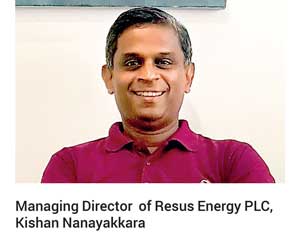
Managing Director Kishan Nanayakkara, Arial view of the Mahiyanganaya solar power project


Tuesday, 31 May 2022

Further expanding its portfolio, Resus Energy PLC, a forerunner in renewable energy, recently connected a six MW ground mounted solar PV (photovoltaic) station to the national grid. 

This comes at a crucial time when the country is facing a massive power crisis resulting from fuel scarcity to operate thermal plants, which in turn results from a forex shortage and unaffordable global fuel prices. 

In this current situation, a higher level of renewable energy in our power generation mix is critical to combat the over-dependency of thermal power and to sustain a more energy secure nation. 

Located in Rideemaliyedda, and connected to the Mahiyanganaya grid substation, the development rights of these projects were secured from the government’s Soorya Balasangramaya tender floated to procure 90 x one MW Solar PV projects. 

Built at a cost of over Rs. one billion with state-of-the-art equipment encompassing tier-1 solar PV panels, top-of-the-range inverters, and other auxiliary equipment, the power station is expected to generate about nine million units of electricity (nine GWh) annually. This is Resus Energy’s second solar PV site. Now together with its first site in Siyambalanduwa, Resus supplies eight MW of solar power to the national grid. 

The project was developed under extremely arduous conditions. Navigating through long lockdown periods, the project was badly affected by hyperinflation and scarcity of construction and other input materials; transportation challenges; forex crisis leading to inability to open LCs; and making suppliers settlements. 

Yet, Resus delivered the project on time keeping its responsibility and promise to the nation to support its crusade to expand renewable energy. With this one, Resus now operates 11 utility-scale grid-connected power stations with an aggregate capacity of about 24MW and estimated annual energy generation of over 60GWh. 

 “I salute our team that worked day and night to make this project a success under most challenging environments with material shortages, transportation restrictions due to fuel shortage, forex crisis, astronomical price increases in input materials leading to cost-overruns, and financing challenges. We still delivered this one despite operating in impossible conditions against all odds. This demonstrates our commitment to partake in fulfilling the country’s dream of becoming an energy secured nation,” Resus Energy Managing Director Kishan Nanayakkara said.

He further said: “This country is paying dearly because of renewable energy shortage. We are having blackouts impacting people’s lives and business and at the same time idling thermal plants due to fuel shortage. That’s ironic. Our economy is pushed to a perilous state for having to pay astronomical prices for fuel to even have a limited operation of our thermal plants. 

“Resus Energy’s newly connected solar PV station gives a huge economic benefit to the nation, supplying electricity at about Rs. 15/- unit for the next 20-years, which is below CEB’s current average selling price, enabling it to make a profit from each unit. Comparatively, the fuel cost of the Puttalam Coal Plant, the cheapest thermal plant, alone is over two and half times of our unit cost and is over six times in the case of diesel and furnace oil plants.” 

“Sri Lanka being a signatory to the 2015-Paris Agreement on climate change is obligated to the implementation of SDGs in which SDG 7 is provision of Clean and Affordable Energy. Through our Nationally Determined Contributions (NDC) we have also pledged to reduce emissions by 30% with 20% to come from energy sector. Renewable energy is a huge element in meeting our promise to the world made through the Paris Accord and NDCs,” Nanayakkara added.

Over the last few years, Resus Energy consistently won awards and accolades for its reporting and sustainability work from CA Sri Lanka and ACCA. It has also won merit award from South Asian Federation of Accountants (SAFA) and has also been a winner of the National Green Awards.

US lawmakers demand White House stop Israeli 'war crime' in Masafer Yatta

In the second letter in the space of a week, White House urged to take steps to prevent the forced expulsion of 1,000 Palestinians in occupied West Bank

Israeli troops move away an elderly Palestinian man during a protest after Israeli top court paved way for razing eight Palestinian hamlets in Masafer Yatta in the Israeli-occupied West Bank on 20 May 2022.
Israeli troops move away an elderly Palestinian man during a protest on 20 May 2022 after Israel's top court paved way for razing eight Palestinian hamlets in Masafer Yatta (Reuters)


By MEE staff-
31 May 2022

More than a dozen members of US Congress sent a letter on Tuesday to Secretary of State Antony Blinken, calling on the White House to take immediate action to halt the Israeli government from forcibly expelling more than 1,000 Palestinians in the occupied West Bank.

The letter, spearheaded by Congresswoman Cori Bush, is the second one in the span of a week calling on the Biden administration to take immediate, concrete steps to prevent the destruction of Palestinian homes in Hebron's Masafer Yatta district

Bush was joined in the letter by a number of progressive Democrats including Andre Carson; Pramila Jayapal; Betty McCollum; Marie Newman; Alexandria Ocasio-Cortez; Ilhan Omar; Mark Pocan; Ayanna Pressley; and Palestinian-American Rashida Tlaib.

Dozens of Democrats urge US to prevent Palestinian evictions in Masafer Yatta
Read More »

"Forced displacement and transfer by Israel of Palestinians in Masafer Yatta would be a grave breach of the Fourth Geneva Convention and would amount to a war crime," the lawmakers wrote in the letter.

"If Israel proceeds with its plans to forcibly displace the indigenous Palestinian residents," the lawmakers wrote, "the State Department and the U.S. Embassy in Israel should immediately, pursuant to the oversight and accountability required by the Leahy Law and the Arms Export and Controls Act, send observers to document the mass transfer, including details of the military units involved in these operations and the use of any U.S. weapons."

The Leahy Law is a piece of legislation that prohibits US assistance to foreign militaries suspected of committing "gross violations of human rights". The law enables the administration to force oversight of and also restrict Israel's expulsion of Palestinians, according to the lawmakers.

In addition to the US lawmakers, the letter was supported by dozens of civil society groups including Jewish Voice for Peace Action; Americans for Justice in Palestine Action; IfNotNow; and the US Campaign for Palestinian Rights.

"Hollow words of concern from the Biden administration are not enough," said Beth Miller, political director of JVP Action. "Palestinians in Masafer Yatta are under daily threat from the Israeli military, living the terrifying reality that their homes could be destroyed at a moment’s notice, with funding from the US government."

Israel's 'firing zones' in West Bank

Last week, 83 lawmakers - 20 members of the Senate and 63 House members - sent a similar letter condemning Israel's plan to evict Palestinians ahead of the visit by US President Joe Biden to Israel next month.

Earlier this month, Israel announced plans to build 4,000 new settlement units in the West Bank and demolish at least 12 villages in the Masafer Yatta district.

A cluster of Palestinian hamlets mainly working in agriculture, Masafer Yatta is disconnected from any water, electricity and sewage networks due to an Israeli ban on Palestinian construction in the area.

Masafer Yatta residents and Israeli rights groups say that many of the Palestinian families have been permanently residing in the 3,000-hectare area since before Israel captured the West Bank in the 1967 Middle East War.

However, in a ruling by the Israeli Supreme Court, the court said local Palestinians - who have kept a generations-old, nomadic way of life, making a living from farming and herding - had not been permanent residents of the area when the Israeli military first declared it a firing zone in the 1980s.

Territories that the Israeli military has declared as "firing zones" are, according to the Israeli government, demarcated as areas to be used for military training. 

Israeli authorities have demolished or confiscated 217 Palestinian structures in "Firing Zone 918" since 2011, displacing 608 Palestinian residents, according to the UN Office for the Coordination of Humanitarian Affairs.

Israel has designated nearly 30 percent of Israel-administered Area C, which comprises 60 percent of the occupied West Bank, as "firing zones", according to the UN.

The violence didn’t stop with Jerusalem’s Flag March

Despite Palestinian resistance, Israeli police arrests and settler attacks inflicted a severe toll before and after the notorious march, says Nasser Odeh.

Israeli Border Police detain a Palestinian man at Damascus Gate during the Flag March on Jerusalem Day, May 29, 2022. (Jamal AwadFlash90)
 

By 
Vera Sajrawi- May 31, 2022

The sight of tens of thousands of Jewish supremacists, many of them young, gripped the world on Sunday during the annual Flag March, the culmination of Israel’s celebrations marking the “reunification” of Jerusalem in 1967. The marchers walked through the streets of Jerusalem on their way to the Old City, many of whom engaged in violent and racist chanting, including “Death to Arabs,” “May your village burn,” and “Shireen is a whore,” in reference to the slain Palestinian journalist Shireen Abu Akleh. 

The marchers were allowed to parade through Damascus Gate — a central hub for the city’s Palestinians — and into the Muslim Quarter, where they attacked Palestinian shopowners, journalists, and onlookers; the Israeli police, meanwhile, cordoned off the area surrounding the Old City and barred Palestinians from protesting.

But with the world’s focus on the Israeli marchers, few paid attention to how Palestinians were resisting that day — and how they were brutally suppressed. Less than a kilometer from the Jewish crowd, Palestinians organized their own counter Flag March on Salah a-Din street, one of the major thoroughfares of occupied East Jerusalem. Unlike the Israeli Flag March, the Palestinian one was swiftly put down by the police.

Other moments of defiance stood out during the day, captured on video and circulated widely on social media. While Israeli marchers danced at Damascus Gate, a drone carrying the Palesinian flag flew over their heads to the delight of Palestinian onlookers. When an Israeli settler pepper sprayed a Palestinian woman and kicked her to the ground, several Palestinian young men sprung to confront him and kicked him back. An elderly Palestinian man, standing before hundreds of shouting Israeli youth, wore a kuffiyeh and insisted on facing the march, until Israeli police removed him from the scene.

“We felt victorious at some points, but it was a relative victory,” said Atty. Nasser Odeh, a Palestinian human rights lawyer and activist. “The fact that Israel had to close the area around the Old City and send reinforcements to guard the Flag March makes Palestinian feel that the Israelis don’t have control over the city. But at the same time, Israel has powerful systems in place to enforce its control, be it the legal system, the police, the government, etc.”

Odeh, who regularly represents Palestinians arrested by Israel in Jerusalem, called the Palestinian Flag March “a natural response by the Palestinians who are daily and repeatedly oppressed at the hands of Israel.”

“We are talking about oppression following you to every corner of your life, whether you want to study, work, marry, or build a house,” he explained. “Anything and everything you try to do in Jerusalem as a Palestinian — Israel will try to stop you.”

‘Scare and silence’

According to Odeh, Israeli police arrested around 150 Palestinians before the Flag March even began. Some of those who were arrested have been released by now, while others are still being held in custody. Despite the Jerusalem District Court ruling that such so-called “preventative” arrests are illegal, the police kept them until the late hours of the day — over 12 hours after the court ordered their release.

Nasser Odeh, a Palestinian human rights lawyer and activist in Jerusalem. (Courtesy of Odeh)

Odeh further described how the Israeli authorities attempted to “scare and silence” Palestinians by sending them summons for interrogations, or threatened them by calling or texting their phones. Some Palestinians, he added, avoided going to work or school out of fear of violence from both the marchers and Israeli forces.

In addition, between 60 and 70 Palestinians were arrested during and after the Flag March itself, nearly a quarter of them minors, Odeh said. By Monday, some of those Palestinians were released, while others had their remand extended.

“The conditions of the release were ridiculous,” Odeh said. “Some were let go on enormous bails; some were given restraining orders, barring them from the Old City for three to six weeks; and others are being confined to home arrests. In one case, a Palestinian was let out of detention, but was ordered to stay 20 meters away from any Israeli home in the city.”

The violence, however, did not end when the Flag March quieted down. In Palestinian neighborhoods such as Sheikh Jarrah and Silwan — which have become renowned for their struggle against Israeli expulsions and settler violence — hundreds of young Jewish extremists, often accompanied by police, attacked residents and their property, which Odeh refers to as “lynching attempts” that the mainstream media did not cover.

A Palestinian woman waves a flag in front of the Israeli Flag March on Jerusalem Day at Damascus Gate, Jerusalem, May 29, 2022. (Oren Ziv)

“The settlers were ready and organized,” Odeh said. “They planned ahead, they were masked, used pepper spray, had sticks on them, and attacked the people and houses that had become a symbol of resistance in Sheikh Jarrah and Silwan. They knew what they were doing.”

In one case, masked settlers attacked Iyad Harb, a prominent Arab journalist who works for Makan, the Arabic branch of Israel’s public broadcaster, Kan. Harb told Haaretz that upon arriving in Sheikh Jarrah, he saw masked settlers who “attacked me in my head, back and leg with sticks, breaking my glasses, stealing my phone and spraying me with pepper spray.”

Although the assailants were arrested, Odeh points to the enormous discrepancy between the handful of Israelis and the hundreds of Palestinians who were detained by the police in relation to the Flag March.

“The attempted lynchings in these neighborhoods were different this year — they were more severe and violent, with a higher numbers of attacks,” he said. “The media covered the march itself and focused on the Old City, but did not cover much of the attacks in Sheikh Jarrah and Silwan ahead of the march and after it ended. The settlers passed through those neighborhoods to arrive at the Old City and wreaked havoc.”

Cars belonging to Palestinian residents damaged by Israeli extremists during the Flag March on Jerusalem Day, May 29, 2022. (Oren Ziv)

In some cases, Odeh said the police arrested some of the Palestinians who had been attacked by the settlers, rather than the assailants themselves. Worse yet, the officers continued to assault the detainees in custody — right in front of the lawyers.

“They severely beat and tasered the detained Palestinians, even inside the police station,” said Odeh. “Lawyers demanded the detainees receive medical treatment because they were bleeding and [some had] their bones broken, but the police stalled for hours. The legal system and the courts are part of this oppressive regime that legitimizes such illegal acts.”


Press Freedom Triumphs With Axing of Jewish Report from Press Council

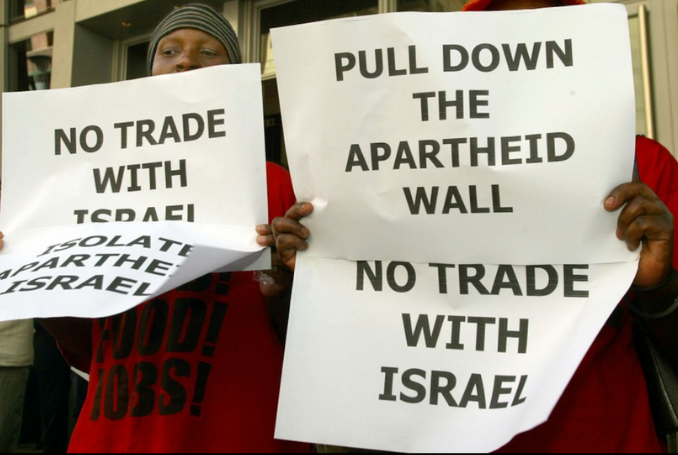
South African trade unions condemn the takeover of Clover by Israeli-led company, Milco SA. (Photo: Courtesy of BDS Movement website)


By Iqbal Jassat-May 30, 2022

In a remarkable testament to the protection of free speech in South Africa, especially in relation to Palestine and the settler-colonial regime of Israel, which usually is marred by intimidatory allegations of antisemitism by pressure groups on behalf of the colonial entity, the Press Council of SA (PCSA) upheld this vital right.

It did so following a protracted battle in which the perpetrator, the SA Jewish Report, found to be in violation of the press code, opted to defy the rulings against it, but finally faced the proverbial ax.

In a dramatic turn of events that promises to have a liberatory impact on civil society’s ability to overcome impediments to freely criticize Israel’s illegal occupation of Palestine and campaign against it, the SA Jewish Report has been expelled from the Press Council of SA (PCSA) with immediate effect.

PCSA executive director Latiefa Mobara, in a statement issued on Friday, said the publication refused to obey rulings by the acting press ombud and PCSA chair of appeals Judge Bernard Ngoepe.

It is clear that contempt and defiance reached a point where the PCSA had no choice but to expel the Jewish Report, it being the first time such an action has been taken against a publication in the last two decades.

The statement also quotes Press Council chair Judge Phillip Levinsohn. He said the decision was taken after lengthy correspondence and after the SA Jewish Report had refused to obey the rulings against it.

“The SA Jewish Report appealed the ruling by acting ombud Johan Retief in the complaint, SA BDS Coalition and GIWUSA v SA Jewish Report, but their application for leave to appeal was dismissed by judge Ngoepe.”

The valiant battle in defense of free speech and against false misleading charges of antisemitism was led by unionist and media activist Hassen Lorgat.

He lodged the complaint on behalf of the SA Boycott Divestment and Sanction Coalition (SABDS) and the General Industrial Workers Union of SA (Giwusa), after a scathing report by the publication accused them of antisemitism.

The report came in the wake of the Clover dairy labor dispute during which Giwusa and SABDS Coalition published a cartoon depicting greed by capitalist bosses.

At the center of the complaint which today resulted in humiliation and embarrassment for the Jewish Report, is the offensive article published in October 2020,  with a brazen and indeed provocative headline: Antisemitic Clover cartoon is BDS’s sour ‘last gasp’.

Ironically, instead of the “last gasp”, Palestinian solidarity movements are having the last laugh.

Not only has their complaint been rewarded with a decisive outcome in defense of freedom of speech and expression, but they are also able to encourage media platforms to overcome the false sense of fear of being smeared as anti-Semites.

South African media coverage of the brutality of Israel’s ethnic cleansing of Palestine and the ongoing incremental genocidal policies of its right-wing apartheid regime, has in general been lukewarm.

The most recent cold-blooded assassination of Palestinian journalist Shireen Abu Akleh is a case in point. The lack of incisive reports and the utter absence of editorials condemning the targeted murder of a media icon, reveals a lackluster approach towards Israel.

Notwithstanding the fact that international human rights organizations have concluded that Israel is an apartheid state deserving censure, boycott and isolation, most media platforms have yet to devote space and time to express support. Such solidarity is after all expected to be informed by the media’s own commitment to human rights.

One would expect of South African journalists and diverse media platforms including the public broadcaster, to be extremely sensitive to abuse and assault of fellow media practitioners in Occupied Palestine. That targeted executions by Israel have cost the lives of more than 20 journalists in the past decade, ought to be of grave concern.

Now that the Press Council has decisively acted to punish the Jewish Report for falsely charging legitimate critique of Israel as anti-Semitism, it has by extension opened media space to engage in robust and fearless debate on the apartheid regime’s litany of crimes.

The shackles of self-censorship for fear of being smeared as anti-Semites have been removed.

Though lobbyists for apartheid practices in Israel are expected to continue stifling critics by invoking the discredited canard of antisemitism, the test of it will reside in the court of public opinion as well as the media’s resolve to buck the trend.

Israeli spy treated as partner in Irish “peace” project

Derry recently hosted a visit by Jerusalem-based school principals. 

 Liam McBurneyZUMA Press


David Cronin
-30 May 2022

The TV comedy Derry Girls has delivered one of the year’s most caustic – and pertinent – observations.

“I’m so fucking sick of peace,” says Michelle, a prominent character. “It’s all anybody ever bangs on about.”

Although the series was set in the 1990s, a farce inflicted on Derry’s schools in recent weeks illustrates how “peace” can be abused.

Principals working in Jerusalem were brought to the northern Irish city, ostensibly so that they could learn about its experiences with conflict resolution.

At first glance, the initiative may seem laudable. Yet a closer look at the leading player in the initiative raises disturbing questions.

The coordinator of the trip was Tony Gallagher from Queen’s University Belfast.

For many years, Gallagher has been arguing that Israel can learn from “shared education” programs in the North of Ireland. Under those programs, children attending separate Catholic and Protestant schools move between schools for lessons.

Bizarre partner

The first Israeli organization to take a serious interest in these activities, Gallagher has indicated, was the Tel Aviv-based Center for Educational Technology (CET).

If Gallagher is genuinely striving for peace, equality and justice – as he has claimed – then the CET looks like a bizarre partner.

Yossi Baidatz, the CET’s current chief, has been involved with Israeli “intelligence” since the 1980s.

After rising through the ranks, he led the analysis section in the Israeli military’s intelligence directorate, known by the acronym AMAN, between 2006 and 2011.

In other words, Baidatz is a career spy.

Baidatz has also advised the Israeli military on modernizing its strategic thinking.

In a 2014 paper he co-wrote, Baidatz recommended that “threats need to be understood by the enemy and also perceived by the enemy as real, rather than empty.”

Earlier in 2014, more than 530 children were directly killed by Israel during a major offensive against Gaza.

Israel has long designated Gaza as a “hostile entity.” All of its 2 million inhabitants, including new-born babies, are effectively treated as the enemy.

If Baidatz is advocating that Israel must be willing to use violence in the knowledge that children will be killed and maimed, then he may not be the most credible advocate of “shared education.” And that is putting it very mildly.

Shaul Gilad, another top figure in the CET, sat on the board of Aeronautics, an Israeli weapons firm, from 2012 to 2020.

Aeronautics is a manufacturer of drones.

Controversially, its products have been coveted by such clients as Azerbaijan – which has reportedly asked Aeronautics’ representatives to demonstrate the effectiveness of their drones by using them in a military strike against Armenia.

Like other Israeli weapons firms, Aeronautics is helping to fuel and exacerbate conflicts around the world.

With his connections to the arms industry, it is, to once again put it mildly, intriguing that Shaul Gilad is part of the Center for Educational Technology – an organization supposedly impressed by Ireland’s peace process.

In certain contexts, shared education is a good idea. Bringing children from different backgrounds together can be vital in overcoming prejudice, provided that the scheme does not normalize an inherently unjust situation such as how Israel forces Palestinians to live under an apartheid system.

If shared education is really about justice and equality, then the whole concept is sullied by Tony Gallagher’s hypocrisy. He bangs on about peace, while teaming up with Israel’s warmongers.