US Ends Aid to Saudi forces in Yemen, but questions persist | Houthis News


February 7, 2021
US President Joe Biden announced his intention to end American support for Saudi Arabia’s “offensive operations” in war-torn Yemen, including the cessation of arms sales to the Riyadh government.
The move marked a distinct change in Washington’s approach to the conflict and a renewed emphasis on finding a diplomatic solution to the years-long war that has sparked what the United Nations describes as the worst crisis. humanitarian aid to the world.
But since Thursday’s announcement, the Biden administration has released few details on support for the Saudi-led coalition forces in Yemen it plans to end – or how it will differentiate it from other US aid and arms sales to Saudi Arabia.
“The United States is providing spare parts, ammunition, technical assistance, all kinds of things to the Saudi Army, which enables its offensive operations,” Bruce Riedel, senior researcher at the Brookings Institution, told Al Jazeera.
“So if the Saudis continued to use the Royal Saudi Air Force to bomb targets in Yemen, presumably, according to this doctrine, this aid and assistance should cease.”
The United States began providing “logistical and intelligence support” to the Saudi-led coalition in Yemen in March 2015, shortly after Saudi Arabia and the United Arab Emirates (UAE) launched an offensive. military in support of President Abd-Rabbu Mansour Hadi, who was reversed by the Houthi rebels.
This support included the creation of a joint US-Saudi “planning cell” to coordinate military and intelligence assistance, technical support to air fleets purchased by the United States and, initially, air refueling. Saudi planes.
Entrenched fighting, a blockade imposed by Riyadh and Saudi airstrikes wreaked bloody havoc on Yemenis, with thousands of civilians killed and a humanitarian disaster pushing 13.5 million people to the brink of famine. The Saudi-led coalition and the Houthi rebels have been accused of committing war crimes.
But since the start of the war, Saudi Arabia has remained the world’s largest importer of U.S. arms, with major imports increasing 130% between 2015 and 2019, compared to the previous five-year period, according to the Stockholm International Peace Research Institute.
During the same period, 73% of Saudi Arabia’s arms imports came from the United States.
 A Houthi detention center was destroyed by airstrikes by the Saudi-led coalition, killing at least 60 people and injuring several dozen in Dhamar province in September 2019 [File: Hani Mohammed/TAP Photo]
The US Department of Defense said on Friday that US intelligence assistance to the Saudi-led coalition, which was largely linked to the airstrikes, would cease.
The Biden administration will go through an “interagency process” to determine what constitutes “offensive” support for the coalition, as well as to assess individual arms sales, State Department spokesman Ned Price said at the time. of a press conference the same day.
But Riedel said many questions remained, including a crucial question related to alleviating the humanitarian crisis in Yemen: will the announcement include the cessation of all intelligence or other support for Riyadh’s blockade on the country. ?
The blockade, first imposed in 2015, closed Yemen’s land, air and sea ports, but has been relaxed intermittently due to condemnation of the humanitarian crisis it sparked. “As long as the blockade is in place, millions of Yemenis will be in danger,” Riedel said.
“[Is the US] will provide support to the Saudi Navy to continue this? Are we going to give them information about the expeditions from Iran to the Houthis? “
Long-standing American support
Biden’s decision is a hard core of support for the Saudi-led coalition in Yemen that started under his former boss, President Barack Obama, and expanded under his immediate predecessor, President Donald Trump.
Joshua Landis, director of the Center for Middle East Studies at the University of Oklahoma, said US support for the Saudi-led coalition in Yemen was “Obama’s way of doing business for the sake of it.” Iran. [nuclear] deal, ”which was concluded in July 2015.“ That was the initial mistake, ”Landis said.
By 2015, the Obama administration had remained largely silent as Riyadh aggressively opposed a Dutch-led campaign for a human rights investigation in Yemen. The United States also did not intervene when Riyadh would have threatened to withdraw UN funding if the organization did not remove it from a list of child rights violators for its actions in Yemen in 2016.
At the end of its term, the Obama administration briefly suspended some arms contracts in Riyadh following a Saudi airstrike during a funeral in Sana’a that killed 140 people in October 2016.
But US support for the Saudi campaign in Yemen increased under Trump, who was a staunch ally of Saudi Arabia and Crown Prince Mohammed bin Salman, in particular. Upon taking office, Trump announced his intention to increase the training of the Saudi Air Force.
Trump also authorized $ 27.4 billion in U.S. arms sales to Saudi Arabia during his first three years in office, a May 2020 Security Assistance Monitor report revealed. “The Trump administration concluded two major deals for precision-guided bombs in Saudi Arabia of the type used in its brutal war in Yemen, as well as upgrades to its US-supplied F-15 planes which are a bulwark of the Saudi air . war in Yemen, ”the report said.
In 2018, as international pressure grew to end the war, then Secretary of Defense James Mattis said the United States would no longer air-refuel Saudi planes – after Saudi Arabia said it had developed its own capability and no longer needed Washington’s help.
Trump continued to support Saudi Arabia in 2019, veto a resolution passed by the House of Representatives and the Senate that called for an end to US support for the Saudi-led coalition.
In June 2020, the Trump administration reported to Congress that the US military “continues to provide limited military advice and information, logistics and other support to regional forces fighting the Houthis in Yemen.”
Which weapons are “offensive”?
The Biden administration has already paused pending Trump-era arms sales to the United Arab Emirates and Saudi Arabia, calling the move a “typical” reassessment by a new administration. Still, two pending deals for GBU-39 small-diameter bombs and precision-guided missiles are expected to be terminated as part of the announcement.
Other arms deals will likely be part of “an ongoing negotiation” as the United States works on a broader diplomatic effort to end the conflict in Yemen, Landis said.
The effort includes the appointment of Tim Lenderking as the new Biden administration envoy to Yemen and plans to lift the US designation of the Houthi movement as a “foreign terrorist organization,” which has been ridiculed for blocking aid. to Yemenis.
“A lot of these weapons are fungible,” Landis said. “They could be for defense or for attack.”
He added that the Biden administration would be involved in a “sticky game” as it tries to step up pressure on Saudi Arabia without leading the country to a new belligerence in Yemen or into the arms of Russia and Russia. China.
This means Biden could fail to enact a more lasting ban on arms sales.
“A lot of it will be the optics,” he says. “There’s going to be a lot of smoke and mirrors, and a lot of fake skulls by the Biden administration.”
“ Don’t let go of the gas ”
Meanwhile, work continues for grassroots organizations who for years have urged the United States to end support for Saudi-led forces in Yemen, said Hassan al-Tayyab, a political lobbyist in the Middle East on the Committee of Friends on National Law (FCNL).
El-Tayyab said the Biden administration’s announcement was a good first step, but activists want the United States to end all assistance to the coalition.
“It means [ending] sharing information for Saudi-led coalition airstrikes and spare parts transfers that keep fighter jets in the air. It means [ending] targeting assistance and logistical support and maintenance, ”he told Al Jazeera.
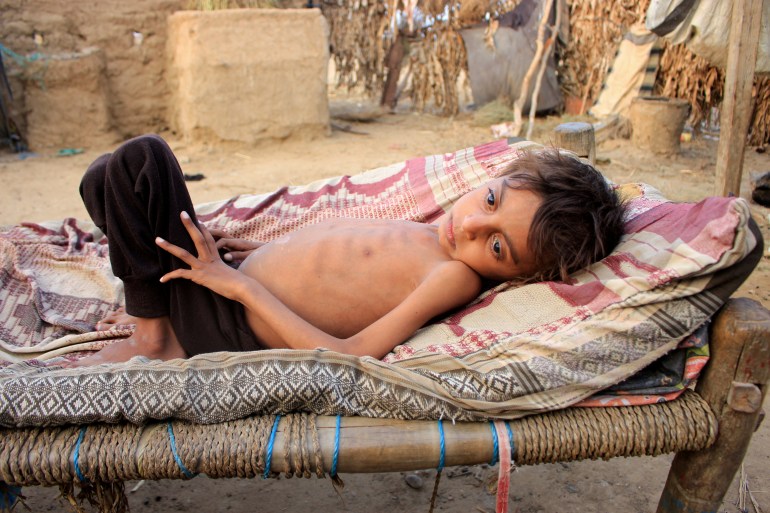 Malnourished Hassan Merzam Muhammad lies on a bed in his family’s hut in the Abs district of Hajjah province, Yemen in November 2020 [File: Eissa Alragehi/Reuters]
El-Tayyab said “offensive weapons” also needed to be clearly defined, and added that he wanted to ensure that weapons such as Reaper drones and F-35s are well defined by the Trump administration. Okay to sell the UAE are included in any ban.
“I’m not completely pessimistic here. I welcome the news, ”he told Al Jazeera. “But I’m just trying to stay vigilant and not release the pressure on the advocacy. Because we don’t know what’s going to happen.

No comments:
Post a Comment
Note: only a member of this blog may post a comment.