For Sri Lankan reporters, the ghosts of violence and intimidation loom again
The terror of earlier crackdowns taught me to write between the lines as a journalist – now I see repressive tactics returning
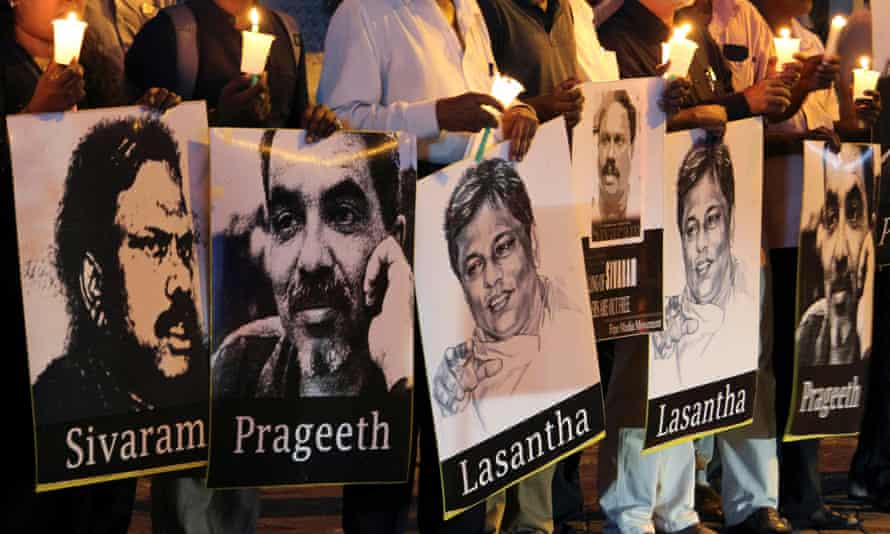
Sri Lankan journalists at the Black January vigil honour colleagues who were killed and abducted in that month over the years. Photograph: Indunil Usgoda Arachchi/Reuters

Dharisha Bastians-Thu 4 Mar 2021
Terror tore through me when I heard that my friend and editor of the Nation newspaper, Keith Noyahr, had been abducted. It was May 2008; the civil war was raging and Sri Lankan troops were chalking up victories against Tamil Tiger separatists in the north. In the fog of war, government critics were being terrorised all over the country. We had learned to expect the worst when a journalist went missing.
Outside Noyahr’s home that night, through his six-year-old daughter’s screams, I heard phone calls pleading with diplomats and politicians to save Keith’s life. The journalist was released by his abductors shortly before dawn and staggered home, his head matted with blood, legs unsteady from continuous beatings.
Within days, Noyahr had fled the country. He told investigators he had been suspended in midair, stripped and beaten by his captors.
Seven months later, we realised the attack had been a trial run. In January 2009 the murder of Lasantha Wickrematunge, another Sri Lankan journalist and editor of the Sunday Leader, sent shockwaves across the world.
The man Wickrematunge’s daughter has accused of planning her father’s killing, Gotabaya Rajapaksa, is now president of Sri Lanka. His election in 2019 heralded an immediate crackdown against the media.
Human Rights Watch says the Sri Lankan media practices “rampant self-censorship” – perhaps because there is an eerie familiarity to the recent intimidation. The last time this regime held power, journalists had a front-row seat to repression.

When Wickrematunge was killed, Gotabaya Rajapaksa was defence secretary. As brother of the then President Mahinda Rajapaksa, Gotabaya Rajapaksa wielded unparalleled military influence, earning a reputation as the country’s most feared bureaucrat. When Wickrematunge exposed a corrupt arms deal Rajapaksa had signed off, he broke the silence in the press about the activities of the defence secretary.
Years later, Sri Lankan criminal investigators alleged that Gotabaya Rajapaksa operated military death squads to attack journalists, including Wickrematunge and Noyahr. Rajapaksa has consistently denied this and all other allegations of wrongdoing.
From 2005 to 2015, Mahinda Rajapaksa presided over a systematic assault on the press. The Committee to Protect Journalists estimates that 13 journalists were killed over the decade. Others were threatened, abducted and tortured. Tamil journalists were disproportionately victimised. In 2014, Sri Lanka ranked fourth on an index of countries where journalists are slain – and their killers go free.
The attacks had a chilling effect on reporters. Fear spread like scars over parts of us cut open by the violence, transforming our reporting. We learned to write between the lines, to leave things unsaid.
Journalism’s calling is to speak truth to power. But every time a journalist is attacked, and the perpetrators go free, the space for independent reporting shrinks. In that decade of darkness from 2005 to 2015, the priority for Sri Lankan journalists was to just stay alive.

No comments:
Post a Comment
Note: only a member of this blog may post a comment.